
Chilean returns piece of 6th-century BC temple to Greece: ‘It was just another ornament in the house’
The mechanical engineer inherited the piece of the Hekatompedon from his father, a member of the Italian Navy who brought it back from Athens in the 1930s
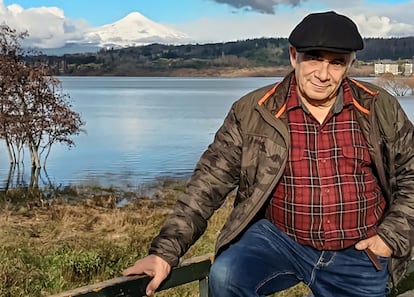

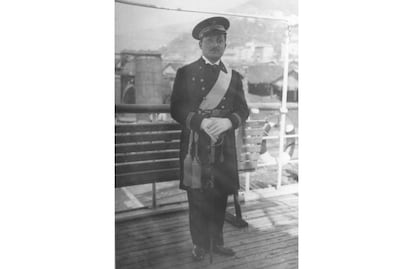
Enrico Tosti-Croce, 77, grew up hearing the story of how his father, a member of the Italian Navy, visited the Acropolis in Greece in the 1930s and brought back a piece of the Parthenon he found lying on the ground. The unique marble piece, carved with lotus flowers, accompanied the chief engineer of the submarine Generale Liuzzi on his various voyages and was part of the belongings he packed when he emigrated to Chile in the early 1950s to set up a mechanical engineering business, far from turbulent Europe. His wife and first two children arrived shortly afterward and the family settled in the coastal city of Viña del Mar, where the piece of the main temple of ancient Athens rested on a shelf in the dining room as “just another ornament.” Earlier this year, Tosti-Croce, an electrical engineer, heard on the radio that Greece was demanding “the stolen sculptures of the Parthenon” from the United Kingdom. At his home in Villarrica, in the south of Chile, he thought: “Wow, I have a little piece of the Parthenon. I think it’s time to give it back,” he told EL PAÍS by phone.
When Tosti-Croce’s parents died a few months apart in 1994, Enrico and his two brothers divided up their belongings. The engineer kept, among other things, the carved stone. He placed it on a coat rack at the entrance to his house, which has a small stand. So, when visitors entered the home, he would take the opportunity to tell them about the relic’s special value. “Some believed me, others didn’t,” he says with a laugh.
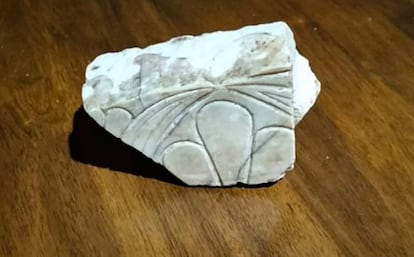
On January 6, Theodosios Theos, Deputy Chief of Mission at the Greek Embassy in Chile, received an email from a man claiming to have a piece of the Parthenon. To investigate further, he requested a photograph, measurements, and weight. Tosti-Croce complied: 8.2 by 11.4 centimeters and 1.2 kilos. He attached the images. The embassy acted as a liaison with the Greek Ministry of Culture, which expressed interest but required an in-person examination. So Tosti-Croce, who had a visit to Santiago scheduled for the end of March, placed the antiquity in a cloth bag, tucked it into his clothes, and transported it to the Chilean capital in a carry-on suitcase. The engineer asked Theos to please let him know which part of the Parthenon the stone was from “to close the cycle.”
Months later, Olympia Vikatou, director of the Greek Archaeological Service, sent Tosti-Croce a letter thanking him for his generous gesture, including details he had never heard of about the piece: “It is part of the marble gutter of an archaic temple, probably the Hekatompedon, the first monumental temple on the Acropolis, founded in the first half of the 6th century BC, during the time of Pisistratus.” The gutter was made of marble quarried from the majestic hills of Mount Hymettus, south of Athens, and was decorated with alternating oval palmettes and lotus flowers. “It comes from the sacred rock of the Acropolis, a unique monumental symbol that has suffered greatly from systematic looting over time,” lamented Vikatou, who noted in the letter to Tosti-Croce her hope that others would follow his example.
“Archaeologists concluded that it wasn’t from the Parthenon, which dates from the 5th century BC, the Classical period, but even older, from the Hekatompedon, in the 6th century BC, the Archaic period,” Theos told EL PAÍS. “That temple was destroyed by the Persians. Some of its fragments are in the Acropolis Museum in Athens,” he added.
The Greek Embassy is preparing a gesture of gratitude for Tosti-Croce on November 4, during a previously arranged piano concert at the Carabineros Theater, where a tribute to Greek artists will be paid. The engineer can’t believe the reception his initiative has received in the press and within the Greek community. His brothers joke that he became famous overnight at the age of 77. “This is very important to us,” says Theos, “because it can be an example of honor and courage for other citizens in Chile or abroad to do the same.” In fact, he notes that a Chilean sent them images of two pieces a few years ago, but they later lost track of him. “We are looking for them,” says the representative of the Greek embassy.
Sign up for our weekly newsletter to get more English-language news coverage from EL PAÍS USA Edition









































