
Knocking down buildings with sledgehammers: Rio de Janeiro’s latest fight against organized crime
The demolition of illegal properties belonging to drug traffickers and paramilitary militias resulted in a blow of more than $300 million over five years
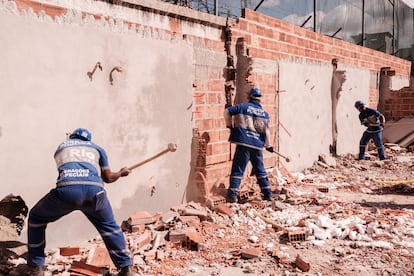
The operations are carried out by surprise. At dawn, dozens of Rio de Janeiro city officials, escorted by police, prepare to demolish illegal buildings. Sometimes they are simple houses, on other occasions, real mansions, refuges for drug lords. It is work that has intensified in recent years and has become one of the most effective ways to hit the finances of organized crime. Since 2021, Rio’s Public Order Secretariat has carried out 5,568 demolitions of illegal buildings, 70% of which were in areas dominated by drug traffickers or paramilitary militias. The operations resulted in 1.8 billion reais ($333 million) in losses for criminals.
On a cold winter morning, a dozen workers gather at a meeting point a few blocks from the demolition site, at the entrance to a favela in the Ilha do Governador neighborhood, not far from Rio’s international airport. They wait for the Military Police to arrive before heading together to the sensitive area. Protocol is strictly followed because you never know what you might find when you arrive. It wouldn’t be the first time they’ve been greeted with rifles.
This time, the project involves tearing down the walls of what were supposed to be commercial establishments, built illegally on a street sidewalk, invading hundreds of square meters of public space.
An armored Military Police vehicle at the entrance to the street indicates that something is about to happen. Without warning, the workers raise heavy sledgehammers and begin to blast holes in the brick walls. Among the early-rising neighbors, expressions of surprise predominate, although no one tries to stop the demolition. Everyone knows it was illegal. “You see it growing, you see it expanding, but you don’t know who owns it or anything,” said the head of an evangelical church on the sidewalk across the street. Nearby, another group murmured: “What a shame, with how expensive materials are these days…” In about three hours, not a trace will remain. An excavator will finish demolishing everything and clear away the debris.
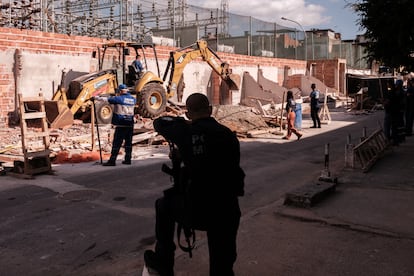
This is the entrance to the Praia da Rosa and Sapucaia favelas, dominated by the Pure Third Command (TCP), one of the drug trafficking factions that reigns over much of Rio’s slums. They are the ones who govern neighborhood life. One of the workers’ first tasks was to remove two drums anchored in the middle of the street as a barricade to prevent the entry of police and outsiders.
A fearful resident explains that before they took over part of the street, neighbors had created a kind of small plaza. They planted palm trees and even set up a ping-pong table for the kids. The drug traffickers ordered everything to be torn down because they had a better idea.
Authorities explain that in recent years, construction has become one of the main methods for money laundering and making profit. The future stores, which would surely provide jobs to needy residents, would swell the coffers of drug trafficking through rentals. Demolishing this fledgling favela shopping center was relatively easy, but sometimes engineering tricks are required. Many of these illegal buildings are located high in hard-to-reach favelas, where cars, much less trucks or excavators, can’t go. There, demolition work must be done by hand, floor by floor. Sometimes it takes weeks.
Rio’s Secretary of Public Order, Brenno Carnevale, explains by phone that demolitions hit where it hurts the most: “They often have more deterrent power than arrests, because people are always replaceable. With demolitions, we’re able to decisively destroy the investment these groups made, we’re interrupting money laundering, and we’re making this illegal real estate market less attractive,” he says.
The financial strangulation of organized crime is one of the objectives of these demolitions, which also seek to preserve a certain order in the city and protect the physical integrity of the people. These buildings are typically constructed without engineering plans and in high-risk areas, such as hillsides where landslides frequently occur.
However, sometimes these operations are not without controversy, especially when they involve practically completed buildings where people are already living. City Hall claims that in most cases, these people are placed there by organized crime groups to hinder demolition, and assures that whenever this happens, social assistance teams offer alternatives.
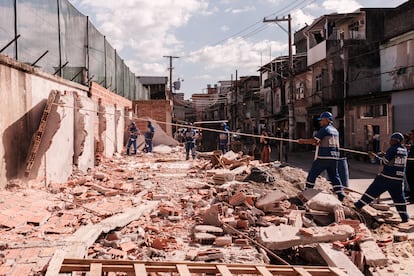
But that doesn’t prevent people from losing their savings buying a house that ends up in ruins because it turns out a drug trafficker or militiaman had built it. “Most of them are innocent people, but they have to understand that they must verify the origin of the property,” the secretary explains. Sometimes it’s not an easy task to discover who’s behind it, because they often use front men. However, the attractive prices, well below market value, usually indicate something shady is going on.
In other cases, the irregularity is obvious. At the top of the Rocinha favela — Rio’s most populated, where tens of thousands of people live — a veritable luxury complex was discovered in June: 2,000 square meters of several interconnected buildings with marble-covered terraces, swimming pools, jacuzzis... The police investigation concluded that it was the refuge of drug traffickers from the Red Command (CV) in the state of Ceará, who had been hiding in Rio for months. Days before the operation to dismantle it, some 400 fled cross-country through the jungle. With the “narco resort” empty, the slow manual demolition operation began. All with hammer blows.
Sign up for our weekly newsletter to get more English-language news coverage from EL PAÍS USA Edition









































