
$350 per body: Mafias take over a public cemetery in Ecuador
What was once a free municipal procedure in the city of Guayaquil is now a shadow business without state control
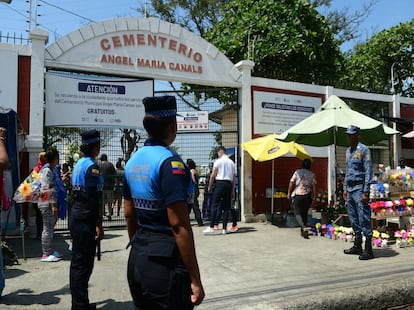
When Luis, 80, died this past April after a long illness, his daughter Mariana went to the offices of the María Canals Cemetery, one of the five public cemeteries in Guayaquil, Ecuador. At the counter, she was informed that the burial would be free for four years, but that she would have to build a cement mound. They explained, without offering much detail, that there are people at the cemetery who build the cement burial vaults where coffins are placed. And they didn’t tell her how much it would cost; they only told her that the people there “made a living” doing this work.
Upon arriving at the cemetery, a group of men asked her a series of questions: whether the deceased had tattoos or if he belonged to a gang. When she answered “no,” they told her the price: $350. Mariana couldn’t understand whether the figure was a flat rate, a discount… or a warning. But she quickly realized that if her father had had a tattoo or a criminal past, the price would have been higher. He would have been assigned to a section meant for those who had been “gunned down.”
The scene lasted only a few minutes, but it was enough for Mariana to understand that she wasn’t dealing with a municipal procedure. Rather, this was a case of extortion. She knew that, if she did it on her own, building the cement mound wouldn’t cost more than $100.
Her sister, Flor, tried to negotiate directly with the cemetery manager, arguing that it was a public site. Between pleading and bargaining, the man agreed to lower the fee to $250… but when Flor insisted that they couldn’t even afford that, his response was blunt: “Better you come back when you have the money.” The next day – the second day of the wake – they returned with what they had been able to scrape together. But the price was no longer the same: now, the employees were asking for $300.
Mariana’s case isn’t an isolated one. Mónica reported that she was asked for $250 to bury her mother. When she explained that she only had $200, she was ruthlessly told that the minimum was $250. She had to borrow money. Part of it from neighbors and part of it from the chulquero (loan shark). This is how locals describe the moneylender who charges 20% monthly interest and sometimes works in alliance with criminal gangs.
“I just wanted to say goodbye to my mom,” Mónica laments. “You’re so full of pain and just want to resolve the situation.” Four years earlier, in that same cemetery, she had buried her father. Back then, she paid less than a dollar to have a document issued at the municipal office.
Ecuador was different back then. Gangs still operated silently, hidden on the margins. This was before they began to show what they were capable of doing for money, with total impunity. Today, they extort retirees who work at the corner store with the same ferocity with which they infiltrate public hospitals, transit agencies, municipalities and government institutions.
According to official figures, 17,597 cases of extortion were recorded in 2023, a 165% jump compared to the previous year. In 2024, the number rose to 20,293. And, as of May 2025 alone, 4,569 reports have been recorded this year in Ecuador.
The sign at the entrance to the cemetery states that all services are free. The Municipality of Guayaquil – responsible for its administration – was contacted by EL PAÍS. Representatives promised to appoint a spokesperson, but as of publication time, there was no response.
Sign up for our weekly newsletter to get more English-language news coverage from EL PAÍS USA Edition
The numerous extortion cases reveal how criminal organizations have managed to penetrate even public spaces that are designated for mourning. What was once a municipal procedure has now become a shadow business that exploits families’ grief. Most victims don’t report their crimes out of fear. “I felt powerless,” Mariana summarizes. “Here, the [gangsters] are the ones in charge. No one cares about other people’s pain.”









































