
Israel prepares ‘unprecedented’ attack after killing over 30 Palestinians at Gaza school
The Netanyahu government claimed to have struck 200 ‘terrorist’ targets in 48 hours, while humanitarian and diplomatic efforts continue to fail
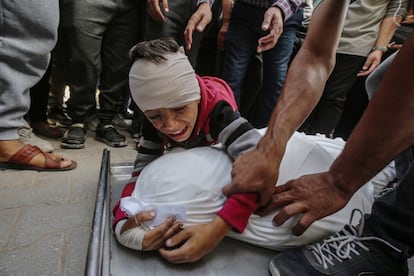

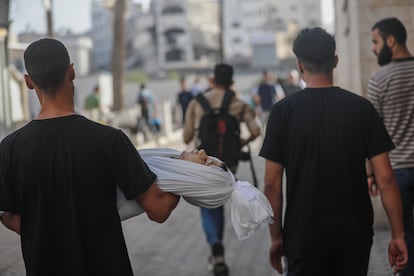
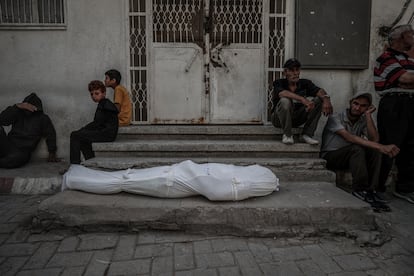
Israel killed at least 36 people — 18 of them young children — in the early hours of Monday morning while they were sleeping, bombing a school in Gaza City that had become a shelter for families displaced by the war, according to emergency services in the Strip. As on previous occasions, Benjamin Netanyahu’s government confirmed the attack with separate statements in which, briefly and without mentioning the victims, it boasted of having bombed 200 such sites in 48 hours to eliminate alleged “terrorist” cells.
Hours later, the Israeli army issued a new evacuation order affecting virtually the entire southern Gaza Strip in the face of an imminent “unprecedented attack” against “terrorist” targets. “The Israel Defense Forces (IDF) will launch an unprecedented attack to destroy terrorist capabilities in the area,” army spokesman Lt. Col. Avichai Adrae said in a message posted in Arabic on his social networks.
Meanwhile, diplomatic efforts to halt the Israeli military escalation are making no progress. Donald Trump announced Sunday night his desire for the war to end “as soon as possible,” but did not advance any measures to apply pressure on Israel. Furthermore, the immediate future of humanitarian work in the Strip is uncertain. Trucks carrying aid continue to trickle in with difficulty after two and a half months of a blockade imposed by Netanyahu. Meanwhile, The Gaza Humanitarian Foundation, an Israeli-led and U.S.-backed project to displace the UN on the ground and seize control of aid supplies, with the claim that Israel is acting to prevent supplies reaching Hamas, suffered a setback just as it was set to get underway on Monday: Jake Wood, its executive director, resigned after expressing doubts that the project complies with “humanitarian principles.”
Wood’s decision comes a day after it came to light that Netanyahu chose the Gaza Humanitarian Foundation — with unknown funding and registered in Switzerland — without going through the proper procedures. The initiative, which would have to be carried out by Israeli soldiers in cooperation with foreign mercenaries, has been rejected by the entire humanitarian aid and NGO sector.
At 8:00 a.m. local time, the Israeli army issued a statement announcing that it had launched an attack on a center that, it emphasized, had “previously” been a school. Without providing evidence, the statement claimed that the Fahmi al-Jarjawi school now housed “command and control centers” for Hamas and Islamic Jihad. Israeli aircraft launched “multiple missiles,” according to local sources. Images of the horror circulated early in the morning, with flames spreading through the building and charred bodies. Fahmy Awad, head of the emergency services for the Gaza authorities, recorded at least 36 deaths and 55 injuries. The Gaza government press office stated that 18 of the victims were children.
The Israeli statement asserts that troops had taken measures “to mitigate the risk of harm to civilians, including the use of precision munitions or aerial surveillance.” It also accuses the Islamist militant group Hamas, which controls the Gaza Strip, of using civilians as human shields. This comes after the Israeli military admitted it was investigating “multiple cases” in which its soldiers used Gazan detainees as human shields.
The IDF said it launched 200 strikes on Gaza in 48 hours. Sources in the Strip cited by the Associated Press and the Israeli newspaper Haaretz confirm that Monday morning was particularly deadly in the north, with nearly 50 fatalities in total up to midday alone.
Using satellite images, the Qatari media outlet Al Jazeera reported that Israeli troops are establishing a siege around several hospitals still operating in the north of the enclave. According to this information, Israeli armored vehicles are within 100 meters of the Indonesian Hospital, where doctors and patients are still present. Soldiers are also surrounding the Al-Awda Hospital. Nearly 600 days of the Israeli offensive have left more than 90% of hospitals damaged or destroyed. During this time, the death toll in Gaza has now exceeded 53,500; more than half of those killed are women and children.
Israel claims it is targeting only terrorists, weapons depots, and tunnels. Representatives of the UN agency for Palestinian refugees (UNRWA) disagree. “There is no place where there is no risk,” the agency stated on social media. The shelters, it added, “are overcrowded with families desperately seeking a sense of security.” “Many of them are taking refuge in abandoned, unfinished, or destroyed buildings. Others, including children and pregnant women, are sleeping in the open,” the agency added. Sometimes, hundreds of people share a single bathroom.
The escalation of the Israeli war effort is part of the gradual implementation of Operation Gideon’s Chariots, through which Netanyahu’s government aims to seize control of the Palestinian enclave. The Times of Israel, which claims to have had access to the IDF’s plans, reported Sunday night that Netanyahu hopes to have effective control of 75% of the strip within two months. Currently, according to the outlet, Israel controls 40%.
The Israeli prime minister, who sends and withdraws his team of negotiators depending on international pressure at any given time, ordered his representatives to travel to Doha, Qatar, on Monday to continue negotiations on a possible ceasefire.
Humanitarian aid
Thousands of tons of food and medical supplies continue to gather dust at the entrances to Gaza, while humanitarian organizations are at a loss to express the urgency of the territory’s population. “I see children every day walking with empty bowls in search of food or water,” Rachel Cummings, director of Save the Children, told Arab media from the Strip. “Mothers tell us they feed their children grass or dirty water, even though they know they can get sick,” she lamented.
On May 18, Israeli authorities announced they were lifting the absolute blockade on the entry of food and medicine into Gaza that they had maintained since March 2. The move, as Netanyahu himself admitted, was intended to satisfy U.S. pressure. However, eight days later, the amount of aid that has been delivered to the Gazan population is minimal. UNRWA spokespersons told EL PAÍS that the number of trucks entering the enclave in recent days has ranged from “none” to “a few dozen.” This flow is far lower than the more than 500 trucks per day that would be needed, according to their calculations, to mitigate a crisis that in just over two months has already resulted in the deaths of 58 people from starvation, most of them children.
Human rights groups in the enclave denounce what they perceive as an operation that is more propaganda than humanitarian. “The Israeli announcement to resume humanitarian aid to Gaza does not indicate a real intention to respond to the humanitarian catastrophe,” denounced the Palestinian Center for Human Rights, based in the Strip. “It is a clear attempt to clean up its image before the international community.”
Sign up for our weekly newsletter to get more English-language news coverage from EL PAÍS USA Edition









































