
Israeli troops deploy to Morocco during largest US military exercise in Africa amid Gaza offensive
Political and social groups denounce the presence of soldiers from the Israeli unit accused of the deaths of 15 Palestinian medical workers in the Strip in March
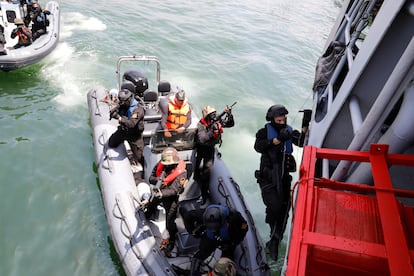

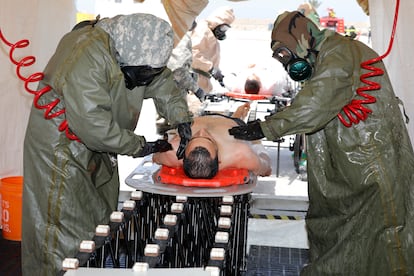
The military dock at the port of Agadir (340 miles south of Rabat). On Tuesday morning, the spring sun is already causing dozens of Moroccan and American soldiers to sweat as they toil in the shadow of the hill of the ancient citadel, marked in giant letters with the motto of the Sharifian kingdom: “God, Homeland, and King.” With well-rehearsed military choreography, commandos in rubber boats, masked bomb disposal experts, and soldiers in radiation protection suits roam the land and sea, while a Super Puma helicopter descends overhead to evacuate suspected victims, and recruits in bloody bandages and makeup moan in a mournful performance.
This is the first exercise to which the press has been allowed access as part of the African Lion maneuvers — which have mobilized more than 10,000 troops from some 60 countries for the past month — through which the United States has been sending an unequivocal message of continental military supremacy and its capacity to respond alongside its allies since its inception in 2004. Amid official silence, Israeli troops are currently participating in the U.S.-led mass exercise in Morocco, despite the popular protests stirring the North African country against the latest Israeli offensive in the Gaza Strip, which has left the civilian population on the verge of famine.
“Ready for the explosion!” warns the Moroccan officer serving as master of ceremonies at the port of Agadir, before the loudspeakers emit a sharp boom.
CBRN units (nuclear, radiological, biological, and chemical warfare) alternate on the dock scene with combat diving teams, counterterrorism forces, and rescue teams. Along with the American and Moroccan units leading the charge around the transport ship Daoud Ben Aicha, some Ghanaian commandos and Hungarian military personnel are also participating.
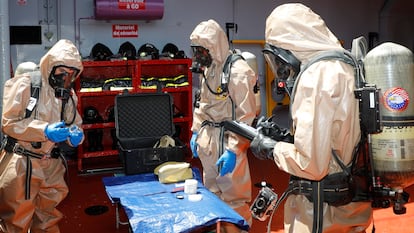
Senior military officers and observers from a dozen countries watch the training exercise against weapons of mass destruction from under a canopy. Meanwhile, several waiters serve mint tea and orange juice with Moroccan pastries.
The Moroccan Front for Supporting Palestine and Against Normalization (of relations with Israel), which brings together some 20 left-wing parties, unions, and associations, condemned the Israeli army’s participation in the African Lion military exercises in Morocco in a statement Tuesday.
The Front considers the maneuvers to represent “a provocation to the entire Moroccan people” and demands an end to the military exercises. It has also joined the denunciations over the alleged presence in Morocco of soldiers from the Golani Infantry Brigade‘s special forces company, implicated in the deaths of 15 paramedics and rescue workers in Gaza in late March. An attempt was made to dispose of their bodies in a mass grave.
Francesca Albanese, the United Nations special rapporteur on the situation of human rights in the occupied Palestinian territories, questioned the alleged deployment of members of the Israeli brigade in Morocco on social media. “If confirmed, this would mark a new threshold of depravity — and a violation of the international obligation to investigate and prosecute individuals implicated in atrocity crimes,” she warned.
If confirmed, this would mark a new threshold of depravity — and a violation of the international obligation to investigate and prosecute individuals implicated in atrocity crimes. 🇲🇦I urge Moroccan authorities to uphold the rule of law.
— Francesca Albanese, UN Special Rapporteur oPt (@FranceskAlbs) May 20, 2025
The world is watching. https://t.co/mpsAEFaL34
Albanese based her warning on a photograph circulating on the X social network — shared by both Palestinian and Israeli activists, without citing its source — which shows a group of young men in olive green field uniforms and wearing the small brown berets of the Golani Brigade commandos. The soldiers do not wear emblems or insignia indicating their rank, the unit to which they belong, or their country of origin, although they display an Israeli flag and the Golani Brigade ensign, both with the logo of the brigade’s Sayeret (Reconnaissance and Special Operations) company.
There is also no indication of the date on which the image was taken, in front of a large banner for the special forces operations phase of the 21st African Lion exercise, corresponding to 2025. At least two of the soldiers are wearing identification badges for the maneuvers around their necks, in the same format as those issued by the Moroccan army to journalists covering the military exercise.
An infographic on press coverage indicated that journalists were scheduled to attend a joint special operations forces exercise in Tifnit, about 25 miles south of Agadir, on Monday May 19. A spokesperson for the U.S. Army Southern European Task Force, Africa (SETAF-AF) assured EL PAÍS it would be able to attend the Tifnit exercise, but officials from the press service of the Moroccan Royal Armed Forces (FAR) ruled out such an option, which they attributed to a coordination error.
Had it not been for a traffic accident last Thursday in which two Israeli soldiers participating in the exercises were injured and treated in hospital, which was reported by the local press, Moroccan citizens would have barely noticed the Israeli troop deployment.
The Israeli army confirmed in late April that soldiers from the Golani Infantry Brigade had opened fire a month earlier on two ambulance convoys in Rafah, southern Gaza, killing 15 medical workers, rescuers, and members of humanitarian organizations. The military investigation described the deaths as a misidentification and insisted, without providing evidence, that six of them were “Hamas terrorists.”
A deputy commander of the Golani Brigade’s special operations company was relieved of his duties, and the commanding officer was reprimanded. A video, recorded by one of the paramedics before his death, contradicted the army’s initial account, which claimed that the ambulances were moving suspiciously and without lights.
Israel sent military observers to the African Lion exercises for the first time in 2022, following the resumption of military relations with Morocco under the auspices of U.S. President Donald Trump in December 2020, in the final weeks of his first term, and has participated in the last three editions of the exercises with an unspecified number of forces. Military sources cited by the French-language magazine Jeune Afrique highlight the presence of Israeli commando units and counter-guerrilla specialists at the continent’s largest military maneuvers.
Daily life on the lively seafront of Agadir, one of the main tourist destinations in Morocco, is oblivious to the military movements taking place in its port and on training grounds in the southern region. Last weekend, a protest filled the viewing platform on Tangier’s central Pasteur Boulevard with Palestinian flags and banners depicting Hamas leaders killed by Israel. “We are against the normalization of relations advocated by our government,” said 54-year-old engineer Nuredín, who preferred not to give his last name, at a rally of several hundred people convened by the Islamist Justice and Charity movement, tolerated by the government despite not being recognized as a political party.
“The Spanish government has banned the docking of ships suspected of transporting weapons to Israel,” explained Nuredín during the protest in Tangier. Earlier this month, clashes broke out between police and groups protesting the alleged passage through the Tangier Med docks of a Maersk company ship carrying spare parts for Israeli F-35 aircraft, manufactured in the United States. “We don’t know what’s happening in the port,” Nuredín acknowledged, “just as we don’t know what’s happening during the maneuvers in the Agadir area.”
The Moroccan government on Tuesday defended a two-state solution to the Palestinian-Israeli conflict. Foreign Minister Nasser Burita reiterated before an international forum meeting in Rabat the message he had delivered on behalf of King Mohammed VI last week in Baghdad at the Arab League summit.
Sign up for our weekly newsletter to get more English-language news coverage from EL PAÍS USA Edition









































