
Levante’s Koné: a man of his word
Striker stops short of contractual goal limit to sign for impoverished club
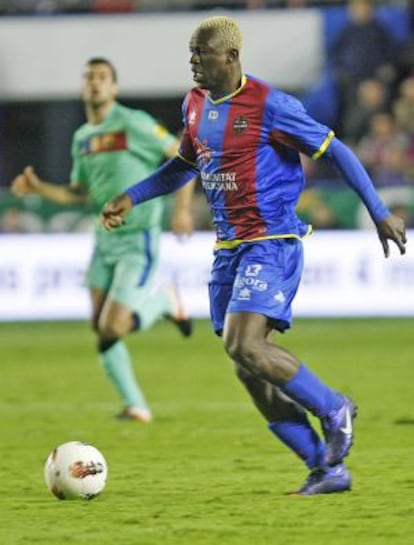
Arouna Koné made two promises to Levante when the low-budget first-division club took the Ivory Coast forward on loan from Sevilla at the beginning of last season. The first was to score the maximum number of goals possible without reaching the 18 that according to his contract would have required him to return to Sevilla; this he did, putting away 17 goals before resting in the final three games of the season, citing injury problems.
The second pledge was to sign a contract with Levante to thank the Valencia side for the opportunity of playing top flight soccer, after four difficult seasons with Sevilla, where he scored just one goal. The 28-year-old Ivorian kept his word, even though remaining a free agent would have allowed him to sign for one of the several English Premier League sides that have shown an interest in him.
Koné has now signed a one-year deal with Levante, which amazed the Spanish soccer world by finishing sixth. The deal includes the option of an extension for a further season, for an undisclosed fee, and Koné will have a buy-out clause of 10 million euros.
If he had scored 18 goals, he would have been forced to rejoin Sevilla
This has enabled Levante to retain his services but, given the club’s heavily indebted state, it will immediately try to sell the striker at an increased price. It is a similar situation to that of Ecuadorian Felipe Caicedo, who finished the 2010-11 season as Levante’s top scorer while on loan before being purchased and sold for 7.5 million euros to Lokomotiv Moscow.
After a poor start to his first season at Sevilla, in April 2008, press reports had suggested that Koné would be leaving that summer. His lack of playing time and a bust-up on the training ground with a member of the club staff that was caught on Spanish television, made for some intense speculation about the player’s future.
Finally, and following the departure of Russian forward Aleksandr Kerzhakov, Koné stayed on, but suffered a serious injury while playing for Ivory Coast in the summer of 2008. He did not return to training until early 2009. Koné fell out of favor at Sevilla, and was rumored to be heading for Zaragoza. Several English clubs also showed an interest in taking him on.









































