
Trump threatens the European Union with 50% tariffs starting June 1
The US president says negotiations with European countries are ‘going nowhere’
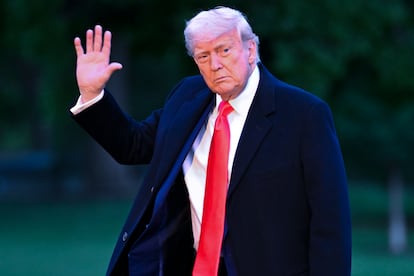

U.S. President Donald Trump has reignited the trade war as part of his erratic economic policy. Just one day after securing a major victory in Congress with his tax cut legislation, Trump has resumed his offensive against his main ally. On Friday, he announced that he had recommended imposing 50% tariffs on the European Union starting June 1, in a message laden with demagoguery and falsehoods — typical of his rhetoric. The renewed trade war has triggered a downturn in the stock markets.
“The European Union, which was formed for the primary purpose of taking advantage of the United States on TRADE, has been very difficult to deal with,” posted Trump, once again distorting the historical origins of European institutions, which were created after World War II to promote peace and economic cooperation.
“Their powerful Trade Barriers, Vat Taxes, ridiculous Corporate Penalties, Non-Monetary Trade Barriers, Monetary Manipulations, unfair and unjustified lawsuits against Americans Companies, and more, have led to a Trade Deficit with the U.S. of more than $250,000,000 a year, a number which is totally unacceptable,” he continued in a message on his platform Truth Social, despite the fact that Europe is one of the most open markets in the world.
The president completely misstated the trade deficit figure, claiming it was $250 million. In reality, the U.S. trade deficit with the European Union in goods reached a record $235.571 billion in 2024, according to official U.S. data. However, the United States runs a surplus in services trade with the EU, making the overall economic imbalance relatively small in the broader context of the relationship.
Following these falsehoods and major errors, Trump issued his threat: “Our discussions with them are going nowhere! Therefore, I am recommending a straight 50% Tariff on the European Union, starting on June 1, 2025. There is no Tariff if the product is built or manufactured in the United States.”
Last EU proposal
Trump’s threat comes after the EU shared a renewed trade proposal with the United States earlier this week in an attempt to revive stalled negotiations. According to Bloomberg, the new framework includes provisions that consider U.S. interests, such as international labor rights, environmental standards, economic security, and the gradual reduction — leading to full elimination — of tariffs imposed by both sides on non-sensitive agricultural goods and industrial products. The proposal also outlined areas for potential cooperation between the U.S. and the EU, including mutual investment and strategic partnerships in energy, artificial intelligence, and digital connectivity.
Trump has been imposing tariffs arbitrarily, often reversing course and contradicting himself. His latest threat against the European Union comes less than halfway through the 90-day partial pause he himself announced — a concession made under market pressure to allow time for negotiations.
Trump was also unable to hold his ground against China, which retaliated against U.S. exports. The Treasury Secretary acknowledged that the tariffs Washington had imposed on the Chinese giant were unsustainable and would harm the U.S. economy, prompting a near-desperate search for a way to reverse course. After staging a negotiation in Switzerland, Trump backed down and portrayed it as a success. The United States has also signed a preliminary agreement with the United Kingdom, but without addressing the specifics. So far, no comprehensive trade agreement has been signed with any country during the 90-day period.
Despite the uncertainty and economic damage already inflicted — and despite the markets having forced his hand more than once — Trump is now charging ahead with renewed energy. His threats have lost some credibility due to his constant shifts in position and frequent backtracking, yet he continues to wield tariffs at will as a tool to exert pressure.
Trump also issued threats on Friday against Apple, stating he would impose a 25% tariff if iPhones sold in the United States are not manufactured domestically. Secretary of Commerce Howard Lutnick recently expressed his hope that the U.S. would one day have an “army of millions and millions of human beings screwing in little screws to make iPhones.”
The tariffs imposed by Trump have been challenged by companies and states who argue that, in his increasingly authoritarian approach, the U.S. president is overstepping the powers granted to him by the Constitution. The International Emergency Economic Powers Act (IEEPA) allows the president to regulate imports and exports in response to certain non-military emergencies, but it also emphasizes that the triggering event must constitute an “unusual and extraordinary threat.” Outside of such circumstances, it is Congress that holds the authority to set tariffs. No other president has ever used tariffs in the way Trump has: he is pushing the boundaries of executive power.
Sign up for our weekly newsletter to get more English-language news coverage from EL PAÍS USA Edition









































