
China hits US goods with 84% tariffs in retaliation against Trump’s levies
Countermeasures are beginning to take effect as taxes on imports from the Asian giant hit 125% while the trade war with the rest of the globe gets paused. The EU has also halted its counter-tariffs but warns they will go into effect if negotiations fail
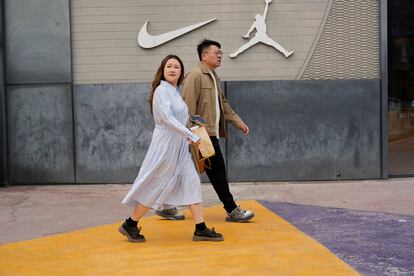

The strange thing about trade wars is that life goes on as if nothing had happened: people wake up early, go to work, children go to school, and cars and bicycles continue to glide along Beijing’s roads. The effects are imperceptible at first glance. But the conflict is a reality in China. One minute past noon in the People’s Republic, additional tariffs of 84% on all U.S. imports, valued at over $143 billion, went into effect.
The blow is part of the Chinese authorities’ response to the tariff war launched by U.S. President Donald Trump, who on Wednesday announced a new increase in tariffs on China to an unprecedented 125% levy on all imports from the Asian country, which amounted to almost $440 billion in 2024. Meanwhile, he declared a 90-day pause in the trade war he is waging with the rest of the world. Beijing has not yet responded to this latest blow, but it is likely to adopt new countermeasures, following the pattern of recent weeks.
Meanwhile, the president of the European Commission, Ursula von der Leyen, on Thursday announced a 90-day pause on the counter-tariffs against the U.S. that it had agreed on in response to the levies decreed by President Donald Trump on steel and aluminum, which were due to come into force next week. “We want to give negotiations a chance,” she explained after a first consultation with member states following the White House’s announcement the day before of a partial truce in the trade war.
But if negotiations fail, the measures will come into force, warned Von der Leyen. The button, therefore, is pressed, but the finger can be lifted at any time. “All options are on the table,” stressed the head of the European executive.
U.S. and China: a colossal confrontation
As the world watches with apprehension, the planet’s two largest economic powers — whose supply chains are deeply intertwined — are now locked in a colossal trade confrontation with unpredictable consequences not just for themselves, but for the globe.
So far, neither side appears ready to hit the brakes. The anticipated high-level talks that might halt this dangerous escalation have yet to materialize. On Tuesday, just hours before the new U.S. tariffs were set to kick in, Trump declared that China “wants a deal badly” and said he was waiting for a call. Yet, there has been no confirmation of any contact between the Republican president and his Chinese counterpart, Xi Jinping.
To date, the Chinese government has responded to each of Washington’s measures with near-symmetrical actions. On Wednesday, only hours after the U.S. imposed a 104% tariff on all Chinese goods, Beijing raised its retaliatory rate by another 50% — from 34% to 84% — mirroring the figure Trump had decreed on Monday in response to China’s earlier countermeasures.
“The U.S. threat to escalate tariffs on China is a mistake on top of a mistake and once again exposes the blackmailing nature of the U.S. China will never accept this,” the Chinese government justified its response yesterday, which was targeted at various sectors.
Beijing also imposed export restrictions on 12 U.S. companies due to the potential dual civilian and military use of their products, added six more to the list of “unreliable entities,” and filed a new complaint with the World Trade Organization. Beyond trade measures, it also issued a “cautionary” warning for Chinese tourists planning to travel to the United States “due to the deterioration of Sino-U.S. economic and trade relations.” This is a sign that ties between the two powers are fraying at breakneck speed.
In addition, China published a lengthy white paper on trade relations between the two countries on Wednesday, seeking to present its factual account of the situation. “If the U.S. insists on further escalating its economic and trade restrictions, China has the firm will and abundant means to take necessary countermeasures and fight to the end,” a Ministry of Commerce spokesperson said when questioned about the white paper, according to state media.
In previous rounds, Beijing also imposed restrictions on the export of critical minerals and rare earth elements to the United States, which play a key role in the technological race. These elements are a top priority for Trump, who has shown interest in obtaining them from Ukraine and Greenland. These resources, whose production is dominated by China, are one of Beijing’s greatest assets in the exchange of blows.
Sign up for our weekly newsletter to get more English-language news coverage from EL PAÍS USA Edition









































