
Gael García Bernal: ‘The common good is no longer a political slogan. Democracy and the use of power are almost like a reality show’
The Mexican actor stars in, co-writes and directs ‘Hombre al agua’, a feature in which he explores complex themes such as the crisis of masculinity and power dynamics in Latin America


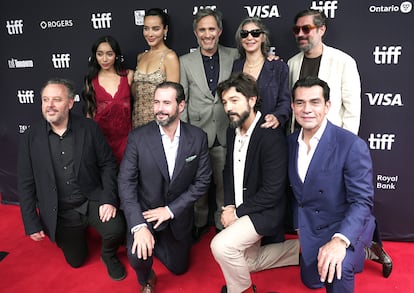
There are film projects that do not arise from a rigid outline but from years of sediment and personal crossroads. For Gael García Bernal, 47, Hombre al agua, his latest feature which he co-wrote, directed and stars in, took more than 15 years to take its final shape, having been seeded at the exact moment he became a father.
The story follows Camilo (played by García Bernal), a Cuban lifeguard who rescues a Mexican businessman named Abel (Jorge Salinas) from drowning in the Caribbean Sea. Grateful, Abel “saves” Camilo by offering to bring him to Mexico and make him his right-hand man. Abel introduces him to his daughter Juana (Esmeralda Pimentel), whom Camilo marries; they later have a daughter. But he soon discovers that everything was part of a Machiavellian scheme of manipulation and control. With his new life collapsing, Camilo must uncover who is behind the plot and take control of his own fate.
In Hombre al agua — his third film behind the camera after Déficit (2007) and Chicuarotes (2019) — which premiered at the Venice Film Festival and at the Toronto film festival, García Bernal makes use of metacinema, a cinematic practice and subgenre in which film turns a mirror on itself to reflect on its own creation processes, codes and fictional nature, as well as comedy, irony and the absurd, weaving together the crisis of masculinity, the exercise of power, migration, political disorientation in Latin America and the perpetual search for redemption in a society marked by simulation.
Question. How did the idea for this comedy with shades of drama and irony originate?
Answer. I began imagining three opening scenes in which the couple is interrupted by the baby and then the father goes to watch a Brazilian telenovela. At the time Lula [president of Brazil] was in prison, and it seemed like a great starting point to imagine a telenovela produced as if Carl Dreyer had been hired by TV Globo to portray the life of Lula and his then-wife Marisa. The mix began to coalesce like a strange geode. I knew it wasn’t a linear A-to-B film; we weren’t telling a conventional story but experimenting with the crisis of masculinity, fatherhood, separation, the Latin American political body, the use of power and migration. All within an archetypal rereading of the genie-in-the-bottle trope, where rescuing a person comes with a desire that always exacts a price.
Q. In the plot we see a film within a film, shifting biographies, a telenovela and even a documentary. How did you build this meta-universe that functions as both a love letter to and a critique of the industry?
A. It emerged as a fundamental dramaturgical device alongside Mariano Pensotti, with whom I co-wrote the script. He proposed that cinema become the vehicle for the sublimation of all the characters. Metacinema, besides being fun, supports our argument about daily simulation and masks. Very much in the spirit of Hamlet, the staging allows us to expose and denounce reality. We were inspired by filmmakers who never feared comedy as a tool to disarticulate truths: Tomás Gutiérrez Alea, Ettore Scola, Luis Buñuel, Jean-Luc Godard and Miloš Forman. Comedy is a genre that opens up, unravels and dismantles many things. It’s extremely hard to do well. It’s one of the most undervalued genres, but also one of the most difficult and complex to execute properly.
Q. In Déficit, Chicuarotes and your recent work you explore characters confronted with realities that are not what they seem. What concerns unite the films you aim to make as a director?
A. There is a clear obsession with inheritance, with what we receive from our parents. I’m deeply intrigued by people who inherit money or positions of power and, along with them, gigantic existential problems. To justify their situation, they construct a daily psychoanalytic architecture and a simulation to convince themselves that nothing is wrong, asking why the world would be against them. In Latin America we keep inheriting vendettas, archaic problems and privileges from generation to generation and try to solve them without ever succeeding. Seeing those human passions exposed through comedy is revealing. I like to close films with an elevated Aristotelian structure, leaving the question open that something good must come.
Q. There have been gaps of 12 and five years between your films. How has your work behind the camera evolved?
A. Many things have landed. As an uncle in Sinaloa says: “You’d better have time serve you as an actor, because if not, what a waste of time.” Experience allows me to arrive on set with enormous enthusiasm and to infect the actors with the notion that making the film you want is a rare privilege. I feel more confident pursuing difficult questions through humor. That said, acting and directing at the same time is exhausting; I doubt I’ll do it again in the short term.
Q. The film tackles the crisis of masculinity in a setting marked by politics and the rise of the so-called manosphere. How does the central character fit into that debate?
A. Camilo’s character, a Cuban in a survival context, is forced to shape his identity according to what circumstances demand: he must be a father, a good husband, a bodyguard, a butler and chief of staff for a potential candidate. His masculinity is bombarded from all sides. There are still sectors determined to reclaim that absurd and ridiculous figure of the “perfect man” that helped trigger the two great wars of the 20th century. Fortunately, thanks to feminism, today we have greater introspection and sensitivity. Men today can carry our babies strapped to our chests, something we perhaps haven’t experienced since the nomadic era. Those questions about masculinity have been present in my work since Y tu mamá también.
Q. The film also exposes messianism, democratic crises and mistreatment of migrant populations. How urgent is this reflection today?
A. The film speaks of imposed realities. We see the millionaire who, from his hubris, believes he can fix everything, and democracy turned into a playing field where a magnate campaigns under the slogan “someone like you.” It’s the cynicism of imposing the idea that the real winner is the one who best knows how to take advantage of others. Leonardo Padura’s latest novel [Morir en la arena, Tusquets] sums it up well: Cubans were hit with the certainty that the worst predictions about capitalism turned out to be true, while the promises of socialism proved to be false. We live in rampant capitalism, with structures in crisis across Latin America. Today the figures of the manosphere do not debate public health, universal education or decent housing; they only talk about security, police and private property. The common good is no longer a slogan of political parties. We are in a complex moment in the world and in Mexico, where politics, democracy and the use of power are almost like a reality show, and we must be extremely alert not to fall into that trap.
Sign up for our weekly newsletter to get more English-language news coverage from EL PAÍS USA Edition









































