
The alliance between the ‘king of cocaine’ and a Gestapo chief to create the first narco-state in Bolivia
In ‘The Narco and the Nazi,’ journalists David López and Christian Bergmann recount the ties Klaus Barbie forged with Bolivian drug lord Roberto Suárez
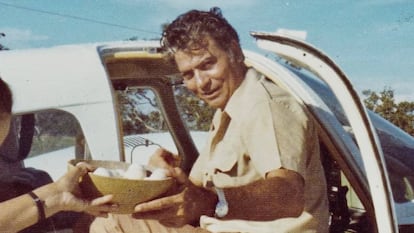

The city of Cochabamba, in Bolivia’s valleys, has few representations in international popular culture. Perhaps the only one is in the film Scarface (1983), when Cuban immigrant in Miami Tony Montana, played by Al Pacino, visits to close a trafficking deal with a Bolivian drug lord, Alejandro Sosa, portrayed by Paul Shenar. Present during the meeting are the interior minister and an army colonel, who watch on television as a connection is alleged between the country’s military government and the cartels. “The parallel is as obvious as it is shocking,” say journalists Christian Bergmann and David López in their book-length investigation, El narco y el nazi (The Narco and the Nazi). They describe the film as a “prophecy”; at the time of its release, the United States was experiencing a cocaine boom with Bolivia as a major supplier.
The work, published in Bolivia by El Cuervo and in Spain by Pepitas de Calabaza, recounts that Roberto Suárez, the person on whom Sosa in Scarface is based, joked about suing the production company for rights to his likeness. “Who told you Tony Montana is Cuban and lives in Miami? Here we all know he’s from the countryside and is sitting next to me,” Suárez said mockingly when he saw the film alongside the partner with whom he built the global cocaine trade, Pablo Escobar. They were enjoying an economic bonanza; Bolivia had, for the first time, surpassed Peru in coca leaf and base paste production.
The year the film premiered, however, coincided with the deportation to France — on charges of war crimes — of Suárez’s main political ally within the then-defunct Bolivian military government: Klaus Barbie. The Narco and the Nazi draws on declassified CIA and Mossad documents and nearly a hundred witnesses to reveal how, in the early 1980s, Barbie — a former Gestapo chief who had become a colonel in the Bolivian army — protected, escorted, and formed business partnerships with Suárez, nicknamed “the king of cocaine.”
López calls this alliance the genesis of the first narco-state: “The idea of a modern state structure operating to obtain economic profit from drug trafficking had never existed,” he tells EL PAÍS. The origin of the unlikely union goes back to a 1979 dinner attended by military officers. Barbie then asked Suárez for $5 million to finance the coup d’état — which would take place a year later led by Luis García Meza — under the banner of preventing the advance of an alleged creeping communism, a mutual enemy. The German later repaid him by granting a special security force, a paramilitary group made up of foreign neo-Nazis, Los Novios de la Muerte.
The cocaine business penetrated García Meza’s dictatorship, the Armed Forces, and the political apparatus. A U.S. intelligence document states that the cocaine trade exceeded $1.5 billion in 1980. Bolivia went from producing just over 17,000 tons of coca leaf in 1979 to more than 141,000 in 1985. Much of the responsibility for the rapid growth lies, according to Bergmann, on Suárez, the prosperous cattle businessman turned architect of large-scale cocaine exports. “By the time he entered the drug trade he was already used to negotiating in bulk, with other estates and exporting cattle to Brazil […] he treated an illegal business like any other he was already running.”
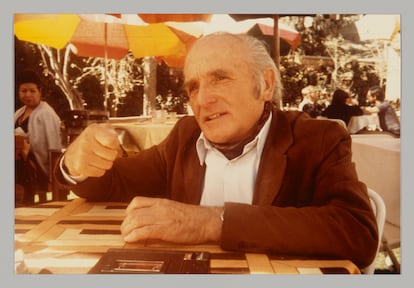
Until the arrival of the “king of cocaine,” Bolivia only had small producers of coca leaf and base paste who sold to Colombian traffickers “at chickenfeed prices, practically nothing,” López says. “With Suárez they controlled and raised prices, which changed the market in Bolivia.” The trafficker’s family was one of the most valuable sources journalists accessed to learn, firsthand, about the rise of the business and the personality of its architect.
The book describes Suárez as an accomplished rancher, shaped by the harsh environment of the jungle where he was raised, in Beni, Bolivia’s Amazonian region. “He grew up seeing death as natural and inevitable. From those animals he learned that what mattered was surviving,” the text says. It also details his relationship with Escobar, a friendship evidenced at Suárez’s birthday parties, attended by the Medellín Cartel leader.
“In Suárez, Escobar found a serious businessman who guaranteed a steady supply of base paste to then manufacture cocaine,” López explains. Suárez’s commercial order and discipline had its counterpart in logistics, protection, and the elimination of rivals through Barbie. The German had been influencing the military establishment for decades, essentially since he arrived in the South American country fleeing his responsibilities in World War II via the so-called Nazi ratlines.
Barbie was appointed in 1942 as chief of the Gestapo in Lyon, the main center of resistance to the occupation. Infamous for brutally torturing and killing with his own hands, his darkest episode came when in 1944 he ordered the deportation to Auschwitz of 44 Jewish children and seven teachers hidden at the Izieu Catholic boarding school, who were later killed in the gas chambers. “One of the worst criminals of the Nazi regime,” according to historian Serge Klarsfeld.
The Barbie case illustrates the refuge offered to Adolf Hitler’s loyalists by Latin American military governments. The reception he received in Bolivia, to the point of being able to move freely and publicly, exemplifies the accommodation military regimes of the second half of the 20th century offered to Nazis. “That fascination with fascism, with violent strategies, was integrated early into Bolivia’s military history. For example, the founder of the SA [the Nazi Party’s paramilitary wing], Ernst Röhm, was invited to advise the Bolivian army,” Bergmann recalls.
The authors, however, do not claim to have been the first to reveal that military governments protected Nazi war criminals. They did, though, make the connections to describe the relationship one of the most brutal National Socialists had with the creation of the first narco-state, and they leave an open question as a hypothesis. López explains: “The U.S. knew what was happening in Bolivia, but what is not clear and what we could not prove with evidence is to what extent they were complicit in Bolivia’s drug trade.” Suárez’s family says he was close to Oliver North, a former U.S. Marine officer and National Security Council member who financed anti-communist guerrillas in Nicaragua as part of the Iran-Contra affair. “We believe Bolivia would have been the dress rehearsal for that scandal.”
Sign up for our weekly newsletter to get more English-language news coverage from EL PAÍS USA Edition









































