
Vlaada Chvátil, inventor of the hit game Codenames: ‘I’m a perfectionist’
The creator of games such as Through the Ages and Dungeon Petz reflects on his career, his creative process and his most celebrated works
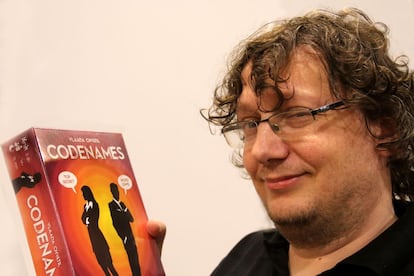

Whenever he is working on a new board game, Vlaada Chvátil thinks about it constantly. “Every spare minute,” he says. Whether he is in the shower or awake at 3 a.m. That is how his creative process works.
It is, inevitably, a very personal way of working. After all, there probably are not many co-designers willing to wake up in the middle of the night to debate cards or strategies. “I couldn’t call them at those moments to share my thoughts, but I also can’t stop thinking about them and then not develop them later,” he reflects.
That is why he usually develops at least the core of his games on his own. Not that the approach has hurt his career. The Czech designer is widely regarded as one of the industry’s leading creators.
His creations include Through the Ages, a game capable of condensing the entire history of civilization into a single board, and Codenames, the family-friendly bestseller built around deciphering clues, which has now spawned a Harry Potter-themed edition. And, more broadly, Chvátil’s body of work is defined by its variety and originality: some of his games differ so radically from one another that the only thing they seem to have in common is his name.
That signature is a guarantee of a challenge for thousands of players. It is also the result of the time he usually takes and the countless rounds of testing he puts his creations through. Some critics, however, complain that his games are too long and overly complex. Indeed, a game of Through the Ages requires reading a 23-page rulebook and takes at least two hours to play.
Codenames, by contrast, represents the opposite approach: conceived in a flash during a convention, it can hook anyone without much preamble or planning. “Sometimes, before releasing a substantial game, I’ve worried that I may have gone too far: ‘This is too much, nobody is going to play it.’ But players always surprise me,” Chvátil explains.
Even his critics, in any case, acknowledge his effort and ambition. The designer has at times rejected the idea of describing himself as a “true artist,” believing that his work is closer to craftsmanship. There is, however, another label he readily accepts: “I’m a perfectionist.”
So much so that he asks for the interview to be conducted in writing. He is currently working on a “really huge” new project, and says that the workload and deadlines have left him “exhausted.” He admits that his first instinct was to reply, “Not now.” In the end, he agrees because exchanging messages allows him to answer when he feels “comfortable.”
“I remember the moment I realized this had become my job,” he says. “A journalist once asked me about my career. I thought: ‘Wait a second, is this my career?’ I never wanted to become a game designer. I just wanted to create games.”
His first creations date back to his childhood in Jihlava. Gradually, however, it became clear that this was more than just a childhood passion. Then, in 1997, Arena: Morituri te Salutant marked his market debut.
Amid gladiators and fights, one could already glimpse what was to come. Chvátil explains that at the time he played many role-playing games and wanted to create a realistic combat system. But he became so absorbed in the idea that he ended up creating a completely original game. It was so unusual that one publisher asked him: “I don¡t understand it. If there’s a die, why is it never rolled?”
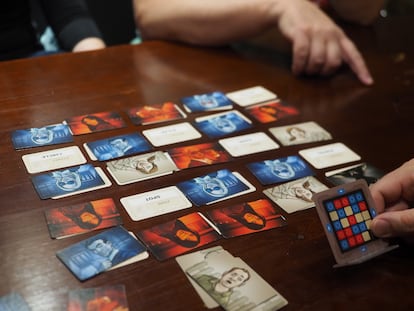
He says ideas come to him whenever he spots “untapped potential.” And that he likes to experiment so as not to get bored: by putting players on a team forced to cooperate in order to survive in Space Alert; by imagining a competition among imps to run the best pet shop in Dungeon Petz; or by creating a vast fantasy war epic in Mage Knight.
Two decades ago, Chvátil also became a publisher, taking the helm of Czech Games Edition. There, he learned to rein in his creative impulses when another designer was leading the project. So he is constantly testing, designing and publishing. At the same time, he may draw inspiration from other cultural fields: he reads, watches films and television series, goes to the theater and concerts, enjoys video games, and develops them as well.
“What makes a good game? One with a large audience, strong sales, high ratings or one that stays in people’s minds? I don’t want to decide what is or isn’t a good game. There are no particular elements that it has to include, as long as there are people who enjoy it,” he says.
In Chvátil’s case, there are plenty. Devir, his publisher in Spain, boasts that he has “no fewer than 10 major titles” to his name. Codenames, released in 2015, is probably the most famous. Apparently, that project finally helped his mother understand what her son did for a living.
But the Czech designer says the milestone that transformed his career happened a decade earlier. It required hundreds upon hundreds of hours of work. He play-tested it relentlessly throughout the process. There was no other way to make it possible to play through the entire course of civilization.
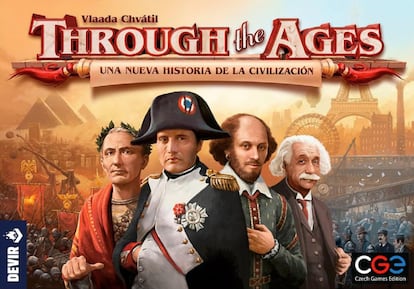
Because a game of Through the Ages takes players from the dawn of humanity to the triumph of computing. There are dozens of cards and hundreds of possible choices: figures such as Julius Caesar, Albert Einstein, Johann Sebastian Bach and Maximilien Robespierre appear alongside developments such as the printing press, nationalism, corruption and the scientific method. Universal history, essentially, packed into a box.
Two decades later, its scale is still daunting. But this contemporary perspective also reveals certain absences: women are underrepresented, aside from figures such as Joan of Arc and Angela Merkel, and the game takes a distinctly Western-centric approach.
“I realized it was something special when one of my friends, who never liked long games, spent five hours playing it and wanted to start again. It was an important turning point in my life: a few friends and I decided that designing board games would become our way of making a living,” says Chvatil.
He is still at it today, and still faithful to his method. Chvátil is now fully focused on making sure every aspect of his new game is “the best it can be.” And, he says, this time he is co-designing it: “At first there were many calls and brainstorming meetings, but it was fun, and I’m happy with the result.”
He claims the project could “easily take 30 hours a day,” if such a thing were possible. Because every spare minute counts.
Sign up for our weekly newsletter to get more English-language news coverage from EL PAÍS USA Edition









































