
The dark side of Spotify’s Wrapped feature: What your colorful year-end summary hides
The streaming giant celebrates diversity while its algorithmic model rewards homogenization, promotes AI-generated music, and includes ICE ads while a Latin artist leads global listening
It’s become a regular occurrence: every December, Spotify Wrapped reappears — the summary the platform offers each user of their most-listened-to music of the year, packed with data and conclusions, as if it were an inevitable cultural event, a collective ritual that tells us who we’ve been (musically) throughout the year. And yet, every time I see it parade across my feed, I experience the same feeling: are we celebrating the music itself, or are we celebrating that a platform has been monitoring us for 365 days and is now putting together an adorable presentation with all that data?
They colloquially call it “my annual summary,” but in reality, it’s theirs. It’s a report compiled from months of meticulous tracking, packaged in animated graphics that serve as visual distractions. Minutes listened to? Artists of the year? Hours spent in endless playlists? It all seems like joy, camaraderie, a party dedicated to musical vanity, but in reality, it hides another way of disciplining us: the more we believe our lives fit into one of those dashboards, the fewer questions we’ll ask about who decides what we listen to and how.
ICE ads are cheerfully circulating on the platform among playlists for teenagers (while, paradoxically, Bad Bunny leads the list of most-streamed artists on the service)
Spotify Wrapped is such a sophisticated and widespread attachment device that it works even when the platform dares to tell you to your face what it thinks your true musical age is (this year, the big and highly viral novelty is that Spotify has calculated your musical age based on the decade that has been most prevalent in your listening: if you’ve consumed a lot of songs from the 1980s, it tells you you are in your fifties; if you’re more into the 1960s, it assumes you are anywhere up to your eighties). I’ll go even further: it works even when Spotify is going through the worst year in its recent history. A year marked by controversies surrounding its CEO’s investments in an arms company, by the exodus of moderately large groups, by the colonization of fake artists created with generative AI, by frauds with artificial streams, and because ICE ads are cheerfully circulating on the platform among playlists for teenagers (while, paradoxically, Bad Bunny leads the list of most-streamed artists on the service).
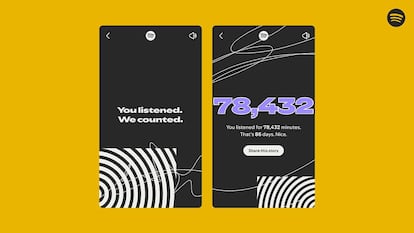
None of that matters, because the moment the Wrapped event is launched, everything is suspended; as if for a week, there were no consequences. During that interval, the boycott is forgotten, political outrage dissipates, and the polygonal esthetic of the “annual summary” covers everything with a layer of shared euphoria. It’s hard to resist: if everyone is posting their slides, how can you not? The Wrapped event activates a sense of identity-based FOMO in which participation is almost mandatory to avoid seeming disconnected. And this social pressure only benefits the company: millions of users generating free publicity, millions of artists grateful for placements that, in many cases, barely compensate for months of precarious work. Who dares not to share when the rest of the ecosystem acts as if this were a real cultural event and not a memetic operation designed to continue diverting our attention?
How can Spotify talk about diversity when its own algorithmic model pushes toward homogenization, prioritizes functionality, and ends up marginalizing local talent?
Wrapped also reveals something else, even more perverse: the ease with which we’ve accepted delegating our experience and memory to a dashboard. We used to recall our musical year through conversations, concerts, and handwritten album annotations. Now we expect an interface to reveal what moved us, even though we know full well that the metrics are rigged and prioritize repetition over impact, or passive habits over conscious choices.
Confetti — messages from your favorite artists that feign intimacy — moving typography, and, according to the platform itself, plenty of diversity. “No two Wrapped playlists are the same,” you hear. A charming narrative that makes us feel different from everyone else. But how can Spotify talk about diversity when its own algorithmic model pushes toward homogenization, prioritizes functionality, and ends up marginalizing local talent? What’s the point of celebrating your top five while Spotify invests in systems capable of replacing those same artists with cheaper, synthetic content?
Wrapped fabricates the illusion of a vibrant culture sustained by a global community, when the reality is quite different: not only do we accept that our sonic life fits into a corporate report, but we end up reinforcing the dangerous idea that the music that matters is only that which can be measured.
Sign up for our weekly newsletter to get more English-language news coverage from EL PAÍS USA Edition









































