
Day of the Dead on wheels: How a van is sharing the tradition with migrant communities through art
Mexican Rosalía Torres-Weiner, who identifies as an ‘artivist,’ travels to various locations in North Carolina with a mobile exhibition that spreads cultural heritage and expression
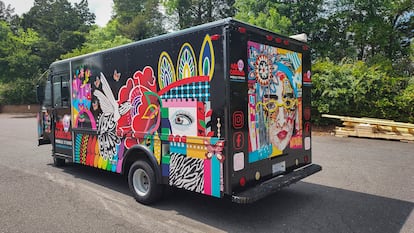

In Charlotte, North Carolina, a black food truck moves slowly down the road. It doesn’t deliver food — it delivers art. Inside, lights, copal incense, pan de muerto (sweet bread for Day of the Dead), and a calavera (skull decoration) welcome anyone who steps into the Mobile Art Studio, the traveling project of Mexican artivist Rosalía Torres-Weiner, 64, which this year’s Día de Muertos, or Day of Dead has been transformed into an immersive, free experience for Latino communities in the southern United States.
“My truck is my baby,” she says with a smile. “I bought it with the money I earned when the Smithsonian acquired two of my works, and since then I’ve used it to bring art to my people. Because I understood that if my community can’t come to the museum, the museum has to come to them.”
Torres-Weiner was born into a family where art was a constant presence and became a form of refuge. Her childhood was marked by domestic violence, but also by the imagination that allowed her to survive. “When my father yelled, I would hide my little brothers and sisters under the table and, with a matchbox that I turned into a camera, I would tell them, ‘Smile, I’m going to take your picture.’ That’s when I discovered that art had power.” Years later, that same impulse would lead her to cross the U.S.-Mexico border.
Her story is that of thousands of migrants: a mix of courage, displacement, and reinvention. She arrived in Los Angeles at 21, dreaming of working as a flight attendant, but found a job opportunity in the hotel industry. She rose through the ranks at Marriott hotels and established herself professionally. Yet art kept following her. “I decorated rooms, drew caricatures for the staff to remember the guests, painted murals… and little by little, the uniforms were replaced by paintbrushes.”
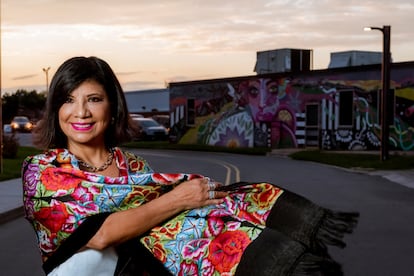
Once settled in North Carolina, she painted for NASCAR drivers, Panthers players, and local celebrities, until the 2008 financial crisis took her in a new direction. “I lost all my contracts. But at the same time, I saw the mass deportations [under Obama], the children being left without their parents, and I thought: art saved me, it can save them.”
That’s how El Proyecto Papalote (The Kite Project) was born: workshops where children from deported families drew their stories and transformed their absent parents’ clothing into kite tails. She told them, “If the tail is long, the kite flies higher.” It was her way of saying, “You’re going to be okay.” Their kites were exhibited at the Levine Museum of the New South and later became part of the collection at the National Museum of the American Latino.
With the rise of anti-immigrant rhetoric and the raids during Donald Trump’s first administration, Torres-Weiner decided to raise her voice through muralism. In 2016, she painted a Virgin of Guadalupe against the Charlotte skyline, surrounded by butterflies that represent migrants. “Some people said, ‘Go back to Mexico.’ And I replied, ‘This is my home too. Here is my Virgin, here is my story.’”
Since then, her projects have become overtly political, intertwining art with community activism. “The fear has come back. Families were hiding, children didn’t know if their parents would come home from work.” But the artivist insisted they weren’t alone. There was a community — hers, the one she had built alongside Latino migrants — that resisted in North Carolina’s largest city. A city that is home to the headquarters of Bank of America and Wells Fargo, and where Torres-Weiner raised her voice to tell them: “You are not alone, you have us, and art can help you heal.”
Day of the Dead on wheels
Today, with Red Calaca Studio, she tours Latino neighborhoods. Her new Day of the Dead exhibition, created with her filmmaker son, blends Mexican traditions with artificial intelligence: projections of marigolds, pan de muerto, copal incense, music, and a film where she appears transformed into a digital Catrina. “I wanted to tell the story of how my mother would wake me up at dawn to go to the cemetery. There was no fear, only love and flowers. I want the English-speaking community to understand this, and for our people to remember where we come from and who we are,” she says.
The project takes on special significance for Torres-Weiner in a context where speaking Spanish, having brown skin, or being Latino can make migrants targets for authorities. “My logo is called Red Calaca because our roots make us strong. Some American friends asked me, ‘Why not Red Skull Studio?’ And I replied, ‘If I could learn to say Starbucks, you can learn to say calaca.’” Her objective is clear: to reclaim the power of art as an act of resistance.
The Red Calaca Studio Mobile will be at the University of Charlotte this week, at Camp North End on Saturday, November 1, and at Spark Center on Sunday, November 2, where activities will be free. A local baker will be donating pan de muerto. “The magic always comes,” says Torres-Weiner. “And as long as there is art, magic, and community, nothing is lost.”
Sign up for our weekly newsletter to get more English-language news coverage from EL PAÍS USA Edition









































