
Celia Cruz, from Cuba to the world
As the planet honors the great singer on the centennial of her birth, it’s very likely that on her home island, at least on an official level, the anniversary will pass without any mention of her universal legacy
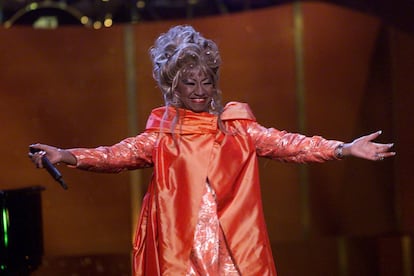

The month of November 1991 left three indelible marks in the fondest part of my memory.
I had arrived at the Mexican resort town of Cancún, invited to cover as a journalist a wonderful Caribbean Culture Festival being established that year. As soon as I entered the hotel where we were staying, my Mexican colleague Paco Ignacio Taibo II surprised me with the best possible gift: four or five copies of my recently published novel Pasado Perfecto, which, given the impossibility of getting it published in Cuba, had finally been published by a very modest collection at the Mexican University of Guadalajara. Anyone who has had a similar experience knows what it means to see the solitary effort of months or years of writing materialized, transformed into a legible and permanent object. I was, of course, exultant and overjoyed.
Then, in the following days, with the Festival already underway, I had two other experiences that would also become unforgettable. The first was that, after attending the concert offered by Willie Colón and his band, I was one of the approximately one hundred guests invited to witness the civil wedding of the by now legendary artist, known as El Malo de la salsa, and who was the architect, along with Rubén Blades, of that Latin music classic called Siembra, described by a friend of mine as “The Abbey Road of salsa.”
However, it was the third experience that matters the most now: among the megastars present at that extraordinary event was my fellow Cuban Celia Cruz, who performed with the band of another monster of universal music, the timbalero Tito Puente.
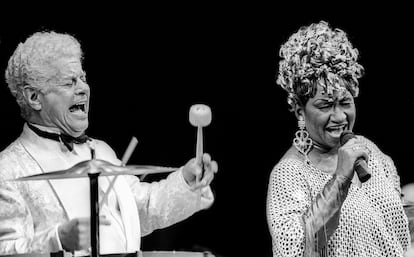
More than 30 years have elapsed since that concert, and even today I close my eyes and recall images: Celia Cruz, the Cuban guarachera, now crowned the empress of salsa, overpowering the stage with her voice, her movements, her Creole grace, her sequined dress and silver wig, while she launched her Cuban battle cry into the Caribbean sky: “Azúcar!” Her performance, as it could not be otherwise, overwhelmingly connected me with an artistic greatness I had heard so much about, with a way of singing that seemed immune to the passage of time, a stage presence and a cultural power that could only be assimilated in all its dimensions by watching her do before me what she did for 60 years around the world: bewitch everyone with her voice and her inexhaustible Cuban sympathy.
The most extraordinary thing about the privilege I had that night in Cancún is that I had attended an event that most of my compatriots, Celia Cruz’s compatriots, would never see live. The obscure distances of politics robbed them of that wonderful opportunity, just as they denied them the opportunity to applaud so many other legendary Cuban figures who joined a diaspora that for many was eternal: musicians like the great Mario Bauzá, the creator of Latin jazz, baseball players like Orestes Miñoso, Luis Tiant, Tany Pérez... and I could go on with the list, painfully growing.
The greatest frustration I experienced during those days was the refusal of one of Celia’s press agents to allow the Bemba Colorá singer to grant me an interview. I don’t know if the reason was the singer’s busy schedule, as I was told, or if some other consideration influenced the decision, but the 1991 refusal haunts me to this day: the absence of Celia Cruz’s words is a gigantic hole in my collection of interviews, The Faces of Salsa, where she should have reigned supreme among her peers, as she did on the world’s stages.
A few years later, the opportunity to fill that void might have presented itself, but our stars definitely didn’t align. In 1995, when the performances of the artists who would appear in the documentary From Son to Salsa, for which I had written the script, were being filmed in New York, the opportunity arose to interview her. As we had anticipated in my text, we fought to have her in the film, as her presence was essential to this cinematic and musical testimony to such an important Caribbean cultural phenomenon. And the filmed conversation took place, moreover, accompanied for the occasion by her friend Tito Puente.
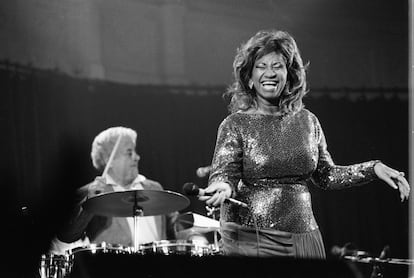
But, unfortunately, my stay in New York had already come to an end (producers’ budgets rule), and I could only be one of the spectators who, during the Havana New Latin American Cinema Festival in 1996, applauded wildly when the documentary directed by Rigoberto López was finally screened in the city where the artist was born. Thus, after more than 30 years of censorship, the words, the grace, the music of Celia Cruz were once again shown in a Cuban public and institutional space. It was a brief and temporary return — but a triumphant one — to the spiritual and cultural universe to which, despite the distance and time, she always belonged, and I am glad to have been one of those who brought about that return to her origins... although I always regret not having been able to interview her.
Now, when so many people around the world are honoring her on the centenary of her birth, surely in Cuba, at least officially, the anniversary will pass without mentioning her legacy or any of the well-earned accolades obtained by one of the greatest figures of culture, not only Cuban culture, but universal.
Throughout a career that began one Havana afternoon in the early 1940s, when she sang the tango Nostalgias on an amateur radio program, the then young owner of a golden voice and a telluric personality began to forge what for many years now has been a legend, more than a person. She was the female voice of the band Sonora Matancera, the woman who sowed and harvested the very masculine universe of salsa, the figure who has received all the awards and who, more recently, has even become the first Black and Latina woman capable of invading the entire United States with her image imprinted forever on 25-cent coins. And there, engraved, is her Cuban and Caribbean cry: Azúcar!... forever Azúcar!
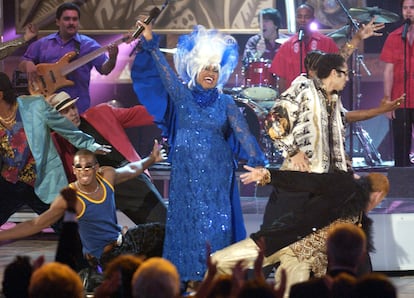
And everything is so transcendent that even the most exaggerated thing seems logical to us: crowning her Queen wasn’t enough, so they had to elevate her to Empress. Since her status, her character, her Cuban identity weren’t enough, she became universal. Since the span of an intense, glorious, immeasurable life didn’t encompass her legacy, Celia is now immortal. Since her country still hadn’t mentioned her, she took over the planet, and the planet surrendered at her feet. And she did it all with the magnificent weapon of her voice, with the spice of her grace, and the power of her strength, because Celia Cruz is the music, of course, of Cuba, but also of the entire world, because Celia Cruz is the victory over time and space achieved only by those who never surrender.
Sign up for our weekly newsletter to get more English-language news coverage from EL PAÍS USA Edition









































