
Heat: The inspirational masterpiece that earned zero Oscar nominations
Michael Mann’s film, which brought De Niro and Pacino together 30 years ago, continues to be a benchmark for directors and a step-by-step manual for criminals
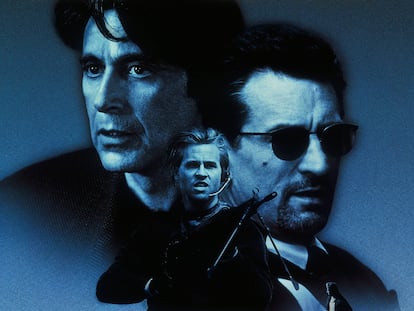

In the summer of 2009, American director Michael Mann spoke at a gathering organized by the Cinematheque Française to promote Public Enemies. On that occasion, a man from the audience got up and said: “I don’t know if you know that Heat is an absolute guide for organized crime. I’ve been a gangster. I don’t brag about it. I just spent 10 years in prison. I’ve robbed armored vans and jewelry stores and to do so I had an advisor, a teacher, a kind of mentor called Michael Mann. Are you aware that there are criminals who are inspired by your movies?”
Disconcerted, the director replied, “Thank you... I don’t know what to say.” The man from the audience was not bluffing. He was Redoine Faïd, one of France’s most infamous criminals, who had carried out some of the most spectacular robberies and get-aways in the history of the country. Faïd had seen Heat “100 times” he said. He did so specifically to dissect the scene of the robbery of the armored van at the start of the film, which he copied in his first major crime.
This anecdote — perhaps one of the most surprising open-floor questions of all time — serves to illustrate the spectacular impact of Mann’s movie, which saw two acting legends, Robert De Niro and Al Pacino, sharing the screen for the first time: both appeared in The Godfather II, but never in the same scene together. Supporting these two titans were Val Kilmer, Ashley Judd, Jon Voight, and Natalie Portman.
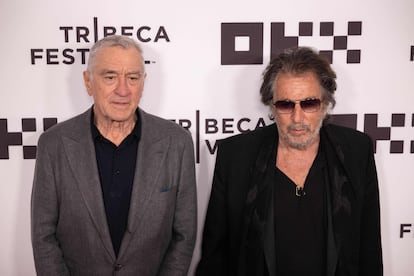
Heat is undoubtedly one of the best action films of the 1990s and a prime example of cop and robber cinema, but what makes it different is that it is also an ambitious study on a wide variety of topics ranging from professional ethics — even if your profession is bank robbery — to love — all the characters become entangled in complex or impossible romantic storylines — plus obsession, loneliness, revenge, desire and evil.
Heat is genre cinema elevated to an almost operatic dimension. As Mann himself pointed out in an interview with Empire magazine in 2007: “To me, Heat was always a highly structured, realistic, symphonic drama. I never thought of it as doing a genre piece.”
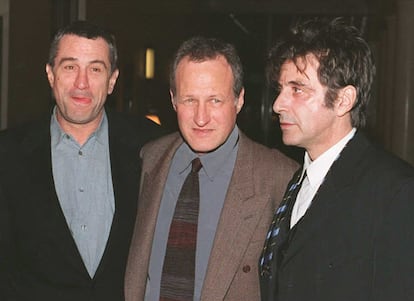
Heat continues to fascinate moviegoers and directors such as Christopher Nolan and Kathryn Bigelow, who have publicly recognized it as one of their influences. In Mann’s hands, the ruthlessness of gangsters pursued by brutal police in an enigmatic and inhospitable city like Los Angeles became poetry.
The hunter and the prey
For those who haven’t yet seen it, Heat’s plot is pretty straightforward: Neil McCauley (De Niro) is a professional thief who operates in Los Angeles with almost military precision. Lieutenant Vincent Hanna (Pacino) leads a group of detectives from the Los Angeles Police Department’s homicide department. Hanna is as obsessed with his job as McCauley is with his, and the chase turns into a personal battle. The men share a number of parallels: consumed by their respective occupations, their life outside of work is a disaster.
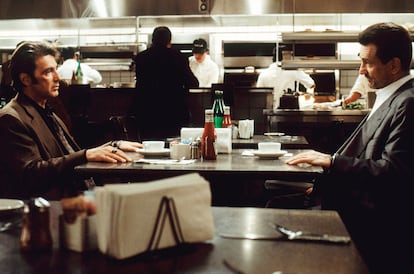
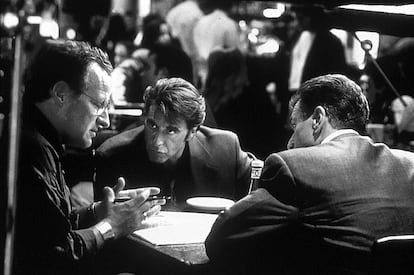
As McCauley plots the heist that could allow him to retire, Hanna closes in on him. The relationship between the two men is not without respect, but they also both know that only one of them is going to come out alive. The plot is, in fact, based on the real-life relationship between detective Chuck Adamson and a gangster called Neil McCauley, in Chicago in the 1960s, and it recreates some of the heists and encounters that actually took place there. For example, at one point in the film, the protagonists meet in a nondescript cafeteria for a brief exchange. This meeting is based on a real encounter between Adamson and McCauley in Chicago, and is also the first time that Pacino and De Niro share the screen.
The shoot
The filming of the movie was a challenge. At Mann’s express wish, there were no rehearsals, depending instead on De Niro and Pacino’s acting skills. “Now Pacino and De Niro are two of the greatest actors on the planet, so I knew they would be completely alive to each other — each one reacting off the other’s slightest gesture, the slightest shift of weight,” Mann explained. “So we read the scene a number of times before shooting — not a lot — just looking at it on the page. I didn’t want it memorized. My goal was to get them past the unfamiliarity of it. But of course these two already knew it impeccably.”
Pacino and De Niro were aware what was at stake as actors and how important it was that they got the vibe between their characters right: two men who could kill each other, but who would also understand one another better than anyone else. The movie was shot with three cameras. Two over-the-shoulders and one profile shot. But Mann didn’t use the latter: “Every time we cut to the profile, the scene lost its one-on-one intensity. I knew ahead of time that Pacino and De Niro were so highly attuned to each other that each take would have its own organic unity,” he explained.
The result is a mythical conversation. Heat’s emotional core. The two men look at each other, respect each other, confess to each other, but, as Mann pointed out, “Both men recognize that their next encounter will mean certain death for one of them.”
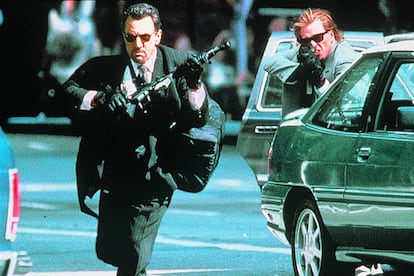
If that encounter in the coffee house is the movie’s emotional climax, the heist is the physical climax. The scene in which McCauley and his gang flee after the robbery of a bank in downtown Los Angeles has become a cinematic seminar. The choreography is perfect. The assembly, surgical. Although everything seems improvised, with shots that seem to be recorded by an intrepid television reporter, the filming was prepared over months.
“That scene arose out of choreography, and was absolutely no different than staging a dance,” Mann explained. “We rehearsed in detail by taking over three target ranges belonging to the L.A. County Sheriff’s Department. We built a true-scale mock-up of the actual location we were using along 5th Street in downtown L.A., with flats and barriers standing in for where every parked car was going to be, every mailbox, every spot where De Niro, Tom Sizemore, and Val Kilmer were going to seek cover as they moved from station to station. Every player was trained with weapons the way somebody in the military would be brought up, across many days, with very rigid rules of safety, to the point where the safe and prodigious handling of those weapons became reflexive.”
The level of expertise is evident. Kilmer, who plays Chris Shiherlis, one of the henchmen, reloads the rifle in the middle of the shooting with a naturalness worthy of military academies.
A style manual for the 21st century
Admittedly, Heat didn’t win any major awards and garnered no Oscar nominations. Many critics think that the way the Oscars ignored the film is one of the great injustices committed by the Academy. The consolation is that few films have left such a deep and lasting mark. Christopher Nolan cites it as having a direct influence on The Dark Knight, especially in its portrayal of a city as a living, oppressive organism.
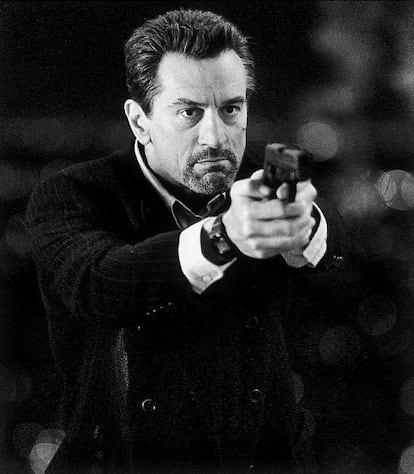
Mann shot without using sets, with more than 70 real locations in Los Angeles. The objective was clear: to capture the city as its own ecosystem, gigantic, nocturnal and strangely solitary. Cinematographer Dante Spinotti used natural lighting and wide shots that enhanced the emptiness surrounding the characters. Other directors such as Denis Villeneuve and Mia Hansen-Løve have recognized the influence it has had on them. But Heat has also been key in other screen genres: a mission from the video game Grand Theft Auto V is a direct replica of the heist that occurs at the beginning of the film.
Critics have also recognized Heat’s significance. Rolling Stone included it in its list of the 100 greatest films of the 1990s, and The Guardian named it as one of the greatest crime films of all time. In general, it is credited with elevating the genre to something more stylized, introspective, and human.
“It’s not just an action picture,” critic Roger Ebert wrote in his review of the film in 1995. “Above all, the dialogue is complex enough to allow the characters to say what they’re thinking: They are eloquent, insightful, fanciful, poetic when necessary. They’re not trapped with cliches.”
The restaurant scene is recognized as a masterclass in acting, but also as the moment when Heat ceases to be film noir and becomes an elegy about loneliness, obsession, and the impossibility of balancing personal life and vocation.
Will there be a Heat 2?
Everything seems to point to Heat having a sequel or, rather, prequel-sequel. After years of uncertainty, the latest news is that Warner Bros. has approved the script for a new film set in the Heat universe, based on the novel of the same title that Mann published with Meg Gardiner in 2022.
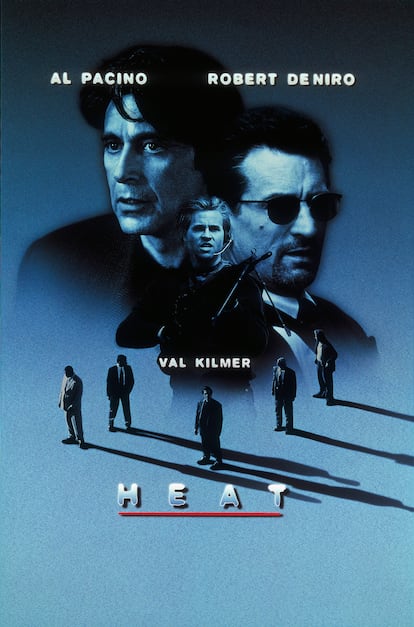
The film would explore the past of McCauley’s character and what happens after the end of the original Heat. Adam Driver could play the character of De Niro and Austin Butler may also take an important role. Mann, at 81, wants to be the director. If the project finally gets off the ground, it will remain to be seen whether Heat 2, whose literary version got good reviews, is worthy of the acclaim that the original Heat was denied.
Sign up for our weekly newsletter to get more English-language news coverage from EL PAÍS USA Edition









































