
A floating school teaches children how to save Lake Atitlán
This is the latest attempt by Guatemalan scientists to make kids aware that the once-pristine lake is in danger of ‘dying’ from the constant discharge of waste water, garbage and erosion
In 1934, the famous British writer Aldous Huxley described Lake Atitlán, in the Guatemalan highlands, as “too much of a good thing,” alluding to its immeasurable beauty. In his travel book Beyond the Bay of Mexico, he compared it to Lake Como in Italy, which “touches on the limit of permissibly picturesque, but Atitlán is Como with additional embellishments of several immense volcanoes,” he wrote, namely San Pedro, Tolimán, and Atitlán.
More than 90 years later, Lake Atitlán faces a serious pollution problem: while on the surface the boats rock to the rhythm of a measured wave, deep below the water is impregnated by the discharge of waste from a dozen indigenous populations.
“Lake Atitlán’s main problem is cyanobacteria, which are highly toxic, and are nourished and spread by feces,” says Fátima Reyes, the head of the research and quality department of AMSCLAE, the Authority for the Sustainable Management of the Lake Atitlán Basin and its Environment. According to Reyes, “cyanobacteria are harmful to fish, ducks and birds while creating problems in the liver and nervous system in humans.”
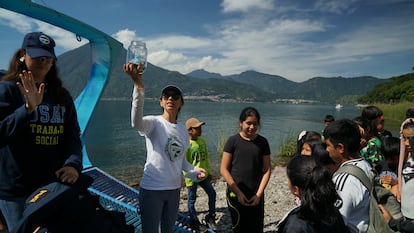
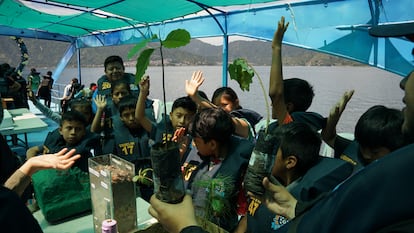
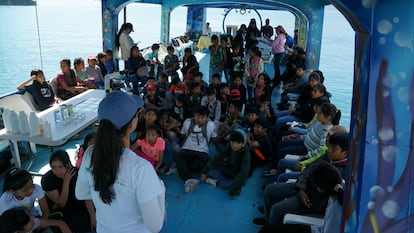
After battling for more than a decade with a variety of strategies to decontaminate Lake Atitlán, the authorities have opted to offer environmental education to the children in the area, resulting in a floating school – a double-decker boat where kids around the age of 10 take a lake class once a month. “We work with children to make them aware from an early age through experiments and research. The idea of the floating school is that they can share what they come to learn with their classmates at school and with their families,” says Reyes.
Water quality, the main focus of the floating school
On a peaceful morning in the mountainous municipality of San Marcos La Laguna, around 60 fourth and fifth graders from the local school have descended from the mountains that surround the lake to the dock where a boat awaits them. One by one, they put on their life jackets and sign the attendance form with a fingerprint. On board, they are divided into groups with different learning modules.
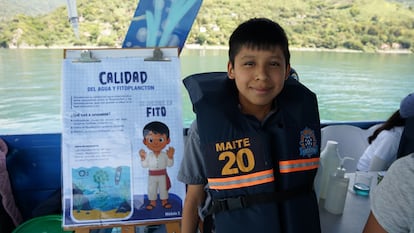
One of the most interesting modules is the water quality and phytoplankton module, in which Iván Coronado de León, an 11-year-old, appears particularly invested. When asked why it is important to learn about the environment, Iván answers: “Because that way we can take care of our lake, and continue to live from the water, because without water we cannot live.”
Lake Atitlán is a water reserve of great importance for Guatemala. According to the Global Water Partnership, the lake region has about 180,000 inhabitants, of which 91% are indigenous Mayans. Paying close attention, Iván learns that much of the drinking water consumed by the Mayan Tz’utujul and Kaqchikel populations is extracted from the lake, so it is a lot more than a “scenic” body of water. “I’ve learned about the bacteria that help our lake breathe and provide food for the fish... The floating school is very beautiful, I really like the lake,” he says.
What Iván does not know is that two municipalities belonging to the lake basin, Santiago de Atitlán and San Lucas Tolimán, get their drinking water supply exclusively from the lake. According to the authorities’ monitoring, the water is highly contaminated by fecal coliforms, bacteria that come in the feces of the wastewater. In recent years, children in these municipalities have suffered episodes of chronic diarrhea, which can be fatal in under five-year-olds.
Fortunately, the municipality where Iván lives, San Marcos La Laguna, obtains water from the rivers that wind through the mountain, ruling out the risk of ingesting cyanobacteria that in turn produce cyanotoxins – microorganisms that can be deadly, and that the students were able to see through a microscope.
Garbage and erosion: The other two sources of pollution
On the second floor of the boat, the environmental education teacher, Pablo Alejandro Tello, queries students on aspects of the lake’s daily pollution. “Can someone tell me what organic waste is?” he asks. “An eggshell,” responds one student; “the skin of an avocado,” replies another. “What else?” the teacher asks.
In his module, Tello has buckets with a variety of organic waste to explain that another major source of pollution for the lake is garbage, but that there is a way to treat it. “We teach them the composting process, in this case, how to compost from their homes. And we explained the importance of soils, the four types that we have in the basin, and did some experiments on how to avoid erosion.”
Soil erosion, a product of intensive agriculture, is another critical reason for the current pollution of the lake. To exemplify this, the teacher uses a watering can to pour water on a model of a sloping mountain with different types of soil. The most eroded part drags everything with it, while the more consolidated part, rich in vegetation, absorbs all the water.
“The children’s response has been very good,” Tello says. “They are pretty interested in the experiments, which is the most important thing. Giving them this experience on the boat, surrounded by mountains and forests, is giving them a chance at dynamic and experiential learning, so that they absorb the advice we give them and the basin improves environmentally.”
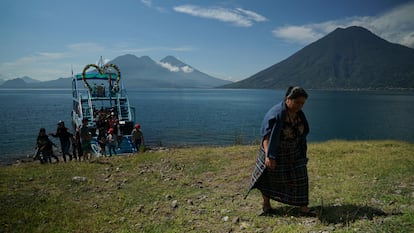
As noon approaches, the boat starts its engines and returns to the dock. In just one day, the children have learned that the spread of cyanobacteria in sewage, poor garbage management and soil erosion have reduced Lake Atitlán to a mesotrophic state, which means an intermediate state of contamination.
And that, if there is not urgent action, that could slide into a eutrophic state, where oxygen is lost and aquatic life dies. It would result in a lake very different from the one known to their Mayan ancestors, and even to Aldous Huxley, when it was pristine.
Sign up for our weekly newsletter to get more English-language news coverage from EL PAÍS USA Edition









































