
Wilber Garcés’s life before being shot by ICE: A sports enthusiast and father of a disabled child
From Venezuela, the family is pleading for the bullet that is still lodged in his back — and which threatens to leave him unable to move one of his arms — to be removed


For five days, Wilber Garcés Pérez’s mother, Flor Pérez, has had high blood pressure and headaches from knowing her son is in custody, still with the bullet lodged in his back that an immigration agent fired last Sunday. At the same time, she looks for explanations to give her seven-year-old grandson, who keeps insisting he wants to talk to his father.
“My thoughts, my prayers, my heart, my soul, everything is with him,” Flor Pérez tells EL PAÍS in a voice message. “I am praying that he gets out of there and that they operate on him, which is what matters most to me right now,” she says from the city of Barquisimeto, five hours west of Caracas, Venezuela’s capital, where she is visiting Wilber’s son.
“She wants to feel close to her son by being with her grandson,” says Mrs. Flor’s sister, Jacqueline Pérez.
On Sunday, September 20, after being chased by immigration agents in Austin, Garcés called his mother by video. He had already been shot by an immigration agent while on his way to deliver an order for the DoorDash app. She remembers it with anguish and pain: “This has affected me enormously.”
Since that day, Wilber, 28, has been at an Immigration and Customs Enforcement (ICE) processing center in south Texas, in the remote city of Pearsall.
Since that day, Flor Pérez has not been able to speak directly with her son. She receives updates from his immigration lawyer, Kate Lincoln-Goldfinch, or from Wilber’s partner.

Provider for his son
Jacqueline Pérez says her nephew Wilber is calm and “has never gotten into trouble”; that while he was in Venezuela he focused on studying and working to help his father with household expenses.
“He did well in school; he didn’t have to try very hard,” she says. His greatest passions, she says, were baseball and soccer. “He’s always been passionate about sports. It was over the top. He’d get hurt trying to score a goal, scrape his legs, and I’d tell him, ‘Do you think you’re going to the World Cup?’”
Garcés played on a soccer team in his hometown, Yaritagua, a city in the state of Yaracuy. But he had to quit when the country’s political and economic crisis began to empty Venezuelans’ pockets. At that time, before 2024 when he emigrated to the United States, he also had to leave a vocational institute where he was studying administrative careers.
His only child, seven, also remembers him with admiration. In a voice message sent by WhatsApp to EL PAÍS, his grandmother Flor asked him: “Who is the man you love most in this world?” And he answered without hesitation: “My dad.”
Flor Pérez says that since Sunday the boy has asked every night to call his father, as usual. She has had to tell him that he is busy, that he cannot talk right now. On Tuesday night, the child insisted on sending an audio message to his father to play a song on the recorder his grandmother had given him.
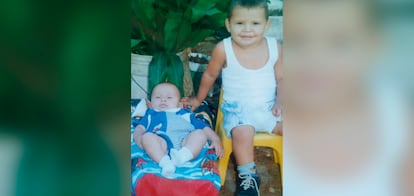
Living in the United States allowed Garcés to earn a better salary than in Venezuela. For the father, that is paramount: he wants to give his son a better life; the child was born with a neuromuscular disorder that makes walking difficult. That is why that Sunday, Garcés was making a DoorDash delivery — because his son requires expensive physical therapies to improve his mobility. And indeed, his aunt says, he has improved.
Lincoln-Goldfinch has explained that Garcés was admitted to the United States by immigration authorities in 2024. He applied for asylum but his case became complicated because the court sent a notice for a hearing to his old home address, even though he had informed the court of his move. For failing to attend the hearing, the judge ordered his deportation in absentia. ICE said that order made him a target of the agency and that this is why they detained him.
“Days of heartache”
Garcés’s family cannot believe what they are going through. His aunt, Jacqueline Pérez, says that since Sunday “they have been through days of heartache.” She stopped reading and listening to news about the case and now only looks for what Lincoln-Goldfinch says. When she watches videos of the arrest and the authorities’ response, she cries: “It is very painful to see what they are doing to him. We carry the sin of being Venezuelan.”
Since Sunday, Garcés has been evaluated by three doctors. The first examination was right after the operation to detain him on Sunday, during which he was shot. His lawyer denounced that he was discharged in less than four hours to be transferred to the ICE detention center.
On that occasion, the bullet was not removed from his back, even though doctors had told Garcés they would prepare him for surgery. In that visit he also learned the projectile had fractured his collarbone and lodged in the upper part of his back, near his spine.
The second medical visit was Monday night: Texas congressman Joaquín Castro then said Garcés was losing mobility on the left side of his body and had been taken to a hospital in extreme pain. At that time, the bullet was not removed either and he was returned to the Pearsall center at midnight.
Garcés’s third visit to a medical specialist was on Wednesday. It coincided with a visit by Austin congressman Greg Casar to the ICE center in Pearsall. The doctor confirmed he required surgery to remove the bullet “or mobility in his arm could be affected for life,” Lincoln-Goldfinch’s office said in an email on Thursday. He continues to suffer intense pain despite receiving painkillers.
The Department of Homeland Security (DHS) responded to Casar in a statement on its X account, saying that “medical procedures are the exclusive competence of the hospital” and that the federal agency “does not and would not advise, nor be the authority on,” such procedures.
For Jacqueline Pérez, the agents’ treatment of Wilber Garcés and their responses give her the sense that in the United States “if you are a migrant, you have no rights.” From Venezuela, Flor Pérez says all they can do is trust in God, because “he can do everything.”
Sign up for our weekly newsletter to get more English-language news coverage from EL PAÍS USA Edition









































