In the US, ICE arrests at school bus stops spark fear as students return to class
Worries about immigration raids are contributing to a decline in Hispanic student enrollment
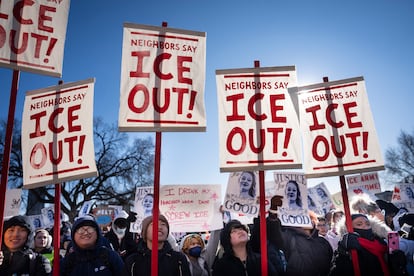

This Tuesday, the biggest event in the city of Danbury, Connecticut, was the start of the new school year, much as it was in other states across the country. But this year, the excitement that back-to-school season usually brings for children and families was overshadowed in migrant communities by the fear of ending the day in a detention center. U.S. Immigration and Customs Enforcement (ICE) chose the symbolic date to ramp up its operations, turning school bus stops into traps.
This morning in Danbury, ICE was arresting parents at school bus stops.
— Chris Murphy 🟧 (@ChrisMurphyCT) August 26, 2026
But it’s more sinister. ICE waited until the kids were on the bus so when they are dropped off at the end of the day, they are alone, scared to death they can’t find their parents.
I’m heading to Danbury.
“This morning in Danbury, ICE was arresting parents at school bus stops. But it’s more sinister. ICE waited until the kids were on the bus so when they are dropped off at the end of the day, they are alone, scared to death they can’t find their parents,” said Democratic Senator from Connecticut Chris Murphy in a post on his social media.
Dozens of people were detained this week by immigration agents in Danbury and, although the operations were not limited to parents of schoolchildren, the first day of the school year was marked by fears of arrest.
Danbury Mayor Roberto Alves, who is the son of undocumented immigrants, posted a video and statement offering guidance on residents’ rights and lamenting that “on a morning that should be filled with backpacks, school buses, nervous smiles and excitement, no child should carry that kind of fear.”
Alves underscored the gravity of the situation: “There are kids who are going to come home from school and there is going to be a parent missing. These folks need our help,” he said.
Videos of some of the arrests in Danbury, showing the heavy-handed tactics of immigration agents, have circulated on social media, spreading fear throughout the migrant community.
ICE, the agency at the forefront of U.S. President Donald Trump’s mass deportation campaign, has consistently denied carrying out operations at schools. But images from the past school year showing agents arresting parents as they dropped off their children and detaining students near school grounds have left a lasting impact on many families, some of whom would rather have their children leave school than risk being detained.
Alves said ICE appeared to be using racial profiling during the Danbury raids, stopping people who looked as though they were of Central or South American origin.
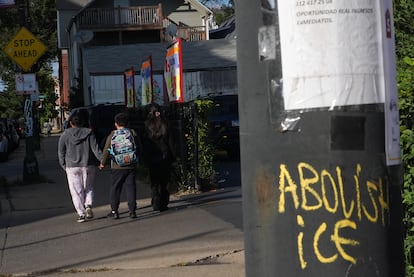
In Maryland, where Hispanic students account for more than 23% of K-12 enrollment, the number of Hispanic students has fallen for the first time. The decline breaks a years-long trend of steady growth, with enrollment having risen from 182,000 students in the 2020-21 school year to 211,000 last year. This year, enrollment has dropped to 209,500.
In Montgomery County, where Hispanic students make up the largest demographic group, accounting for more than 35% of enrollment, Montgomery County Public Schools (MCPS) issued a statement acknowledging that “recent federal immigration enforcement actions, locally and across the country, have caused anxiety for many members of our community.” Enrollment in MCPS exceeded 159,000 students last school year, but this year’s projections suggest a total of only “more than 150,000.”
Beyond fears of encountering immigration officers on the way to school, many parents worry that the information provided when enrolling their children could end up in the hands of immigration authorities. MCPS has sought to address those concerns, stating that “Montgomery County Public Schools does not ask about immigration status at enrollment or at any other time. We protect student privacy as required by federal law and strictly safeguard student records and personal information.”
Legislative shields against raids
For the second year in a row, since Trump launched his crackdown on immigrants, the start of the school year in the United States has prompted measures and guidance aimed at protecting students and families from the administration’s immigration policies.
In Massachusetts, state officials on Tuesday issued guidelines for schools and daycare centers across the state to follow if an ICE agent seeks access to a student. Earlier this month, Democratic Governor Maura Healey signed the PROTECT Act, which bars federal immigration agents from entering schools, churches and courthouses, among other public spaces. Previous administrations, both Republican and Democratic, had generally treated such locations as “sensitive” locations where ICE enforcement was restricted, a practice Trump ended shortly after returning to the White House.
The guidance issued by Healey in collaboration with the state attorney general and the Department of Elementary and Secondary Education is a 16-page document outlining a range of scenarios and how school staff should respond. In addition to providing suggested responses for employees if agents appear either on school grounds or nearby, the manual says that “schools should review school transportation contracts and communicate with school transportation companies regarding policies and protocols for bus drivers in the event of active law enforcement activity near a school bus stop.”
“As families prepare for the new school year, every child should feel safe walking into their classroom and every parent should feel confident dropping them off,” Healey said in a statement.
This week, a court filing in New Jersey revealed that earlier this year four ICE vehicles sped past a stopped school bus with its lights flashing before heading toward an apartment complex where elementary school children were waiting for another bus. The children scattered and ran away.
“Donald Trump and Stephen Miller have built a deportation machine that treats five-year-olds on their way to kindergarten as targets and school bus routes as hunting grounds,” said Vanessa Cárdenas, executive director of the pro-immigrant group America’s Voice. “Children who should be thinking about homework and recess are instead fearful that going to school could mean losing a parent. The damage shows up in empty desks, falling enrollment, and a generation of kids who now associate school with fear instead of safety.”
Target boycott
Opposition to Trump’s anti-immigration campaign has also led teachers to call for a boycott of Target when shopping for back-to-school supplies. The American Federation of Teachers (AFT), which represents nearly two million members, has launched a nationwide campaign titled “Shop Smart, Support Working Families,” urging consumers to buy school supplies elsewhere.
The initiative emerged after Target, which is headquartered in Minneapolis, declined to condemn ICE operations in Minnesota earlier this year, when Renée Good and Alex Pretti were killed by immigration agents. In February, a Target spokesperson said the company does not cooperate with ICE through any formal agreements, but several people were nevertheless arrested at Target stores.
Sign up for our weekly newsletter to get more English-language news coverage from EL PAÍS USA Edition