New York court orders Trump administration to return another wrongfully deported migrant
The Salvadoran national Jordin Melgar-Salmerón was sent to his home country in May despite a court ban
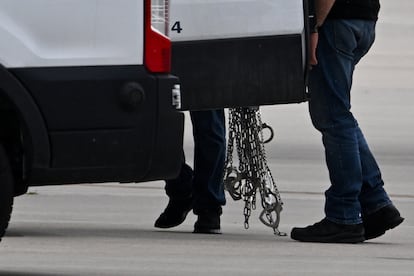

That’s four now. A New York court has ordered the Trump administration to “facilitate” the return of a fourth wrongfully deported immigrant. The Salvadoran national Jordin Melgar-Salmerón, 31, was deported to his home country in May just minutes after the New York federal appeals court ruled that he should remain in the United States.
In an order issued this week, judges on the U.S. Court of Appeals for the Second Circuit declared that “the Government is hereby ORDERED to facilitate the return of [Melgar-Salmerón] to the United States as soon as possible to ensure that his case is handled as it would have been had he not been improperly sent to El Salvador.” The judges noted in their ruling that Melgar-Salmeron’s stay of removal was issued at 9:52 a.m. on May 7, but that a flight carrying him to El Salvador departed approximately 30 minutes later.
The Trump administration had already admitted to the court that the man’s deportation was due to a “confluence of administrative errors.” Now, the court is demanding that the government submit, within one week, a declaration detailing Melgar-Salmeron’s current location, what steps will be taken to bring him back to the United States, and when.
It’s a story that has already been repeated four times under President Trump’s anti-immigrant crusade. The most famous case is that of 29-year-old Salvadoran Kilmar Abrego García who, along with more than 200 Venezuelans, was deported to El Salvador last March and imprisoned in CECOT, the infamous maximum-security prison denounced for its poor conditions. His removal was acknowledged by a government employee as a mistake.
Abrego García was returned to the U.S. earlier this month after the administration had refused for months to facilitate his return as several courts, including the Supreme Court, had demanded. The migrant now faces a U.S. trial on charges of smuggling undocumented immigrants.
There’s also the Guatemalan migrant identified by the initials O.C.G., who was mistakenly deported to Mexico in February. He, too, was returned to the United States this month. And the Venezuelan Daniel Lozano-Camargo, expelled to El Salvador last March despite having a court document protecting him from removal. All of them were protected from deportation and yet ended up on a plane bound for another country.
New prisons for migrants
The White House’s detention and deportation machinery knows no bounds. The Trump administration recently announced it would add new prisons to its growing list of detention centers at a time when criticism has surfaced about overcrowding in these facilities and the appalling conditions in which thousands of detainees are being held.
Now, ordinary migrants detained by federal agents—those who left their homes to go to work on any given day, or attended their court hearing, or received a traffic violation ticket—could end up locked up in the same prison that has housed inmates such as the drug lord Joaquín “El Chapo” Guzmán; former Mexican Secretary of Public Security Genaro García Luna, accused of drug trafficking and organized crime; or the musician Sean “Diddy” Combs, investigated for organized crime and sex trafficking. The Metropolitan Detention Center in Brooklyn, described by inmates themselves as a “hell on earth,” is one of three federal prison facilities the Trump administration will use to house migrants.
Benjamin O’Cone, a spokesman for the Federal Bureau of Prisons, told The Miami Herald that, in addition to the Brooklyn prison, the Federal Correctional Institution at Lewisburg in Pennsylvania and the Federal Detention Center in Honolulu, Hawaii will also begin receiving migrants as part of an agreement between that entity and Immigration and Customs Enforcement (ICE).
In the message sent to the Florida media outlet, O’Cone confirmed that “we are assisting the United States Immigration and Customs Enforcement (ICE) by housing detainees and will continue to support our law enforcement partners to fulfill the administration’s policy objectives.” According to the spokesperson, they have collaborated so far with the “temporary detention” of more than 4,000 people.
With these latest additions, the number of federal prisons that will house migrants, most of whom have no criminal history in the country, now totals eight. Internal data obtained by CBS News shows that ICE has 59,000 immigrants in its custody in centers across the United States, and that, of those, 47% have no criminal record and fewer than 30% have been convicted of crimes. Similarly, government data indicates that, at least as of the end of June, ICE’s detention capacity was over 140%, a figure that exceeds the 41,500 beds designated for inmates nationwide.
The federal government has also built detention centers across the country in an effort to meet its goal of approximately 3,000 arrests per day, or the equivalent of more than a million in the first year of the Republican president’s administration. This is the case with Delaney Hall in New Jersey, which has more than 1,000 beds, and with the same goal in mind, work has begun on “Alligator Alcatraz” in Florida, a center that will have approximately 5,000 beds.
Terrible conditions
Even so, the historic deportation Trump is seeking requires more space and infrastructure, which is why the government is turning to prisons where migrants will be held in deplorable conditions and exposed to all kinds of violence. For example, the Brooklyn prison, opened in the early 1990s and now housing 1,095 people, has been widely criticized for delays in providing medical care to the inmate population, poor food quality, restricted access to visits and calls, and the numerous drug trafficking problems at the facility.
Migrants at that facility are also allegedly being exposed to violence, a phenomenon widely reported by human rights advocates. Five years ago, Cameron Lindsay, who served as warden there, said that “it was one of the most problematic facilities, if not the most problematic, in the Bureau of Prisons.”
In 2019, the prison made headlines after a power outage left inmates without heat and in freezing temperatures, sparking protests from the prison population. In 2024, the deaths of 37-year-old Uriel Whyte, stabbed by other inmates, and 36-year-old Edwin Cordero, the victim of another fight between inmates, were reported on-site. Genaro García Luna himself described the prison’s conditions in a letter sent to the media last year. “I have been detained at MDC Brooklyn, N.Y., for a period of 58 months, almost five years, in inhumane conditions. I have witnessed homicides, stabbings, and systematic threats to my safety,” he said.
If there’s another factor affecting this prison, and others across the country, it’s the staff shortage. Brooklyn currently operates at 55% capacity, making it a much more dangerous place due to the lack of oversight and the poor security of inmates. Kathleen Toomey, deputy assistant director of the Bureau of Prisons, told Congress in February that there were approximately 4,000 vacant positions nationwide, and that the agency spent $437.5 million in fiscal year 2024 on overtime pay. “These shortages pose the greatest threat to ensuring the safety and security of inmates and staff,” she said.
Sign up for our weekly newsletter to get more English-language news coverage from EL PAÍS USA Edition