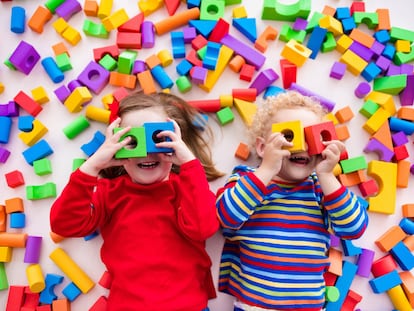
A three-year-old Indian boy becomes the youngest chess player in history after being recognized by FIDE
The International Chess Federation recognizes Sarwagya Singh Kushwaha with an official rating, meaning has defeated at least three players in the ranking

Two trends are converging. One is the boom of chess in India, where it competes with cricket as the most popular sport; the other is the surge of precocious chess players, whose numbers have skyrocketed thanks to training with very powerful computers. But until recently no one could have imagined that a child of three years, seven months, and 20 days, Sarwagya Singh Kushwaha, could enter the international list of players. And he’s not the only chess player that young.
Abstract intelligence, essential for playing chess, does not begin to develop until the age of five or six, except in infants with very high abilities. Kushwaha’s must be extraordinarily high because — according to information from the Reuters agency — he has already defeated at least three players who appear in the rankings of the International Chess Federation (FIDE), a prerequisite for entering that list.
The surprise is all the greater given that no one would have predicted this a decade ago. This near-toddler has surpassed the record of another Indian prodigy, Anish Sarkar, who entered the list last year at three years, eight months, and 19 days. This flood of precocity began in the wake of the successes of five-time world champion Viswanathan Anand, who continues to achieve brilliant results at age 55 (he just finished second in the Jerusalem Masters rapid tournament). Thanks to his fame as a living and active legend, chess has gone from being a minority sport to competing with the most popular ones (cricket, badminton, field hockey, squash…) in a country of more than 1.45 billion inhabitants.
This reporter has witnessed several times that many Indian couples change their lives (residence, job, status…) to maximize their son’s or daughter’s chess talent, knowing that only a tiny percentage of those who try will become well-paid stars. Apparently, Kushwaha’s parents belong to that bold group: “We want him to become a grandmaster [the highest title],” his father, Siddarth, told Reuters, even though his prodigious son still has no idea what that means.
Sign up for our weekly newsletter to get more English-language news coverage from EL PAÍS USA Edition