
An interstellar traveler is getting closer to Earth than ever before: How to observe comet 3I/ATLAS
On December 19, this interstellar visitor with its peculiar composition offers a glimpse into the makeup of celestial bodies beyond the Sun
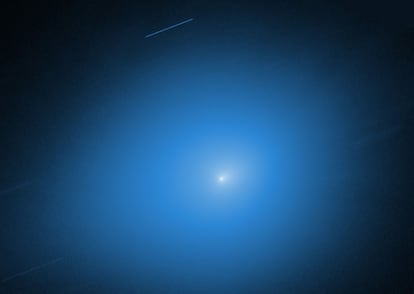

An ancient visitor, forged in another corner of the universe, is preparing to approach Earth. It goes by the name of comet 3I/ATLAS, and was discovered five months ago by the ATLAS telescope network in Río Hurtado, Chile. Classified as the third interstellar visitor to cross our skies, it follows the asteroid Oumuamua in 2017 and the bright comet Borisov in 2019. On December 19, this wandering celestial body will be 270 million kilometers (168 million miles) from our planet — almost twice as far away as the Sun.
It’s a distance that seems unbridgeable to humans, but it is considered close for an object from another star system. As it passes through our solar system, its presence offers the international scientific community the chance to analyze its composition, giving us a glimpse of conditions in other corners of the galaxy.
César González, a spokesman at the Madrid Planetarium, explains that 3I/ATLAS differs physically from other comets. “A higher volume of gases, mostly carbon dioxide, has been discovered in the coma [cloud of gas and dust]. A greater amount of ionized nickel has also been observed, a material that had not been seen in other comets,” he explains.
The unusual structure of the 3I/ATLAS’ coma and the chemical composition detected so far could be explained by the combination of a high metal content and abundant water ice. “This does not mean that we do not detect dioxide or carbon monoxide ice in our own comets, but that the relative proportion of these ices is different,” says astronomer Julia de León, from the Canaries’ Astrophysics Institute.
Due to its peculiar characteristics, social networks have been abuzz with speculation that it is a technological alien. It is a hypothesis explored by Avi Loeb, a Harvard physicist. NASA dismissed the idea, however, after examining the photos and signals captured by its probes. “These theories generate unnecessary noise and detract from the real scientific interest of these objects, which are already very interesting in themselves,” says De León.
Gas eruptions on the surface
Josep María Trigo, a researcher at the Institute of Space Sciences (CSIC), has led a recent study published on Cornell University’s ArXiv platform, in which he describes how the comet emitted jets of gas and dust particles during its perihelion — the point in its orbit when it is closest to the Sun. This point occurred on October 29 and was detected by the Joan Oró Telescope of the Montsec observatory. The phenomenon happens because the internal heat of the object melts the ice, giving rise to eruptions that expel gas, steam and dust into space. “This is a transitional object, halfway between a comet and an asteroid; it is extremely pristine. Our study spectroscopically confirms that its characteristics are compatible with the objects we call trans-Neptunian [beyond the orbit of Neptune],” says Trigo.
Another independent research team led by scientist Nathan X. Roth has worked out of the ALMA observatory, also based in Chile, and detected the most enriched concentrations of methanol and hydrogen cyanide of any comet, second only to C/2016 R2 (PanSTARRS).
According to Trigo, objects like 3I/ATLAS have great astrobiological potential: they could act as receptacles of organic matter and catalytic minerals, capable of generating precursor ingredients for life if they find a suitable environment. “But careful! That does not mean they contain life,” Trigo warns.
How should we observe the comet?
The comet will pass close to Earth, but unlike on other occasions, it will not be visible to the naked eye. César González and Julia de León agree that the best time to observe it will be at 12 midnight from December 18 and 19 in mainland Spain. “It will reach its highest position in the sky at six in the morning,” says González.
González recommends using a telescope or binoculars with a 50 mm aperture to be able to distinguish it as a “point of light.” Rural areas with minimal light pollution are ideal for appreciating this phenomenon. In any case, González insists that the significance of this comet lies in the fact that it was forged in a foreign solar system. “It is a good time to verify whether the theories we have developed observing the creation of our solar system are valid for other systems and other stars,” he says.
Sign up for our weekly newsletter to get more English-language news coverage from EL PAÍS USA Edition









































