
The great revolution against Alzheimer’s: ‘It’s the first time in human history that we’ve managed to slow the disease’
A scientific review examines advances in the field and addresses the controversy surrounding new drugs, questioned due to their price and modest efficacy
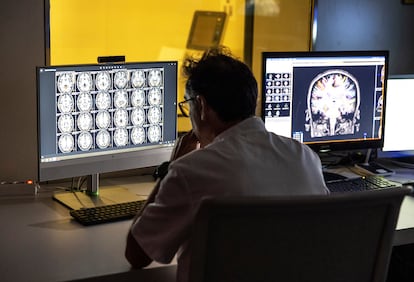

The fight against Alzheimer’s has entered a new era. The emergence of new drugs that slightly slow its progression, along with the discovery of biomarkers that pave the way for early detection, has renewed hope for tackling a condition that affects 50 million people worldwide. After decades of setbacks and the failure to find effective treatments for a dementia that destroys memory and individual autonomy, the scientific community is watching with anticipation the diagnostic and pharmacological revolution underway. A panel of experts published a series of articles in The Lancet on Monday detailing these advances, while also addressing the major controversy surrounding the new treatments — the first to alter the course of the disease, but criticized for being expensive, having side effects, and showing only modest efficacy.
Juan Fortea, head of the Neurobiology of Dementia group at the Sant Pau Research Institute and co-author of one of the Lancet articles, says Alzheimer’s research is at a “paradigm shift.” “We are not curing the disease,” he clarifies, “but it is the first time in human history that we have managed to slow the progression of Alzheimer’s disease.”
The driving force behind this scientific turning point is a new generation of drugs that eliminate beta-amyloid protein, which accumulates in diseased brains, and slow disease progression.
Albert Lleó, head of Neurology at Sant Pau in Barcelona, emphasizes that this is just “the beginning of the journey”: “There are 138 more drugs under investigation. These are the first of many to come.”
Researchers are also exploring, for example, the potential of semaglutide, which has already revolutionized obesity treatment.
The drugs that have raised all hopes are called lecanemab and donanemab. In clinical trials, the first slowed disease progression by 27%, and the second by 35%. Both are approved in the United States and other countries, but the European Medicines Agency (EMA), more conservative, took time to approve lecanemab (giving approval a year ago after initially rejecting it) and is still reviewing donanemab.
Both drugs have been surrounded by controversy, even within the scientific community. First, because of potential side effects — for example, lecanemab has been linked to cerebral hemorrhages and the deaths of two patients — but also because of doubts about the clinical benefit: what does reducing disease progression by 27% really mean for a family’s day-to-day life? Other concerns include the price (estimated at around $25,000 per patient per year) and the fact that the drugs are only intended for very specific patients in the very early stages of the disease, with specific characteristics.
In the Lancet series, the authors — some of whom disclosed conflicts of interest due to ties with the pharmaceutical companies producing these drugs — analyze this “range of reactions” and the “skepticism” these drugs generated in the scientific community, asking whether the same would have happened with other diseases.
They even compare efficacy, cost, and impact of the new Alzheimer’s drugs with those of other biologic drugs for different conditions. For instance, with lecanemab and donanemab, serious adverse effects occurred in 1 in 300 and 1 in 65 patients, respectively; but in trials of pembrolizumab (an immunotherapy) for lung cancer, side effects occurred in 27% of cases. Another comparison: the reduction in disability from anti-amyloid drugs in Alzheimer’s is similar to that observed in trials of biologic drugs for rheumatoid arthritis or multiple sclerosis.
Based on the history of other biologic drugs in different diseases, the authors argue that the magnitude of effect may be very similar. In those cases, they note, prices were also high and the drugs were not free of side effects. Regarding the limited access to a very specific group of patients — experts estimate that for now only 5% of people with Alzheimer’s will benefit — the authors point out that in multiple sclerosis, for example, the use of innovative drugs was limited to 36% of patients in 2017 and rose to 74% in 2020.
“What these authors are putting forward isn’t a direct comparison with other diseases, but rather a demonstration that there are other therapies in medicine that have a comparable magnitude of effect, but Alzheimer’s has characteristics that undervalue these advances,” says David Pérez, head of Neurology at the 12 de Octubre Hospital in Madrid, who was not involved in this series. He refers to a handful of factors, ranging from scientific skepticism to social prejudices, which have created a climate conducive to controversy.
Pérez notes, for example, that the history of Alzheimer’s drug development has been “bumpy,” marked by successive failures that planted a seed of distrust in the scientific community. The controversy over aducanumab, a drug approved in the U.S. under controversial circumstances but which failed commercially and was later withdrawn by the manufacturer, did not help. “It was approved in a twisted way, without clear benefit, and that generated an atmosphere of mistrust,” Pérez explains.
Nihilism and ageism
There is also “a lot of nihilism” surrounding this disease, says Lleó: “Many times, the diagnosis is not made accurately, and since there is no treatment, the public feels no need to demand a diagnosis or timelines the way they do for stroke or cancer. Sometimes, the symptoms are considered part of normal aging. All of this contributes to the perception of a disease in which there is little that can be done.”
Another factor affecting the debate, according to Pérez, is ageism: “This is a disease that primarily affects older people, who cannot raise their voices and demand anything from society. These patients are a vulnerable group.”
The scale of the disease, the experts consulted add, has also fueled doubts at the policy and regulatory level. “If it weren’t such a prevalent disease, if it didn’t cause a strain on the healthcare system, on costs, and on procedural changes, some of the controversy wouldn’t have arisen. If it were a rare disease, we have little doubt that this would have been approved without any controversy and very quickly,” Fortea says.
This first generation of drugs presents a challenge for healthcare systems. Both in identifying patients who can benefit — which requires diagnostic and biomarker tests to confirm the disease, as well as genetic studies to rule out incompatible mutations — and in the treatment and follow-up itself: the therapy is intravenous, administered in a day hospital, and requires regular MRIs to monitor for potential hemorrhages.
“Seeing patients in outpatient consultations, once every six months or once a year, is one thing; lecanemab treatment is another. It involves infusions every two weeks in a day hospital, plus four MRIs per year and numerous visits… A patient goes from one or two relatively short visits per year to 24, 30, or 35 visits. Imagine the workload this represents. It will be challenging for the system to adapt, but since it will [initially] involve only a minority of patients, the system can gradually adjust,” Fortea says.
The experts consulted emphasize that potential side effects are manageable. Regarding clinical benefit, Fortea notes that “that 30% translates into the patient gaining six months over 18 months.” In other words: “To progress to the next phase, you progress 30% more slowly. You maintain more autonomy and quality of life because we are slowing a disease that causes significant disability. We are not curing the disease. Patients get worse, but at a slower pace,” he adds.
In an interview with EL PAÍS, Cristina Maragall, president of the Pasqual Maragall Foundation, argued that for both the scientific community and families, “it is essential that these medications begin to be used.”
Diagnostic revolution
Therapeutic advances, however, are only one part of this scientific transformation shaking up Alzheimer’s research. The other pillar — diagnostics — is also advancing by leaps and bounds, particularly with the development of biomarkers that identify biological traces of the disease ever earlier. The authors estimate that the arrival of plasma biomarkers, which detect traces of the disease in the blood — with a simple blood draw, like a routine test, biochemical signals of the disease can be identified — “will lead to a new diagnostic revolution.”
These tools are “crucial” for confirming the diagnosis at all stages of the disease, says Fortea. He explains that when clinical evaluation and neuropsychological testing confirm mild cognitive impairment, in 60% of cases it will be Alzheimer’s, but in the remaining 40% it will not; and depending on the situation, the patient’s progression and prognosis will be very different. “Therefore, I absolutely need a biomarker to identify who has Alzheimer’s. Otherwise, I won’t know what’s happening,” he says. According to Fortea, in asymptomatic contexts, the only way to select individuals who have Alzheimer’s will also be the biomarker. “The day there are preventive treatments, that biomarker will be our only tool to identify these people,” he adds.
Fortea is very optimistic about the med-term advances: “We can now diagnose the presence of proteins [related to Alzheimer’s] in the brain of cognitively healthy people. We still can’t predict with certainty whether or when all of these people who have these proteins in their brains will develop the disease, and that’s why population screening isn’t recommended, but this isn’t science fiction. These are clinical trials that are underway and will be published in 2027. In two years, we’ll know if removing amyloid in people without symptoms slows the onset of the disease.”
If this is the case, he says, “conducting population screenings and trying to prevent it would be justified.” “We’re not there yet, but we have diagnostic tools that work and clinical trials are underway. This doesn’t end with these two approved drugs; there are many more to come, not only in these stages of the disease but in others as well. The disease in five years may be unrecognizable from the perspective of how we treat it, prevent it, and what we do.”
Experts also predict more advances in the field of prevention. In fact, a scientific review identified 14 risk factors — including smoking, hypertension, sedentary lifestyle, and pollution — to avoid in order to prevent nearly half of all dementia cases. “There is potential in prevention,” argues Eider Arenaza-Urquijo, ISGlobal researcher and author of one of the articles in The Lancet series: “We have already seen a study that has shown that a lifestyle intervention — physical exercise, nutrition, cognitive and social activity — has an impact on cognitive decline in people at higher risk of developing Alzheimer’s,” she says.
Sign up for our weekly newsletter to get more English-language news coverage from EL PAÍS USA Edition









































