
Ant bridges and bird-built pergolas: What animal architecture teaches us about evolution
Science is investigating this field to better understand how complex behaviors evolve in nature
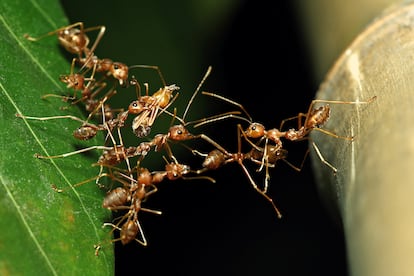

The natural world is full of architecture. We see it in an enormous diversity of structures, like beehives, bird nests, spiderwebs, beaver dams, termite mounds, and burrows. All have one thing in common: they are the product of complex, largely innate animal behavior that does not require that it be taught. How has evolution led this to be the case?
How genetic changes lead to different behaviors is an unknown that has long fascinated the scientific community. Given that animals’ architectural structures are often precisely built, they offer excellent clues towards solving the mystery. Here are three revealing examples of animal architects.
Ant bridges: simple rules for complex behaviors
Army ants (often of the genera Eciton) live in South American tropical jungles and, in contrast to other species, are nomadic. Every day, a colony of thousands or even millions of individuals moves in search of food. Such a lifestyle requires rapid adaptation to its environment. While other ants carefully explore their territory to create efficient routes, army ants must improvise paths through complex jungle terrain full of obstacles like holes and branches.
To overcome these challenges, the insects have developed a very peculiar behavior: collective assembly. They use their bodies to build temporary living bridges that facilitate the passage of their peers. They can be up to 12 centimeters long, the equivalent of 12 times the length of an ant’s body.
In 1874, U.S. naturalist Thomas Belt documented this army ant behavior for the first time, and asked a question: “Can it not be said that such insects are capable of determining through reasoning the best way to achieve something, and that their actions are guided by thought and reflection?”
Thanks to prior studies, we know that ant architecture doesn’t require centralized planning nor advanced cognitive skills. Instead, it is a behavior guided by simple rules, in which tactile sense and pheromones are key.
The first rule is “if you find a hole in the road, cover it and stop.” So is formed the first row, and as more ants cross, they join the bridge, extending and reinforcing it. Next comes the rule of “don’t move if someone is on top of you.” This tactile response allows structures to remain cohesive and stable, even with fluctuations in traffic. Finally, more ants are attracted via pheromones, which further reinforces the bridge.
These guidelines allow ants to regulate their behavior as a function of traffic. In this way, a bridge can rapidly dissolve if flow decreases or is interrupted, freeing the “structural” ants to return to their normal activities.
Rodent burrows: a model of extended phenotype
In 1982, Richard Dawkins coined the concept of “extended phenotype” to describe how an organism’s genes don’t only impact its body, but also its surrounding environment. He predicted that genes are favored when they allow organisms to modify their environment in a way that favors their propagation. Animal architecture serves as a clear example of extended phenotype, and to this end, rodents from the genera Peromyscus offer the perfect research model.
These rodents are distributed throughout North America, inhabiting environments that range from forests to open fields. Of them, P. maniculatus and P. polionotus are two closely related species with notable differences in the burrows they build.
While P. maniculatus makes simple burrows, with a short entry tunnel and a small nesting chamber, P. polionotus goes to the next level. It builds longer and more complex burrows that include an escape tunnel in case a predator enters. These differences remain constant even if individuals from both species are raised in a laboratory, underlining the behavior’s strong hereditary aspect.
A study carried out by the Princeton Neuroscience Institute found that the locus (the physical site of a gene) that makes P. polionotus a digging champion is located in chromosome 4. Scientists inserted this P. polionotus locus into a P. maniculatus mouse and it built 20% longer burrows. This shows how small genetic changes can have a large impact on behavior.
That doesn’t mean that environment doesn’t play a role in the final result of animal architecture. All behaviors are the product of an interaction between genes and the environment, even those seen as the most innate. P. polionotus is monogamous and both progenitors cooperate in the digging of a burrow. A study published in 2022 showed that when the pair is of different sexes, they are better at coordinating and burrows turn out much larger than when two individuals of the same sex work together.
The pergola: the important of sexual selection
Without a doubt, one of the great motivators of complex behaviors in nature is sexual selection. Among the most fascinating examples of this are a kind of bowerbirds (of the family Ptilonorhynchidae) who live in Australia and New Guinea. Their scientific name is Pergolero Pardo Amblyornis inornato, the first word stemming from the fact that males build pergolas solely in order to attract females.
The birds use leaves, branches and a wide range of objects to build and adorn their masterpieces. Adornments include natural elements like flowers and shells, but also artificial objects like plastics and cans. Some species like the satin bowerbird (Ptilonorhynchus violaceus) paint the interior of their pergolas with pigments obtained from fruits, carefully selecting specific colors, like blue.
When a female enters the general area of a pergola, its male begins to show it off, beginning with its exterior. With rapid movements, it shakes and throws colored objects outside the field of vision of the spectator while making a large variety of vocalizations. It’s all done with the goal of keeping her attention for the longest time possible, and if the female remains in the area after his show, the male will take advantage of the opportunity to copulate with her.
A recent study revealed that bowerbirds don’t only pay attention to esthetic concerns in their pergola constructions, but also matters of acoustics. The shape of their structure and the hard materials used to build it, including bones and shells, reflect and amplify their vocalizations, directing their voices to the exact spot where the female is located. In this way, he sounds more intense and clear, raising the probability of attracting her attention.
Curiously, within the bowerbird family are species that vary widely in the complexity of the structures they build. The most primitive don’t make pergolas and primarily base their courting around vocalizations, which indicates that auditory signs could be the first evolutionary step in mating rituals. With time, some birds incorporated visual elements of increasing sophistication. This combination of signs, known as multimodal communication, is often linked to greater reproductive success.
Sign up for our weekly newsletter to get more English-language news coverage from EL PAÍS USA Edition









































