
Armie Hammer: Hollywood’s canceled cannibal heartthrob comes back laughing at himself
After his exit from the industry due to a sexual scandal, the actor is carving out a new path with three independent films and a podcast
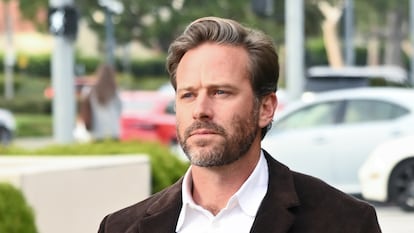

Silence, time, and distance. Not the most usual ingredients for movie stars to build a career, but for Armie Hammer, 39, surprisingly, they are working for him. Of course, the noise before had been deafening. Four years ago, Hammer, the latest in a wealthy oil dynasty — the kind that gives its name to museums and golf courses — became the center of conversation in Hollywood, which didn’t hesitate to label him a cannibal just as it had once called him a heartthrob. And Hollywood didn’t flinch when it came to stripping him of everything — projects, agents, family, fortune. The actor’s life and career sank. How do you get out of that? Or rather, can you get out of that? He is living proof that you can. And that collective memory is short, very short, capable of turning scandal into just an anecdote.
Hammer, the epicenter just four years ago of ridicule and scandal in the ever-prudish entertainment industry, seemed finished. His leaked sexual messages with women, accusations of cannibalistic tendencies, and, in one case, even of rape (which the Los Angeles District Attorney investigated thoroughly and dismissed for lack of evidence) cast him into a social and professional exile that, surprisingly, no longer seems endless. The actor, who starred in The Social Network (2010) and Call Me by Your Name (2017) only to fall into the abyss, canceling series and movies with Jennifer Lopez, has figured out how to make the perfect — or almost perfect — comeback, on his own terms: quietly, without fanfare, without major projects. Simply, working on what he wants, giving just enough interviews and keeping exposure to a minimum. And knowing how to make light of his situation, with humor and without deflecting responsibility.
But he’s back: in addition to his own podcast, he has three films awaiting release, the first coming very soon. And that’s despite the fact that, until now, since early 2022 when Death on the Nile was released, he had only appeared in a small project: a music video by singer Georgina Leahy, in which he played a character named… Kannibal Ken.
Now he is getting serious and taking things a step further. On December 5, Frontier Crucible — a classic Western featuring cowboys in hats, long-haired Native Americans, and the Monument Valley peaks as a backdrop— opened in U.S. theaters. Along Sunset Boulevard, already getting ready for awards season, there are no huge posters of the film; there is no big promotion, no massive premiere at the Chinese Theatre. Directed by Travis Mills, it is a small movie, with Hammer and William H. Macy as the main draws. But for the fallen heartthrob, it is the biggest project of his career. Because it represents going back to work, restoring his image, finally being seen by his peers as just one of them.
It’s not the only project he has in the works, but it is the largest in the last four years since the scandal. Filming has also wrapped on German filmmaker Uwe Boll’s Citizen Vigilante (originally titled The Dark Knight, a title they decided to change after consulting Warner due to its similarity to Christopher Nolan’s Batman film). Shot in Zagreb, Croatia, Hammer is the lead, playing a vigilante hunter of criminals pitted against an Interpol agent on his trail. The film was presented at the Cannes market (not the festival) and received numerous offers.
Additionally, at the end of June, Hammer finished shooting a noir-style film in Los Angeles, Night Driver, directed by John Bevilacqua and co-starring Rainey Qualley (daughter of Andie MacDowell and sister of Margaret Qualley, from The Substance), in which he plays a war veteran now doing nighttime errands and deliveries.
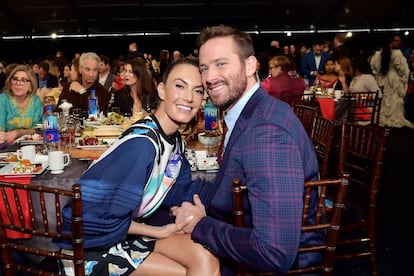
Securing these projects without an agent guiding his career — he himself has admitted that his only team now is his lawyer, and that’s enough — is no small feat. At a time when Hollywood’s film industry is not exactly thriving — with cuts, layoffs, and mergers — landing three projects after being considered a pariah is no minor accomplishment.
In fact, Hammer himself said on a podcast called Your Mom’s House earlier this year that his schedule was quite full and that he had even turned down several offers. “That first job that I turned down after four years of this shit, it was the best feeling I’ve ever had,” he admitted. “It’s slow, but generally now the conversation when my name comes up with people in the industry is, ‘Man, that guy got fucked.’ And that feels really good. It’s really encouraging.”
A couple of veteran Hollywood publicists consulted on the case agree that this is indeed the sentiment in the industry: being free of criminal charges makes it more than possible that Hammer could make a comeback, especially in a landscape where there aren’t many profiles like his.
He’s returning calmly and confidently. He has been his own harshest judge, acknowledging in talks and podcasts — he launched his own a year ago, Armie Hammer Time, which he has now paused to focus on his acting career — that he was “an idiot,” that he didn’t handle things well, that he had been abusive toward women, and that, in part, hitting reset helped him realize exactly what he wanted. Although this has cost him his marriage to Elizabeth Chambers, and led to being separated from his two children, Ford and Harper, he is beginning to mend the relationship: in the summer, his ex-wife posted a photo of the four of them together celebrating the end of the school year. Back to normal.
He has only agreed to give one interview to a major outlet, The Hollywood Reporter. It took place in February and was done with every possible precaution — the kind that media organizations rarely admit to: by email, with the option to leave questions unanswered. Even so, he was clear and concise. Therapy had had an effect on him, that much was obvious.
Controlling his own narrative, the actor explained that he didn’t care what people thought of him, that he was having a much better time working on smaller films, and that he was happy to be back on set — but that his profession, and whether or not he was working, no longer defined him. He spoke of what he called a kind of “mass hysteria”: “People said the word ‘cannibal’ and everyone said: ‘That makes sense, he eats people.’ What a time to be alive. In hindsight, it is hilarious. Just as a social observation.”
It may be easy to look back now, but the whole episode put him in an extremely difficult place. He had suicidal thoughts. He spent a year in rehab. He lost his fortune — so much so that he moved to the Cayman Islands (in the Caribbean, near Cuba) to work selling timeshares. His life alone would make for an entire screenplay, though perhaps bigger than anything he seems interested in taking on. Or at least that’s what he says now. In Hollywood’s hypocritical ecosystem, the big studios are just around the corner waiting for him.
Sign up for our weekly newsletter to get more English-language news coverage from EL PAÍS USA Edition









































