
Netflix sells Trump a ‘made in USA’ plan with Warner: thousands of jobs and 20 times more filming space in the US
The historic Hollywood studios spent more than $5 billion on restructuring in the three years prior to being put up for sale

There was no photo op with Donald Trump like there was at his inauguration ceremony, where the world’s most powerful tech tycoons mingled. There’s no official confirmation, but there is tacit agreement from both sides: Netflix CEO Ted Sarandos met with the U.S. president in November for an hour, during which he hinted that Netflix was going to acquire Warner Bros. in one of the biggest deals of the century. Nothing more has been revealed about that meeting, except that the Republican leader responded with pure liberalism, favoring whoever would present the best offer; and, from the buyers’ side, with a very significant line in the official statement released last week: “This acquisition will enhance Netflix’s studio capabilities, allowing the Company to significantly expand U.S. production capacity.”
Sarandos can frame the acquisition of his biggest rival as fulfilling one of the Administration’s major obsessions since Trump returned to the Oval Office: more jobs for Americans and increased production on American soil. The Warner acquisition would mean both things in abundance for Netflix: thousands of new salaried jobs in the U.S. and up to 20 times more studio space to film without leaving home. If major international automakers, from Toyota to Hyundai, have announced factories and assembly lines in the U.S.; if global pharmaceutical companies are rushing to announce new plants in the American heartland; and if even Apple itself is coming up with a list of $100 billion in “made in USA” investments, Netflix is not going to be left behind.
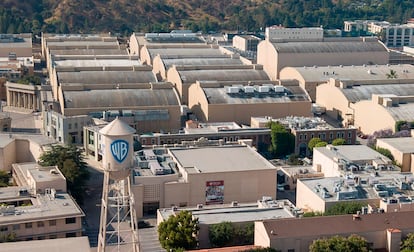
Unless Paramount and its own offer for the entirety of Warner Bros. Discovery (as opposed to Netflix, which is bidding just for the company’s streaming and studio businesses) change things, Netflix will soon join the elite of the film industry. Having spent over 100 years at the foot of Hollywood Hill, as the historic studio has done, commands a price tag that is more than symbolic. The four Warner brothers, who had started projecting home movies in a canvas tent in Ohio, moved to California and, in the mid-1920s, embraced sound film. When their film The Jazz Singer (1927) became the first resounding success of the format, they used the proceeds to buy the more than 400,000 square meters of studio space that First National owned in Burbank, in the suburbs of Los Angeles. Today, the studios are located at 4000 Warner Boulevard and, despite a few fires and minor sales, it still occupies practically the same area. It is the crown jewel of studios that Netflix is after.
According to its own financial statements filed with the Securities and Exchange Commission (SEC), Warner Bros. Discovery owns an additional 100,000 square meters in Atlanta (including studios and corporate offices) and approximately 120,000 square meters of filming space in Leavesden, UK. In addition, it owns two large locations of roughly the same size in New York and Burbank, both leased. Between leases and owned assets, the company’s most recent total land availability for sale amounts to 1.6 million square meters worldwide, a third of which is in California.
Virtually everything Warner owns in the Pacific Rim would be included in the purchase proposed by Netflix. The company behind Stranger Things and Squid Game is far behind the major film studios in terms of production capacity. Relatively new to filming with its own resources, the company only reports three large studios: in Albuquerque, New Mexico (23,000 square meters), Brooklyn, New York (7,000 square meters), and Longcross, 50 kilometers from London (approximately 10,000 square meters). To these must be added the 22,000 square meters it already occupies in Tres Cantos, outside Madrid, which has made the Spanish hub the company’s largest in Europe.
A growing workforce
The final number of jobs at the future Netflix is proving more difficult to calculate, due to the nature of the available official information and, in particular, the continuous changes in Warner ownership over the past decade. According to Warner Bros. Discovery’s last complete annual report, from the end of 2024, the company had 35,000 employees. From this number, we must subtract the 11,000 employees who belonged to Discovery Channel before its merger with Warner in 2022, according to the 2021 accounts. This division is expected to break off again with the announced separation of Discovery Global into a new publicly-traded company by next year. Finally, from Warner’s theoretical 26,000 employees, we would have to subtract those who do not belong to the studios and streaming division, which is what Netflix is acquiring for €72 billion.
These figures are also unreliable due to the mass layoffs the century-old company has undergone in the last three years, which, according to its 2024 annual report to the SEC, are a consequence of the alliance with Discovery that began in 2022. In just three years, the merger resulted in nearly $5 billion spent on internal business restructuring, including terminations of employment and commercial contracts.
Netflix, on the other hand, is much more linear in terms of its workforce and continues to break records year after year in terms of staff size. It has been doing so uninterruptedly since 2013, growing from 2,022 employees to 14,000 at the end of last year (69% of whom were in the U.S. and Canada). The big difference between Netflix then and now is that it was in 2013 that it launched its first major original production, House of Cards. Back then, the company relied on reproducing successful franchises made by others, like Marvel, Star Wars, Harry Potter and Friends. This is what it will partially regain with the Warner acquisition (the superheroes and galaxies remain Disney’s property).
Sign up for our weekly newsletter to get more English-language news coverage from EL PAÍS USA Edition









































