
Goodbye to the US? Not yet in Ramstein, home to the largest American base in the world
The most pro-American corner of Germany faces a potential rupture following Trump’s threats against Europe and Greenland: ‘He has caused a lot of damage’

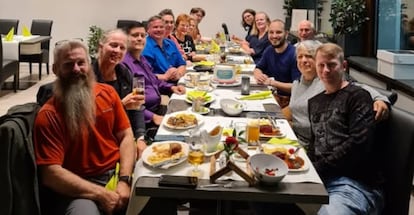
“Hallo!” “How are you?” “English?” “Deutsch?” Languages mingle at Da Nino restaurant, and so do the people. About 20 friends and acquaintances, German and American, have come here to have a good time and cultivate transatlantic friendships. A challenging task today.
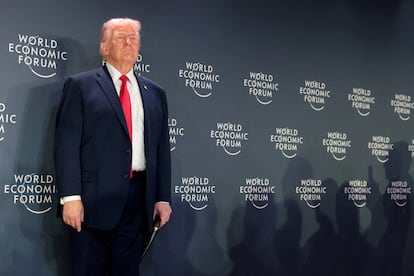
The echoes of Donald Trump’s threats to his allies reach even the Stammtisch, a German-American discussion group that meets monthly in Ramstein-Miesenbach, the German municipality that houses the largest U.S. military base overseas. The attendees catch up on each other’s lives. They practice English (the Germans) and German (the Americans). They plan activities, relax with a beer or a soft drink. On this Thursday — it’s unavoidable, and to top it off, there’s a journalist in the room — they talk about Trump and his attempts to seize Greenland, a territory of the Kingdom of Denmark. It’s not a comfortable topic.
“I’m embarrassed,” says Judy, a civilian employee at Ramstein Air Base. Like others at the Stammtisch, this Minnesota native doesn’t want to give her last name. Ronnie, a retired U.S. serviceman who decided to stay in Germany, explains: “We have barbecues together with the Germans. We’re neighbors. We help each other. We respect each other. What happens in politics is beyond our control.”
The connection between Germans and Americans is deep in the Ramstein-Miesenbach region, home to some 50,000 Americans, including soldiers, families, and civilians. Over the decades, friendships have blossomed and marriages have taken place. Some, like Ronnie, have stayed to live in this most pro-American corner of Germany, a symbol of the strained transatlantic relationship.
“We survived Trump’s first term. I hope we survive this one,” says Maria, a German high school teacher. She explains that she sometimes tries to avoid the topic in conversations: “It can ruin friendships.” “I have friends on both sides,” says Vivian, another German in Da Nino, who works for a pharmaceutical company. “Most of them tell me, ‘I don’t understand what this man is doing.’”
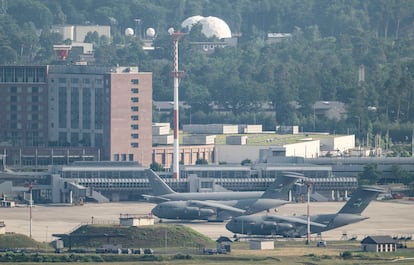
A sigh of relief swept through Ramstein-Miesenbach on Wednesday when Trump said he was ruling out the military option to gain control of Greenland. Some felt they had just dodged a bullet that could have proven fatal. What would be the point of this base — and this region — if the protecting power became the enemy?
“We’ll see what happens,” says John Constance, the organizer of the German-American discussion group at Da Nino. Constance, who works at the Atlantische Academie, a non-profit organization in Rhineland-Palatinate, wonders: “What would have happened if U.S. armed forces had attacked Greenland? What if there had been a conflict within NATO, with a NATO base here? How could we be here together if one member is attacked?”
Journalist Holger Stark, author of the recently published Das erwachsene Land. Deutschland ohne Amerika: eine historichen Chance (The Grown-Up Country. Germany Without America: A Historic Opportunity), describes the current moment as “a second fall of the Wall.” After the Berlin Wall came down in 1989, the Soviets withdrew from East Germany. Is it time for the U.S. to withdraw?
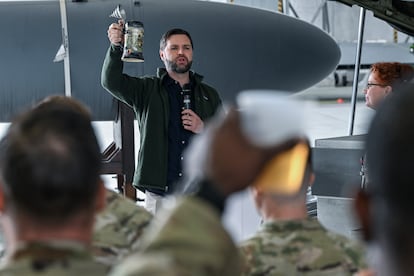
Of the 84,000 U.S. military personnel in Europe, nearly half are stationed in Germany, with Ramstein as their main base. It has been described as “a stationary aircraft carrier,” as it is a crucial installation for the U.S. to project its power globally (the Spanish base of Rota, a sister city of Ramstein-Miesenbach, is another such location).
During the Cold War, with the Iron Curtain just a few hundred miles away, this was the theater where World War III could have erupted. When George W. Bush invaded Iraq in 2003, the wounded arrived daily at the military hospital in nearby Landstuhl. Today, everything is up in the air. When Trump said he would take Greenland “the easy way or the hard way,” the idea of closing the bases ceased to seem like a fantasy.
“People here aren’t afraid that everything will suddenly disappear, but they do wonder what will happen tomorrow or the day after,” says Ralf Hechler, mayor of Ramstein-Miesenbach. His office is adorned with symbols of German-American friendship and a statue of the Virgin Mary. A Christian Democrat in the pro-European and pro-Atlantic tradition of his party, he finds it hard to imagine his town without the base: “I don’t think it will happen.”
Hechler recalls all that Germany owes to the United States: the Marshall Plan, the reconstruction after Nazism, the defense of democracy... And he points out that the U.S. presence is also an economic engine for the region, comparable to the role that the chemical giant BASF plays for the nearby city of Ludwigshafen. “Trump,” he says, “has caused a lot of damage with his actions and the way he treats others. What he hasn’t yet managed to do is turn the people here against the Americans.”
Atomic bombs
Leaving Ramstein, 80 miles north, the road winds through a picturesque landscape of hills and forests. It skirts the Moselle River and its vineyards until reaching Büchel, an airbase of the Bundeswehr, the German Armed Forces.
“This could be paradise, if it weren’t for the bombs,” says Elke Koller, a retired pharmacist who has spent three decades campaigning against nuclear weapons, in Büchel and around the world. Koller lives a few miles from the base, where the United States stores between 10 and 20 B61 nuclear bombs. “They protect Germany and at the same time make it susceptible to blackmail,” Stark writes in The Grown-Up Country.
“They offer us no protection. They make us a target,” laments Koller, who unsuccessfully took the case to the Constitutional Court a few years ago. “I wouldn’t be upset if Trump withdrew them.” “Our motive isn’t personal,” notes Hildegard Slabik-Münter, also an anti-nuclear weapons activist and a pediatrician, in Koller’s living room. She means that they aren’t fighting just for Büchel: “The important thing is that it’s a threat to the whole world.”
At the entrance to the airbase, Koller and Slabik-Münter’s group has installed several crosses, a peace bell, and a banner calling for an “ecumenical prayer” on February 6. At the entrance to the village of Büchel, next to the base, a sign in Cyrillic script advertises a general store selling Eastern European products. It is run by Alexander Hofmann, a member of the minority of Germans whose ancestors emigrated to Russia and, for the most part, were deported by the USSR to Kazakhstan. Hofmann was born there 42 years ago. In 2004, he emigrated to Germany. He ended up here, right next to Germany’s largest nuclear arsenal.
“We’re not afraid. We have Jesus Christ,” Hofmann says at the counter. “I’d be happy if the Americans left. Let them take their bombs and go.”
Sign up for our weekly newsletter to get more English-language news coverage from EL PAÍS USA Edition









































