
A survivor’s account of the Interoceanic Train accident: ‘We were scared because of the speed on the curve’
The train car in which Katherine Vásquez was traveling derailed and fell 6.5 meters. The victims’ families continue searching for their loved ones
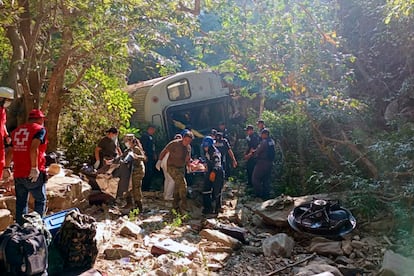

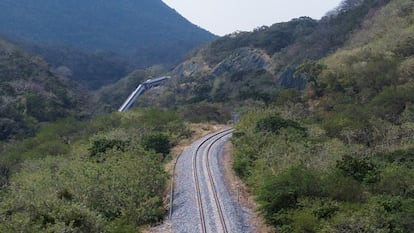
The memories of December 28 are like capsules in Katherine Vásquez’s mind. The 21-year-old is one of the survivors of Sunday’s derailment of the Interoceanic Train that runs through the Isthmus of Tehuantepec, near the town of Nizanda, Oaxaca. With 250 people on board, the second locomotive derailed and dragged the rest of the train with it. One of the four passenger cars plunged into a six-meter-deep ravine, and another was left partially suspended. The accident resulted in the deaths of 13 people and left approximately 100 injured, 36 of whom are still receiving medical attention, according to a statement from the Mexican Navy.
Vásquez, a psychology student, recalls boarding the train at the Ixtepec station at 9:00 a.m. Her destination was Chivela, the nearest stop where her father was waiting for her. From there, she planned to travel to the town of Motillas, where her grandparents live. During the trip, she was distracted, transferring data from her old cell phone to her new one. The last thing she remembers before the accident is the train attempting to turn a curve, but instead of continuing on its course, it lurched sideways. The car in which the young woman was traveling was the one that fell 6.5 meters, according to authorities.
It was Vásquez’s first time traveling by train. However, she remembers the hostesses commenting on the speed at which it was moving. “I heard them say they were scared because it was going so fast and it was even throwing the suitcases around. We were scared because of the speed on the curve. I felt it lurch and the weight shifted. It was a very sharp curve, almost a U-turn. I feel like it took it at a lot of speed. I couldn’t think straight. There wasn’t a jolt, it just went sideways,” she recounts over the phone.
The train consisted of two locomotives and four passenger cars. It was traveling on the Z line, which runs from Salina Cruz, Oaxaca, to Coatzacoalcos, Veracruz. The line is owned by the Mexican government and is part of the Interoceanic Corridor of the Isthmus of Tehuantepec project, which has been working since 2023 to revitalize rail services in southern Mexico. The rail route was opened for tourism and connects the Pacific Ocean to the Gulf of Mexico.
“People started screaming. I lost everything because my instinct was to throw my things away, and I got caught on the luggage rack. I remember, in flashes, that it spun around a lot. I don’t know exactly how many times. The next thing I clearly remember is that when I put my feet on the ground, someone fell on top of my leg, and my knee popped,” Vásquez adds.
The memories of the accident are still hazy. However, she recounts that when she recognized her backpack, she tried to pick it up, but someone was on top of it and told her not to lift it because she could hurt them. “It was very stressful. People were injured. I also remember someone saying to me, ‘Help me.’ I told them I couldn’t because their hands were all broken and I was afraid of hurting them more.”
There were about 10 people in the train car waiting for help. They were told they had to get out and climb up so they could be attended to when responders arrived. Vásquez doesn’t know how, but she managed to climb up and reach the tracks where the other two cars were left hanging. People from the surrounding area began to arrive. It was one of them and the first responders who immobilized her leg with some pieces of wood they found near the accident site. Her father caught up with her after learning that the train had derailed. He thought the car had just come loose. He never imagined it had fallen so far.
Sheinbaum promises aid for victims
Vásquez was taken to hospital and told they needed to take X-rays to see if her leg was fractured. They gave her a pain injection. However, she says they never showed her the X-rays or explained what was wrong with her. They only told her that her family would be visiting her and that she would be discharged because they needed the space for more serious cases. They prescribed ketorolac, a powerful anti-inflammatory drug for the short-term management of moderate to severe pain. When her mother went to get it, they told her it wasn’t available. Vásquez went home thinking she would be better on Tuesday, but she woke up unable to move her neck, with pain and swelling in her head, and severe pain in her legs and arms.
Her mother took her to a private doctor. They took more X-rays and told her she only had a bruised knee, but that she should wear a neck brace due to the damage the accident caused to her neck and cervical spine, and to prevent future complications. During her visits to the Tehuantepec Clinic Hospital, the IMSS Bienestar General Hospital, and General Zone Hospital No. 2, both in Salina Cruz, President Claudia Sheinbaum announced the distribution of 30,000 pesos ($1,670) in aid to the families of those affected to cover immediate transportation expenses. “Everyone is being attended to. It is immediate support, in addition, I repeat, to transportation costs and all the support the families may require,” Sheinbaum said in an interview with local media.
In its most recent report, the Ministry of the Interior has released the identities of the 13 people who died in the train accident. Among those killed are Israel Enrique Gallego Soto (60), Inés Alvarado (57), Bersaín Cruz López and his wife, María Concepción Barbosa Acevedo (both 65), María Antonia Rosales Mendoza (58), Amada Rasgada Lázaro (70), Patricia Medina Pérez (49), María Luisa Pasaron González (66), Raúl López Cruz (67), Rogelio Alfonso Luna Luna (63), Honoria Medina (56), and two minors, Luisa Camila Serrano Moreno (15) and Elena Solórzano Cruz (6).
On Monday, various news outlets in Oaxaca reported that Patricia Medina, sister of Honoria — one of the deceased — had also died in the accident. Her nieces have confirmed to this newspaper that she was transferred to Mexico City for treatment. The year is drawing to a close, but the uncertainty surrounding the condition of the victims and the causes of the Interoceanic Train accident is only just beginning.
Sign up for our weekly newsletter to get more English-language news coverage from EL PAÍS USA Edition









































