
The miracle of Ivory Coast’s Nero Mer
In a coastal village in the African country, the inhabitants banned the poaching of monkeys and transformed their coexistence with them into a lever for community development and ecotourism
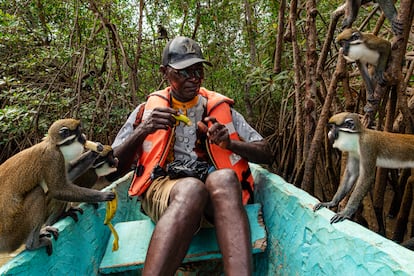
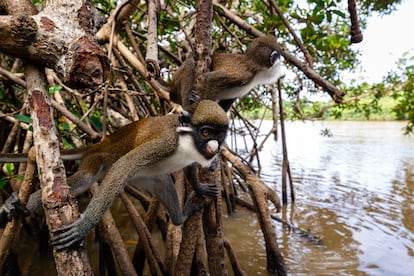
From a canoe, 58-year-old tour guide León Djirobo makes an ordinary gesture, which has an extraordinary effect. He arches his hand near the corner of his lip. This doesn’t produce words, but rather a sound similar to that of a wild cat. Almost instantly, the verdant mangroves of the Nero River are filled with small black and white spots. Milliardaire, the guide’s young assistant, stops paddling as about 20 monkeys respond to Djirobo’s call; a call known for generations. The species, commonly called the white-nosed monkey (Cercopithecus petaurista), confidently and securely approaches to eat bananas from the guide’s hand.
The Bas-Sassandra region, one of the most popular tourist destinations in Côte d’Ivoire or Ivory Coast, has fallen victim to the massive deforestation and alarming loss of biodiversity that the country has suffered since its independence in 1960. “There used to be chimpanzees, panthers, antelopes, and buffalo here, but now only monkeys remain. Now we only eat fish, crab, and crayfish,” says the guide. The traditional chiefs of the Nero Mer village, belonging to the Krou or Klayou ethnic group, located on the outskirts of the coastal city of Grand-Béreby, made an unprecedented decision in the 1990s: to prohibit poaching and the consumption of monkeys and dedicate themselves to preserving almost the only animal they had left.
It’s thanks to the monkeys that we can study at night, watch television, charge our cell phones at home, listen to music…León Djirobo, tour guide
Cocoa and cashew plantations, along with mining, are some of the factors that have led to the disappearance of 90% of the area’s forest cover, according to official data, resulting in a significant loss of habitat for many species. The inhabitants of this village of 500, who are also palm, cocoa, and rubber farmers, have created a self-managed, community-based tourism model that focuses on the conservation of these animals and on offering visitors a glimpse into their customs and way of life.
A community-based vision of sustainable tourism
New generations understand the importance of conservation and the potential that ecotourism can offer. For Nemlin Prince, 32, president of AGtour, an association of tour guides in Côte d’Ivoire created in 2020, this community-based approach is fundamental, both because of the lack of financial support from the government and the need to involve communities in protecting their own environment, which can in turn bring them economic benefits. “Our vision is based on three principles: tourism that preserves the environment, contributing to the local economy, and valuing the social aspects with local communities and cultures,” he explains.
For Djirobo, the development they have achieved as a community since that visionary decision 30 years ago has had a significant impact. Less than a decade ago, they were still lighting their homes with oil lamps, but everything changed when a visitor helped them get electricity installed in the village. “It’s thanks to the monkeys that we can study at night, watch television, charge our cell phones at home, listen to music… the monkeys have given us so much,” he says. “Thanks to the monkeys, our village is on the path to development: we already have electricity, and very soon we will have drinking water,” the guide affirms enthusiastically. It took six years to convince the villagers to stop eating monkeys, but the long-term benefits of that decision are already evident throughout the community.
Extending the cultural and generational shift that Nero Mer has achieved among its own residents is one of the fundamental challenges the association has set for itself in order to successfully conserve nature in other places. “We want to make communities understand that nature conservation is, above all, beneficial for them,” Prince states.
“Community initiatives are the only way to show people they can reap economic and tourism benefits,” agrees José María Gómez Peñate, a 57-year-old Spaniard. Peñate is the founder of Conservation des Espèces Marines (CEM), an NGO operating in Grand-Béreby, in the department of San Pedro, the only area in the country with a marine protected area. However, he says he has only been able to keep his project afloat with private funding since he began his turtle conservation journey 15 years ago.
For the founder, conservation only works if it generates economic benefits for the communities; conviction alone is not enough. “We operate because we can pay local people and because tourists come thanks to the turtles, but if we didn’t have that advantage, we wouldn’t have any room to maneuver in Côte d’Ivoire,” he states. On the other hand, while feeding wild animals is not an orthodox way to preserve them, the community social pact implemented by Nero Mer to eliminate poaching was designed with the vision of providing a tangible benefit for the communities— and that has led to a relationship of interdependence.
A ban that changed destiny
Through collaboration with local hotels, León Djirobo and the inhabitants of Nero Mer receive over a thousand tourists a year from all over the world. Using social media and hotel communications, Djirobo and other guides introduce tourists to the monkeys and then take them to the village, where they are welcomed with traditional customs by the village chiefs. There, they are offered kola nuts, chili peppers, and sugarcane liquor, greeted in the Krou language, and given a deeper understanding of the village’s culture and way of life. The visit costs 6,000 CFA francs per person (about $10), and a donation is requested for the village, which funds various community projects. “For example, we don’t have a health center or a school; the children have to cross the river to get to school,” explains Djirobo.
While 30 years ago the inhabitants of Nero Mer enjoyed monkey meat, today the coexistence between them is symbiotic
Furthermore, the activity also allows young people to train in tourism-related fields and enter the industry. Prince, for his part, is aware of the global climate challenges and his efforts seek to counteract these challenges by developing the tourism potential of his region. “Our goal is to conserve the environment through the local communities, and our biggest dream is to make Grand-Béreby the first ecological capital of Côte d’Ivoire.”
Today, Nero Mer is reaping the rewards of a historic decision, reflected in the dedication of its inhabitants. The absence of litter in the alleyways, the cleanliness of the village, and the care given to its trees and plants speak volumes about the respect the community has for its environment. While 30 years ago the inhabitants of Nero Mer enjoyed monkey meat, today the coexistence between them is symbiotic. By eating bananas from the hands of their former predators, the primates now provide them with sustenance and greater well-being.
Sign up for our weekly newsletter to get more English-language news coverage from EL PAÍS USA Edition









































