
At least 60 dead in mega-operation against organized crime in Rio de Janeiro
Authorities were targeting Comando Vermelho, which has become Brazil’s second most powerful criminal organization
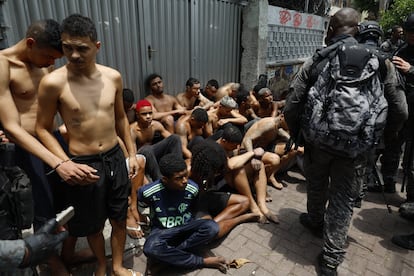

The Brazilian city of Rio de Janeiro witnessed a day of unprecedented chaos and heavy gunfire on Tuesday due to a police operation against organized crime — the deadliest in the city’s history. At least 60 people have died (including four officers), and around 80 have been arrested, reports the newspaper O Globo.
Authorities deployed around 2,500 police officers to two major favelas in Rio as part of a mega-operation aimed at curbing the expansion of Comando Vermelho, the second most powerful organized crime group in Brazil.
The governor of Rio de Janeiro state, Claudio Castro complained that “Rio is alone in this war,” criticized the lack of support from the federal government, and requested assistance from the Armed Forces.
Rio de Janeiro — a tourist hub, former capital, and home to six million people — is a city long accustomed to inequality and violence, but the scale of Tuesday’s operation is extraordinary even by local standards. The massive police deployment has been met with intense gunfire from Comando Vermelho members, who have even launched grenades from drones at officers. Hours later, the criminal group deployed its members across the city and metropolitan area, blocking avenues and streets with barricades.
Authorities have raised the alert level in Rio, and news coverage is filled with images of blocked streets with buses, burned cars, and dozens of shirtless men being detained by officers. Police have seized at least 75 rifles.
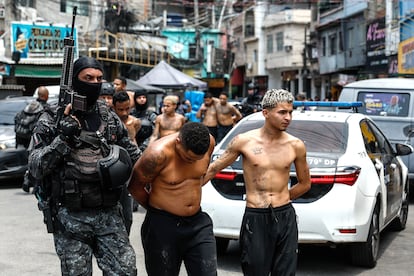
The main target of the police operation is Edgar “Doca” Alves de Andrade, the head of Comando Vermelho in a Rio favela called Complexo da Penha. Authorities, who have around a hundred arrest warrants, are also seeking dozens of his lieutenants.
Comando Vermelho is a criminal organization involved in drug trafficking and other illicit activities. Founded in 1979 in a Rio prison, it has expanded to other states in recent years. In Brazil, only the São Paulo-based Primeiro Comando da Capital (PCC) is larger, and it remains Comando Vermelho’s fiercest rival.
Early in the morning, authorities reported that shootouts between police and criminals forced the closure of 45 schools and the diversion of 12 bus routes. By the afternoon, Comando Vermelho had blocked traffic at at least 15 points in the city, including Avenida Brasil, one of Rio’s main thoroughfares.
To capture the leaders of the operation, the accountants who help launder their profits, and the foot soldiers who maintain absolute control over entire neighborhoods where they dictate the law, authorities mobilized a massive deployment. In addition to the 2,500 military and civil police officers involved, the operation included around 30 armored vehicles, two helicopters, police drones, and a dozen demolition vehicles.
Governor Castro — an ally of former president Jair Bolsonaro — complained that the Armed Forces had refused his requests for armored support three times. He called on the military for assistance, arguing that “this is a war that has nothing to do with urban security” but is fueled “by the weapons of international drug trafficking.”
Public Security Secretary Victor Santos said that the entire operation was planned and is being carried out with federal government support. Santos expressed regret for the chaos caused to residents and those injured, but stressed that this action “was necessary, was planned, was based on intelligence, and will continue.”
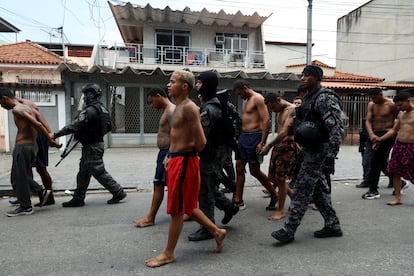
The target of the mega-operation is two massive favela complexes, home to nearly 300,000 people: the Complexo da Penha and the Complexo do Alemão. According to Rio’s prosecution office for combating criminal families, the first is a key hub of Comando Vermelho’s activities. A statement from the Special Group for Combating Organized Crime (Gaeco) describes the Complexo da Penha as “a strategic point for the flow of drugs and weapons, thanks to its proximity to several highways, and it has become one of the main bases of the criminal group’s expansionist project.”
One in four Brazilians — around 50 million people — live in neighborhoods dominated by organized crime, according to a recent study by the University of Cambridge. Comando Vermelho, PCC, and other armed groups impose their own laws on residents and sometimes block or hinder the actions of authorities. The communities most affected — often poor, Black, and living on the outskirts — are caught in the crossfire, neglected by authorities, exposed to stray bullets, and vulnerable to extortion.
Recently, criminals have discovered the benefits of remote management. A prosecutor from the Amazonian state of Rondonia explained to O Globo that Comando Vermelho leaders from other states — particularly those bordering other countries — have been relocating to Rio de Janeiro, which until this Tuesday was the group’s main stronghold.
“They realized the boss no longer needed to be in his home state. He could be protected in Rio and make decisions via video call,” said Anderson Batista de Oliveira, head of Gaeco in Rondonia. “The kingpin is in a place that is difficult for the police to access, and the organization thus protects its main assets,” he added.
Until now, the deadliest operation in Rio was in the Jacarezinho favela, in the city center, where 27 people were killed in 2021. Brazil’s police are considered among the most lethal in the world, with around 10% of violent deaths typically caused by officers. Both city and state police in Rio have long stood out nationally for their high rates of violent deaths. The growing use of body cameras has helped reduce fatalities in shootouts with criminals.
Sign up for our weekly newsletter to get more English-language news coverage from EL PAÍS USA Edition









































