
India announces steps to implement a citizenship law that excludes Muslims
Human rights watchdog Amnesty India in a statement called the law ‘discriminatory’ and said it ‘goes against the constitutional values of equality and international human rights law’
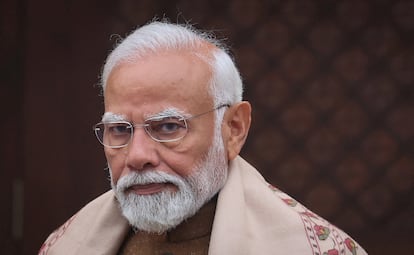
Prime Minister Narendra Modi’s government on Monday announced rules to implement a 2019 citizenship law that excludes Muslims, weeks before the Hindu nationalist leader seeks a third term in office.
The Citizenship Amendment Act provides a fast track to naturalization for Hindus, Parsis, Sikhs, Buddhists, Jains and Christians who fled to Hindu-majority India from Afghanistan, Bangladesh and Pakistan before Dec. 31, 2014. The law excludes Muslims, who are a majority in all three nations.
The law was approved by Indian Parliament in 2019, but Modi’s government had held off with its implementation after deadly protests broke out in capital New Delhi and elsewhere. Scores were killed during days of clashes.
The nationwide protests in 2019 drew people of all faiths who said the law undermines India’s foundation as a secular nation. Muslims were particularly worried that the government could use the law, combined with a proposed national register of citizens, to marginalize them.
The National Register of Citizens is part of Modi government’s effort to identify and weed out people it claims came to India illegally. The register has only been implemented in the northeastern state of Assam, and the ruling Bharatiya Janata Party has promised to roll out a similar citizenship verification program nationwide.
Modi’s government has defended the 2019 citizenship law as a humanitarian gesture. It argues that the law is meant only to extend citizenship to religious minorities fleeing persecution and would not be used against Indian citizens.
“These rules will now enable minorities persecuted on religious grounds in Pakistan, Bangladesh and Afghanistan to acquire citizenship in our nation,” Home Minister Amit Shah wrote on X, formerly Twitter.
India’s main opposition Congress party questioned the announcement, saying “the timing right before the elections is evidently designed to polarize the elections.”
Human rights watchdog Amnesty India in a statement called the law “discriminatory” and said it “goes against the constitutional values of equality and international human rights law.” It said the law “legitimizes discrimination based on religion” and is “exclusionary in its structure and intent.”
India is home to 200 million Muslims who make up a large minority group in the country of more than 1.4 billion people. They are scattered across almost every part of India and have been targeted in a series of attacks that have taken place Modi first assumed power in 2014.
Critics say Modi’s conspicuous silence over anti-Muslim violence has emboldened some of his most extreme supporters and enabled more hate speech against Muslims.
Modi has increasingly mixed religion with politics in a formula that has resonated deeply with India’s majority Hindu population. In January, he opened a Hindu temple at the site of a demolished mosque in northern Ayodhya city, fulfilling his party’s long-held Hindu nationalist pledge.
Most poll surveys suggest Modi will win a majority in a general election that is scheduled to be held by May.
Sign up for our weekly newsletter to get more English-language news coverage from EL PAÍS USA Edition









































