
Have sex toys taught women how to masturbate — or are they just doing the work for them?
Devices like the Satisfyer have helped to shatter taboos of female self-pleasure, but the same technology has kept others from exploring their bodies and the infinite paths to ecstasy
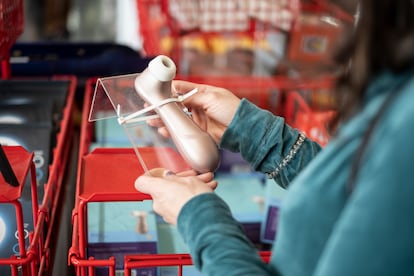

Erotic toys, particularly the Satisfyer, have redefined women’s concept of masturbation. The strangest part is that, despite being designed for the genital area, their area of greatest influence has been in their users’ minds. All of a sudden, touching oneself in the privacy of one’s room was no longer a stopgap when there was no better option; no longer a secret that you couldn’t share with even your best friend. Toys were no longer just a consolation prize, but rather, allies. They turned self-pleasure into joy, a shared delight, something to brag about, the perfect Christmas gift.
But we mustn’t believe that such rapid evolution is without its side effects. Female masturbation, though no longer taboo, is still the subject of much misinformation, requiring coexistence with other sexual relations, and body awareness. Toys have shaken off their dark and depressing reputation, but the technology of pleasure has prevented some women from exploring the infinite paths to ecstasy for themselves, directing them straight to the express lane. Machines do the job, but must it come at the expense of our skills?

Discovering the erogenous map
Masturbation is the first step for anyone who is looking to improve their sexuality, to get to know oneself in erotic terrain, and to explore the paths to pleasure. To share pleasure with others, one must first learn to access it on their own. Sonia Bedate, a Spanish physical therapist who specializes in the pelvic floor and sexology, says that masturbation is essential to focusing on the body-mind connection, so that the brain can discover and record the sensations that provoke stimulation to our genitals and erogenous areas. “It also increases pelvic blood flow and lubrication. Endorphins are released to ease pain, cortisol levels decrease due to that relaxation, and insomnia and sleep problems clear up. The pelvic floor is strengthened and kept in shape through sexual intercourse, whether alone or with a partner, and if orgasm is achieved, so much the better, as the contractions it produces are excellent for this part of the anatomy,” she says.
Self-pleasure is always among the tasks that Bedate assigns to her patients. She clarifies the pros and cons of sex toys: “Using toys is positive, but abusing them is another matter. Pelvic floor physiotherapists prefer vibration to suction, as the latter is a very powerful and direct stimulus. Getting used to this pattern, which produces a very quick orgasm, can be counterproductive and hinder other kinds of sexual relations in which the stimuli is not as strong.” She adds, “Furthermore, ideally, people should not only focus on their genital organs, but on any part of their bodies that, when stimulated, gives them a feeling of pleasure. That’s why we always advise women to map their erogenous zones and locate sensations in certain parts of their anatomy, which may be the hair, the face, the inner thighs, the crook of the elbow…”
The verbs of eroticism
Our bodies are the object of study of Sexocorporel, a sexological approach created by Jean-Yves Desjardins (1931-2011), which stems from a premise that everything that occurs in our physiology correlates to our emotions. Claude Roux-Deslandes is a doctor, sexologist, and disciple of Desjardins who lives in France, where she puts this school of thought into practice and shares its teachings. “Female masturbation has gone from being a taboo to something that a very precise machine does to us, with many speeds and kinds of vibration,” she says. “So it should come as no surprise that so many women are still unaware of the process of arousal. That is why we talk about the ‘verbs of eroticism’ and about how you can arrive at pleasure by many paths. But first comes the body, and not so much the mind, because arousal is something physiological and reflexive,” she adds.

Among the verbs that must be conjugated in order to come into contact with pleasure are, according to Roux-Deslandes, “to savor, because one must play with all the senses — not only pleasure, but hearing, feeling and sight.” In fact, science long ago disabused us of the idea that men are more visual than women when it comes to the process of arousal. As Molero points out, in 2019, “a study was done that demonstrated that erotic images equally activated [cis] male and female genitals. What was happening is that among men, there was greater consistency, while among women, physical arousal did not always correspond to mental arousal. In other words, although there were physiological changes, the female brain did not interpret them as sexual arousal.”
To breathe is another verb that Deslandes mentions. “The way you breathe affects how you feel and how your arousal circulates, but the key here is to exhale, to let go — and that would be the main verb. Especially for women who find it difficult to reach orgasm, because that’s what it’s all about, surrendering, losing control,” she says.
And if breathing is the movement of energy, the movement of the body is also important. “You just have to let yourself go,” repeats Bedate. “Pelvic blood flow is almost instinctual, and generally goes with the rhythm of our breath.” Another area to observe when one is on a date with oneself is the fact that, as Bedate says, “starting in a relaxed state, when the dominant nervous system is the parasympathetic, which is where arousal starts. If you are nervous or stressed, first, you have to relax.”
When it comes to problems involving a lack of desire, self-pleasure is the shortest road to recovery; though if there’s no spark, things are a bit more complicated. To break this vicious circle and enter into an erotic mood, there are other preliminaries to try, like erotic literature, porn, stimulating baths, massages, and anything else that can potentiate and awake the senses. “Generally, men are more connected to their need for pleasure,” says Molero. “Women stray from this path, especially as they get older and/or do not have a partner. Often, a woman who does not masturbate is someone who needs to have everything under control, a perfectionist who works towards her goals, requires results, and has a hard time letting go. But pleasure is not only a hedonistic function — it also give us the feeling of being alive, connected to our bodies, and in control,” she explains.
Sign up for our weekly newsletter to get more English-language news coverage from EL PAÍS USA Edition









































