
Trans migrants are adrift in Trump’s America
The president’s tax law, which was passed over the summer, cut funding for hormone treatments. This has led to medication shortages and long waits at clinics, causing uncertainty within the trans community

This past July, Evanna Vásquez arrived at the Betances Health Center, in Manhattan. She was hoping to pick up her monthly dose of estradiol, an estrogen steroid hormone.
Over a year ago, this Peruvian woman migrated to the United States and began her gender-affirming treatment in New York. Since then, this community clinic has been providing her with the medical care she needs. But during one visit over the summer, the doctor greeted her with shocking news: there were no supplies.
Concerned, she called Javier Tejada. He’s the social worker who has supported Vásquez since her arrival in the city back in 2023. Tejada managed to obtain the doses she needed, thanks to donations, but the uncertainty of not knowing if she will be able to access her monthly medication has become a constant. “Some months, they give me injectable estradiol. Other months, pills. Every time they get a donation, they contact me,” says Vásquez, 35. “The problem is that I need a double dose of estradiol, because my [estrogen] levels are very low. And that makes everything more difficult.”
Estradiol is the most important female sex hormone, and is primarily produced in the ovaries. In trans people, it plays a crucial role in gender-affirming hormone therapy, which is used to induce feminizing physical changes, such as breast development, redistribution of body fat, decreased body hair and reduced muscle mass. Low estrogen levels in transgender women can lead to a lack of development or reversal of female characteristics.
Since late-2024, trans rights activists in the United States have reported that the community is facing a shortage of gender-affirming medications, as well as long wait times for appointments at clinics that offer these services. This situation worsened in July following the passage of Donald Trump’s One Big Beautiful Bill Act. This legislation prohibited the use of federal funds to cover gender-affirming treatments and cut Medicaid, leaving people with humanitarian visas — like Vásquez, an asylum seeker — without medical coverage.
With the reduction in federal funding, people who have lost Medicaid coverage are turning to nonprofit clinics. Similarly, since undocumented immigrants lack access to preventive healthcare services through Medicaid, they’re also turning to these same clinics, because they offer low-cost or free options for people without a stable income.
This situation is overwhelming the clinics’ operational capacity and lengthening their wait times. And the impact on trans migrants is significant: approximately 174,000 of them live in the United States, many of whom came to the country fleeing transphobia, violence, or lack of healthcare in their countries of origin. In Latin America, conditions for trans people are so precarious that their life expectancy doesn’t exceed 35 years, according to the Inter-American Commission on Human Rights.
A wave of anti-trans laws
Trump’s tax reform bill is intended to reduce taxes and modify spending for various federal programs. However, it has been criticized for its ideological manipulation of the federal budget. And, in the healthcare sector, it prohibits the use of federal Medicaid funds for gender-affirming procedures, such as surgeries and hormone therapy.
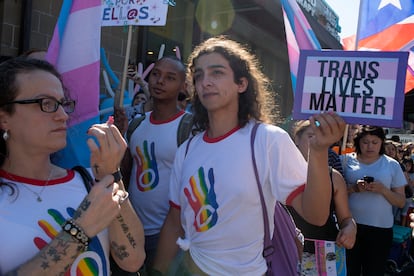
This legislation joins a growing list of federal and state laws that restrict the rights of trans people, including their sexual and reproductive rights. Earlier this year, the Trump administration cut funding to Planned Parenthood, the largest sexual and reproductive health organization in the U.S., which provides gender-affirming treatments, contraception and treatment for HIV and other sexually-transmitted diseases.
According to the American Civil Liberties Union (ACLU), 616 other anti-LGBTQ+ bills have been introduced in various states. And, in addition to legislative changes, the Justice Department has issued more than 20 subpoenas to investigate doctors and clinics that provide gender-affirming medical care to minors.
Because of all these attacks and the fear surrounding a second Trump administration, the demand for gender-affirming medication containing hormones such as estradiol, testosterone and spironolactone has been increasing. As far back as during the 2024 presidential campaign, Trump had announced that he would cut federal funding for gender-affirming treatment. As a result, many people decided to stock up in large quantities of medication. And now, not only is there still high demand for these medications, but clinics that offer these services are also becoming overwhelmed.
“We’re receiving referrals from women coming from other healthcare facilities, because of the shortage of doctors or other healthcare professionals due to budget cuts,” says Denise Gutiérrez, director of the Transgender Family Program at Community Healthcare Network. This New York-based organization is operating normally, because its funding doesn’t depend on the federal government. Rather, it receives municipal funds and grants from private entities.
When Lady Dariana Camas, a 35-year-old Ecuadorian trans woman living in the Bronx, arrived in the United States in 2022, she was already receiving gender-affirming hormone therapy. At the time, she didn’t feel pressured to undergo certain surgeries like facial feminization to affirm her gender.
However, with the return of Trump, she saw that her chances of accessing these kinds of surgeries were being limited. As a result, she decided to seek treatment as soon as possible. But when she went to her doctor in December 2024, he told her that the surgery she wanted wouldn’t be available until the following year.
“Now, with the budget cuts, I’m starting to feel like I have to get my face done quickly, before something happens and they tell me ‘no,’” Camas sighs. Like her, other trans people are trying to move up the surgeries they want, fearful that the cuts will make them unattainable in the near future. This is confirmed by Chance Krempasky, medical director of Community Healthcare Network.
Some activists and gender-affirming clinics are counting on local and state governments to guarantee the rights of trans people. States like Oregon, Connecticut and Vermont have passed laws that protect trans people who are seeking gender-affirming services. Meanwhile, cities like Boston and West Hollywood have declared themselves to be sanctuaries for trans people and the wider LGBTQ+ community.
New York has laws on the books that protect people who legally seek or provide gender-affirming services in the state. And the legislature in Albany recently passed a bill that seeks to strengthen legal protections, so that people who provide or receive reproductive or gender-affirming care are protected from civil or criminal liability outside of New York. This legislation is expected to be signed by Governor Kathy Hochul.
“Local public policies are the only way to survive,” says Mila Hellfyre Hernández, a Puerto Rican activist for the rights of transgender Latinas in the United States. She’s also vice president of the Equality Empowerment Center, a nonprofit organization that defends the rights of the LGBTQ+ community in Florida. “I’m talking at the city level, because in cities, the state is in control; not all the support has to [come from the federal government].”
The enactment of local or state policies to protect the transgender community has led 48% of trans people in the U.S. to migrate internally or consider relocating to other states with laws that safeguard their rights. This is according to a report that was published in May of 2025 by the Williams Institute, a public policy research center focused on issues related to sexual orientation and gender identity.
“Many transgender people are going to want to leave certain Republican states – [where they’re] under constant attack – and are going to want to come to states that welcome them,” Jesús N. Soto explains, from the National Alliance on Mental Illness. “So, even though [a state’s budget may be sufficient for now], they’ll need more [money] in the future.” This means that the ability of local or state governments to protect access to gender-affirming services may be affected by demographic changes.
Concern and fear
Evanna Vásquez has had to migrate twice. In 2017, she left Peru, after her family began harassing her for expressing her gender identity. She chose to go to Panama, where she worked for a long time as a stylist. It was there that she met her current husband. But with the Covid pandemic, her salon closed. When the lockdown eased, she tried to find work again, but she couldn’t. Feeling desperate, she decided to go to the United States.
Migrating a second time meant leaving everything behind again: selling all her belongings, hugging her friends and saying goodbye to Sirius, Jade and Nagini (her two cats and her dog). The journey was difficult; they were robbed, lost their identity documents and, on multiple occasions in Mexico, Vásquez suffered sexual abuse. But there was no time to process the pain.
The United States presented itself as a place where laws existed that would allow Vásquez to change her name, access the healthcare she needed and finally marry her partner.
“I come from a country where everything [was] taken from us, only to have it taken away [again] in a country where we have even more laws designed to protect us,” she laments. “My community really needs the government’s support.”
The federal healthcare budget for 2024 was $1.9 trillion, during the Democratic administration of President Joe Biden. That funding was projected to increase by 5.8% in 2025. However, with the passage of Trump’s tax reform bill, the government cut it by 15%, according to an analysis by the School of Public Health at the University of California, Berkeley.
Meanwhile, other departments, such as the Department of Defense, Veterans Affairs and Homeland Security (DHS) — the latter being responsible for the president’s immigration policy — are projected to receive increased funding. The DHS budget, for example, is set to increase by 65% next year.
Another consequence of the lack of access to gender-affirming services and the rise in anti-trans laws is that the suicide rate among members of this community may increase. “For our community, access to gender-affirming services is seen as a fundamental suicide-prevention measure,” William Lopera warns. He’s a representative of Voces Latinas, an organization dedicated to reducing the HIV transmission rate among migrant communities.
Trump’s tax law “has generated great uncertainty and stress, leading clients to feel hopeless and to expedite surgeries and [update their ID cards], for fear of losing access [to these procedures in the future]. This has had a direct effect on the mental health of the community,” Lopera adds.
For Vásquez, not being able to access her medication regularly is a major concern. It reminds her of other periods in her life when she hasn’t been able to take estradiol continuously: those were times of abrupt hormonal changes, headaches, depression and gender dysphoria. For now, she approaches the 16th of each month with both hope and worry, trying to overcome the fear of not being able to receive her medication.
Sign up for our weekly newsletter to get more English-language news coverage from EL PAÍS USA Edition









































