
Thousands take to streets in protests against government labor reforms
Unions cite figures as high as 500,000 in Madrid and Barcelona Demonstrations a "warning" that a general strike could be next “We don’t want confrontation, we just want correction,” says UGT leader
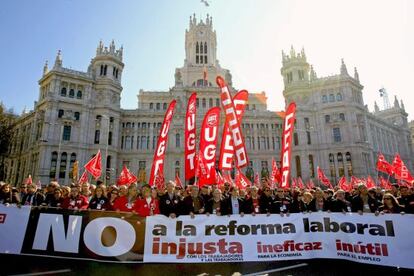
The conservative government of Mariano Rajoy had its first taste of widespread social unrest on Sunday when hundreds of thousands of citizens took to the streets of major cities to protest far-reaching labor reforms.
Although official figures were not available by mid-afternoon, unions claimed that half a million protesters came out in Madrid, 450,000 in Barcelona, 80,000 in Valencia, 35,000 in Alicante and 70,000 in Zaragoza, with thousands more backing the rest of the 57 nationwide demonstrations. The police offered more conservative figures, while the government claimed that only 30,000 protesters had come out in Barcelona.
The labor unions CC OO and UGT described the marches as a show of force to protest the liberalization of the job market, which will mean that it is cheaper and easier for companies to fire workers.
Under the new system, firms can lay off workers with a payout of 20 days for each year worked if employers can demonstrate actual or forecast losses, or show that they have had nine consecutive months of falling sales. In these so-called “express firings,” unions and employers will no longer have to come together to negotiate the conditions of the layoffs.
Sunday’s display, said the unions, was a warning to the Popular Party (PP) that a general strike could be next unless it reconsiders.
“If the government does not rectify, we will increase the action,” said the youth section representatives of CC OO and UGT. But although many cries of “general strike” were heard among the crowd in Madrid, UGT leader Cándido Méndez stopped short of announcing such a plan. “We don’t want confrontation, we just want correction,” he said.
Rajoy had already anticipated trouble ahead of announcing his plans: at a meeting in Brussels, he was overheard telling another European leader that his reforms would cost him a general strike back home.
Spain’s jobless rate climbed to 22.85 percent at the end of last year as the economy shrank again, with some 5.3 million people out of work.









































