Street signs that reflect reality
A series of fake place names created by an artist have been left untouched
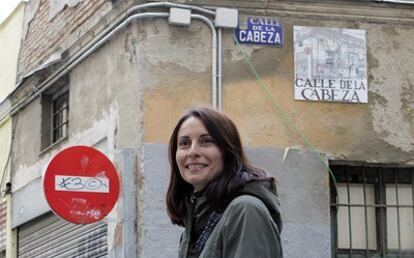
If you took a quick glance at the sign in Cabeza street you would be forgiven for not realizing that it is unofficial. It is made with the same tile and the same font as the other place names that are so prevalent in the old part of Madrid. But this one is different. Instead of the usual illustration, usually alluding to the history of the street in question, there is an image that reflects a regular Lavapiés street, with a rundown building facade, cables hanging loose, damp patches and a STOP sign covered with stickers advertising rooms to rent for 200 euros. In fact, it's a drawing of the very street corner where the sign is located.
"I wanted to reflect the reality using a very common element as a way of drawing attention to the actual state of the neighborhood," explains Diana Larrea, who is behind this urban intervention. "But they are very well disguised, and not a lot of people even notice them."
"The original signs are fine, but they show an idyllic Madrid," says Larrea
The project is called Calles distinguidas (Distinguished streets, www.dianalarrea.com), and won a competition run by the Associated Visual Artists of Madrid (AVAM), which received sponsorship from the regional government.
But interestingly, the project was initially supposed to brief, with the signs designed to stay there as long as the graffiti Larrea also added would - or at least for the duration of the Noche en Blanco cultural night, which is when they were put in place. But they have remained there for six months, having hardly been touched in that time.
"Council workers have painted over the graffiti with grey paint, but they've left my work alone," the artist explains. "I think they have assumed that they are something to do with the council."
The original sign on Cabeza street, which is a few meters below, features a dagger along with the head of a man placed on a plate. The illustration is a reference to a legend from the 17th century, which tells of a servant who cut off the head of the priest he was serving.
"The original signs are fine, but they show an idyllic Madrid, a historical quarter that is made to look like a kind of Disneyland for tourists," Larrea explains.
She put up five of the signs in broad daylight, using a stepladder and a drill, and without official permission. "We were so bold when we did it that the police passed by several times but didn't say anything," the artist says.
On Sombrerete street she drew a sub-Saharan peering round the corner. "A friend saw it and said, 'Isn't the council modern, to have put immigrants on the signs!'" But on Rodas street, the sign has gone, as well as the building that she had drawn, which was the feminist squat Eskalera Karakola. It was demolished last week, according to the owner of the bar next door, who hadn't even noticed the discrete invader.
"People only use the streets to get from A to B," says Larrea, who has a theory as to why no one has taken down the signs after so many months. "It's because they are in Lavapiés," she says. "That's the good and the bad thing about this neighborhood: the chaos in public places. If they were on the up-market Serrano street, they wouldn't have lasted so long."