
The animals condemned to live behind bars
Brussels promised to end the practice of caging livestock five years ago, but the law is still pending and millions of hens and pigs remain in confinement
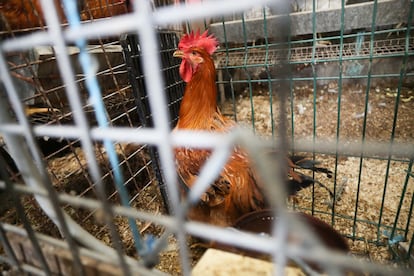
To be born, grow and die hardly able to move; battery hens that can’t open their wings, rabbits that never step on grass, and breeding sows immobilized for weeks on slats. That is the reality for 300 million animals in Europe. In 2021, Brussels promised to put an end to animal confinement with a law to progressively eliminate cages in livestock farming. The Commission was responding to the demands of more than 1.4 million citizens who supported the End the Cage Age initiative. Five years later, that promise is a dead letter.
Brussels promised years ago to legislate against this situation, but progress remains blocked. “To date, no bill has been presented nor has any binding timescale been established,” says Javier Moreno, co-founder of the Animal Equality Foundation. “Nor has a specific financing plan been announced at the European level. Years of promised reforms have only given rise to rhetorical statements,” he says. Waiting for a change in the law that has failed to materialize led the associations to have a hearing with the courts in March. Now, the EU’s Court of Justice will rule in the coming months on the Commission’s failure to take action.
The truth is that steps have already been taken. Years ago, the EU approved a directive for minimum protection standards for laying hens, which meant the end of battery cages in 2012. However, that measure did not end animal confinement. So-called conditioned or enriched cages are still allowed – somewhat larger structures that incorporate nests or areas for digging and pecking. There is also no blanket ban on other species, such as calves. If Brussels recognized that part of this caging model had to disappear, why does it still not ban all cages?
The reason, to a large extent, is economic. “Eliminating cages has a cost and, for the moment, nation states have not offered farmers sufficient funds to support them towards confinement-free systems, which is incomprehensible,” say Marisú Ocaranza and Annamaria Pisapia, spokespeople for Compassion in World Farming. However, the experts believe that the problem is not only the investment, but also how the budget is allocated. “They offer funds in abundance to maintain an obsolete system that is frowned upon by citizens who are increasingly demanding products from farms that do not use cages,” they add.
The transitional cost
Many farmers are afraid to make investments that won’t pay off. However, animal rights activists maintain that change is possible. “Countries such as Germany and Denmark have shown that the transition is totally viable,” says Aïda Gascón, director of AnimaNaturalis. “Spain is adopting a position of resistance in both political and business spheres, shielding itself behind the enormous weight of the sector to push back the deadlines for as long as possible.” Gascón adds that the time is right now for change “as long as the government provides aid for the conversion to a cage-free system, especially for small and medium-sized farmers.”
Animal rights activists are also demanding that imported products derived from confined animals be limited. “It is essential to safeguard local production, avoiding the import of foreign products that do not comply with European requirements,” Gascón adds. She believes that the delay in banning cages in Spain has given the country an economic advantage, but at the cost of lagging behind in terms of ethics and quality.
The market is not pushing for change either. In some sectors, such as poultry, many producers do not see an urgent need to alter their business model because it is still profitable. “With a demand that cannot be covered by supply (for example, eggs) and higher prices at source, the producer does not feel the need to make the change,” explains Alberto Díez, director of the National Association for the Defense of Animals (ANDA). But, he adds, “livestock structures must evolve – not facing change will mean becoming obsolete.”
Time for action
Spain occupies an uncomfortable place in this picture. “More than 86 million animals are still living in cages. We have the highest number of animals raised in confinement in Europe,” says María González, lawyer and member of the animal rights organization Intercids. Blanca Ponce, manager of institutional relations at the Animal Welfare Observatory, adds: “Can anyone imagine their breastfeeding children being taken away from them to start the reproductive process over and over again? Behind the figures are actual beings capable of feeling pain, fear and stress,” she explains. “Basically, lives that feel, love and suffer, relegated to the role of simple cogs in an immense food machine.”
The associations also criticize the fact that Europe has chosen to leave the decision on banning cages in the hands of the member states. “The Commission formally made a commitment to propose legislation and put an end to the use of cages in livestock farming,” say Marisú Ocaranza and Annamaria Pisapia. María González adds, “What we are asking for – and we trust that this will be done – is that the Commission complies with this commitment as soon as possible.”
Labels to avoid misleading consumers
A ban on cages does not in itself guarantee a profound transformation of the livestock model. The National Association for the Defense of Animals (ANDA) fears that some companies will take advantage of the ban to improve their image without introducing real changes. “The only way to avoid this is by establishing sustainability labelling that allows consumers to differentiate between industrial and non-intensive production,” says its director, Alberto Díez. “Everyone has the right to be in the market, but each one in his place.”









































