
Ronald Lauder, the wealthy heir who gave Trump the idea to buy Greenland
According to various accounts, it was Estée Lauder’s son who first planted the idea in the US president’s head
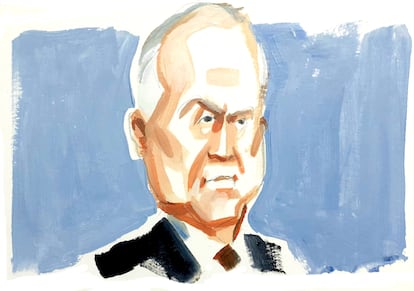

If you reread the news stories from 2022 that recounted how Donald Trump had the idea of buying Greenland, you realize how deliriously the world has changed. At the time, the notion, suggested by businessman Ronald S. Lauder (New York, 81), was nothing more than a crazy fantasy to many. But those were different times.
The story was recounted by John Bolton, then-National Security Advisor, to The Guardian newspaper in 2018. According to his account, during his first term, the U.S. president called him to discuss a new idea: a prominent businessman had just suggested buying Greenland.
That friend, Bolton learned, was Lauder, heir to the global cosmetics empire Estée Lauder Companies, a philanthropist, art collector, and friend of Trump’s for decades. Apparently, the two spent a long time discussing the proposal, and the Republican left the conversation fully persuaded.
According to Bolton, this is, broadly speaking, Trump’s modus operandi: he assumes much of the information he hears from those close to him to be true and rarely revises his positions. The idea of Greenland absorbed the National Security Council staff for months. Eight years later, Trump is not only thinking of buying the island, but even of seizing it by force.
According to The Guardian, as Trump has intensified his threats over the vast mass of frozen territory, Lauder has acquired commercial interests in the area. It is worth reading the article the businessman published about a year ago in The New York Post, in which he declares himself an “expert on Greenland” and outlines the three paths that, in his view, could make the island the next frontier for the United States.
Lauder recounts how this idea, when first proposed in 2020, was met with “almost universal derision,” and how — once again — the critics were wrong. Critics and “narrow-minded thinking,” he wrote. He argues that beneath the territory’s rocky soil lies a treasure trove of rare earth elements essential to artificial intelligence, weaponry, and modern technology; that Greenland is already an epicenter of competition between major powers; and that it offers a strategic position that has yet to be forged.
Lauder is the son of legendary cosmetics entrepreneur Estée Lauder and Joseph Lauder, co-founders of Estée Lauder Companies in 1946. He grew up immersed in the family business and, following the death of his older brother Leonard last year, inherited control of the empire, although he does not serve as CEO. According to Forbes, his personal fortune is estimated at around $5 billion.
Lauder attended the prestigious Bronx High School of Science in New York. He then studied business at the Wharton School of the University of Pennsylvania. He completed his education at the University of Paris and also obtained a certificate in international business from the University of Brussels. In 1967, he married Jo Carole Knopf, with whom he had two daughters, both of whom are involved in the beauty industry: one as a designer and the other in various executive positions within the family group.
Ronald Lauder joined the company at the age of 20, initially heading up the international expansion division. Over the decades, he held various positions of responsibility and, in the 1980s, was appointed president of Clinique Laboratories, the division specializing in the Clinique brand. After more than half a century with the company, Lauder announced his retirement from the board of directors last year. However, he remains connected to the group as chairman of Clinique Laboratories and retains considerable influence in corporate governance, including the right to appoint two members of the board of directors.
Lauder, who is Jewish, has been a prominent donor and influential figure within the Republican Party for decades. In 1989, he ran unsuccessfully for mayor of New York City. He has consistently defended pro-Israel positions and has maintained a close personal relationship with Benjamin Netanyahu for many years.
In 2020, more than 100 company employees went so far as to call for Lauder’s dismissal in a letter addressed to the group’s president, his nephew William P. Lauder. The signatories demanded his removal from the governing body because of his political donations and the negative impact they believed he had on race relations within the company, given his views.
Since 2016, Lauder has donated more than $1.6 million to pro-Trump organizations. In 2018, amid growing questions about the president’s suitability, he publicly described him as a man of “incredible insight and intelligence.”
His public career includes intense diplomatic activity during the Cold War. In 1983, Ronald Reagan appointed him Deputy Assistant Secretary of Defense for European and NATO Affairs, a position from which he participated in the formulation of strategic policies in the final stages of the East-West confrontation. He was then appointed ambassador to Austria. In 1998, Netanyahu appointed him special envoy in secret peace negotiations with Syria, a key role in regional mediation efforts at the time.
Since 2017, Lauder has chaired the World Jewish Congress, a federation of Jewish communities in more than 100 countries. In this capacity, he has invested considerable political and philanthropic capital in Eastern Europe to rebuild Jewish life after the fall of the Iron Curtain. His philanthropic commitment was formalized in 1987 with the creation of the Ronald S. Lauder Foundation. He also founded an association dedicated to the fight against Alzheimer’s disease.
A first-rate art collector, he was a member of the board of trustees of the Metropolitan Museum of Art and in 2001 founded the Neue Galerie New York, with emblematic works by Klimt and Schiele. His collection also includes one of the largest private series of European armor, of which he donated 99 pieces to the Metropolitan in 2020.
Lauder has managed to turn an exceptional inheritance into a career marked by diversification of interests and power. It remains to be seen whether, among all these facets, a conversation with one of his friends will ultimately prove to be the most decisive factor in the story.
Sign up for our weekly newsletter to get more English-language news coverage from EL PAÍS USA Edition









































