
The digitalization of tourism: ‘They promise experiences and gave us the worst possible one’
The incorporation of machines into services that were previously provided by humans improves efficiency, but risks ruining the holiday
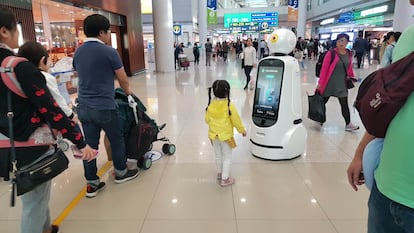

Tourism is doing what banks did some years ago: the sector is embarking on the digitization of all possible services to lower costs, reduce human errors, streamline and extend operations and make decisions based on data. But several studies show that the dehumanization of customer service can lead to undesired consequences. These may include the inability to be specific regarding the holiday offer, the depersonalization of care and human resources, and the ineffective response to incidents.
Brana Jianu, a researcher at Surrey University, UK, and author of a study published in Science Direct, says that “digital management is transforming the way hotels operate, from scheduling shifts to assigning tasks, with algorithms making decisions that were previously reserved for human managers.” This change, which she describes as “seismic,” questions “not only the future of frontline management, but also the general employee experience within hotels. As these systems take root, the risk of dehumanization and alienation among workers increases, creating a pressing need for effective solutions.”
According to Jianu, this massive shift in tourism forces managers to become coaches rather than controllers. “This transformation is not just about embracing technology; it should also be about humanizing the workplace and ensuring that staff remain at the center of activity.”
Xabi Zabala, chief operating officer of the tourism technology firm HBX Group, agrees that the digitalization of services should free up employees and not displace them. “By automating repetitive or administrative tasks, we free up time for teams to focus on offering closer and more personalized attention, making human contact an increasingly important and differential factor,” he says.
This was not the experience of Manuel Fidalgo, a bank employee who traveled to Manchester with the world’s most famous accommodation platform. He warned his accommodation in advance of the flight time, which was in the early hours of the morning and requested a human to speak to. He did not get a response and, when he arrived in Manchester with his wife and three children, the address to pick up the key was wrong, and the surrounding premises were closed. “We had to look for rooms in a hotel. The next morning, neither the owner responded nor the company. The promised experience was the worst possible one. I have never used them again, I unsubscribed and just hearing the name of the app makes me anxious.”
But digitalization advances apace. It seems unstoppable, no matter what the public thinks. Now new AI agents promise to be able to manage a person’s entire trip, from tickets to accommodation and activity options. Professor Anna Mattila, co-author of research from Penn State University, admits that “robots can be designed or programmed to have human-like characteristics, such as names, voices and body shapes,” but the study detected misgivings in customers and gaps in the results offered, particularly associated with the gender of the robotic voice.
However, Xabi Zabala has detected that the biggest problem regarding companies replacing humans with digital tools is generational. “New generations are more likely to have a positive experience,” he says. The HBX Group executive has detected differences in receptivity depending on the type of voice, rather than the gender of the voice. “Some voices generate a higher level of trust and result in a more satisfying experience for users, but this happens with both male and female voices,” he explains.
He also says that the programming of the services can show different types of biases. “That’s why, when we implement this type of technology, we apply strict criteria for monitoring and validating the messages shared with users,” he says.
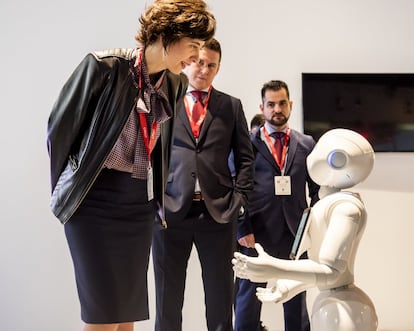
Despite the bad experiences, digitalization is being adopted by all and sundry. As Kiyoshi Kiyokawa, from the Nara Institute of Science and Technology (NAIST) says: “Our goal is to develop what we call personalized reality: systems capable of creating dynamic experiences adapted to each individual.”
In collaboration with the technology company NTT Docomo, Kiyokawa is researching how to combine the virtual and real for the best experience and ensure complete user immersion. The technology is designed for a range of sectors, but in the tourism sector it aims to offer travelers a virtual experience to destinations around the world.
Zabala accepts the enormous potential of augmented reality and immersive technologies as “tools for inspiration and promotion of destinations to make it easier for the traveler to choose specific hotels or rooms before confirming the reservation. “But rather than replace, they will promote the physical experience of travel in most cases,” he says.
Zabala insists that this type of technology opens up an interesting dimension: the democratization of travel. “Not everyone can physically visit all the places they would like and these types of tools will allow them to virtually explore spaces that would otherwise be out of reach. It is a new form of tourism that is not yet fully developed, but it is very promising,” he says.
Zabala adds that “from our point of view, just as in recent decades television, the internet or social networks have helped to promote destinations and have encouraged physical travel, virtual reality will be a new way of getting to know destinations before being able to go in person.”
Sign up for our weekly newsletter to get more English-language news coverage from EL PAÍS USA Edition









































