
Tech’s AI debt surge cools market fever
Oracle is the most indebted, and analysts warn that it is at risk of a credit rating downgrade. The five largest firms will issue $1.5 trillion in debt over five years


The revolution of so-called hyperscalers is reaching ever more colossal proportions. Tech companies’ gamble on artificial intelligence is measured in hundreds of billions of dollars — investments that until recently came exclusively from astronomical, yet finite, profits. The sector still needs more data centers, and to finance them, it has begun turning to the debt markets, raising investors’ concerns and cooling the market’s previously warm embrace of technology.
Oracle, the most indebted of the major players and one that has pinned its future on contracts with OpenAI, is at the center of these doubts: its shares have fallen 33% from their September peak. Its debt is taking a hit as well, trading below par, while credit default swaps on its bonds — a measure of financial risk — have risen to levels unseen in three years, dragging along those of other companies with high AI exposure and weaker credit histories.
The market is anticipating a debt glut and has gone on alert; financing investments with borrowed money is very different from paying for them out of multimillion-dollar profits. According to J.P. Morgan’s estimates, building the global infrastructure of data centers and AI, along with the necessary energy supplies, will cost more than $5 trillion by 2030. Of that total, only $1.5 trillion will come from companies’ organic cash flow; the remainder will require major tech firms to turn to the capital markets. “It will be an extraordinary and sustained capital markets event,” the bank concludes.
The bank estimates that over the next five years, the major tech companies exposed to AI — Alphabet, Amazon, Microsoft, Meta, and Oracle — will need to issue $1.5 trillion in bonds, with $300 billion expected just in 2026, more than half of what the U.S. Treasury issues. “If anything like our forecast plays out, AI/Data Center related sectors could represent north of 20% of the market by 2030,” the report notes.
For now, just between September and October, tech giants have raised $75 billion in investment-grade bonds, and they are expected to close the year issuing more than $200 billion in debt, through both private placements (to venture capital funds with less transparency) and public markets. All of this is aimed at funding $380 billion in investments to build AI-related infrastructure.
So far, Oracle and Meta have shown the greatest capacity to finance their AI strategies, followed by Alphabet (despite Google’s parent company holding $100 billion in cash). Alphabet kicked things off in May with an $11 billion issuance, and Oracle followed in September with a record-demand $15 billion issuance. In October, Meta raised $30 billion in bonds and another $27 billion through private market deals to fund a data center in Louisiana, U.S. This was done via a special-purpose vehicle (SPV), allowing a company to finance a specific project without the debt appearing on its balance sheet.
This surge has prompted UBS to express “concerns over concentration risk,” as the issuances are concentrated in a handful of companies: Meta, Oracle, Alphabet, Broadcom, and Dell. The spreads on some of these bonds are already widening. Banks are deploying a range of exotic financial instruments in response, including data center-backed mortgage bonds and ABS (asset-backed securities). Bank of America estimates that next year, the market for data center securitizations could reach $110 billion.
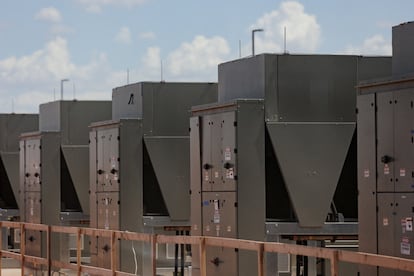
Rising investments and questions about profitability
Meta founder Mark Zuckerberg revealed that the company will invest around $600 billion in AI-related infrastructure in the U.S. alone; just in 2025, it plans to spend $71 billion, a figure it expects to nearly double by 2027. For now, it has some leeway: it anticipates increasing its debt fourteenfold over this period (from $4 billion to $59 billion). However, this will come at the expense of its share buyback programs — which will drop from $35 billion to $5 billion — and will cut free cash flow by more than half.
Oracle’s AI gamble — driven by its agreement with OpenAI — has made it, in just a few quarters, the most indebted investment-grade tech company and the only one with negative cash flow. While J.P. Morgan notes that its debt maturities are manageable, it warns about rising interest rates and large future investment commitments.
Revenue pressure adds to the risk: by 2028, one-third of its income will come from a single client, OpenAI. This scenario has led Barclays to predict that rating agencies may downgrade Oracle to BBB– (S&P and Moody’s have already placed it on negative outlook), just above junk status, and that the company may need to turn to private debt markets — which are less transparent and more expensive. The British bank even recommends buying credit default swaps (CDS) on Oracle, a signal that has already pushed its CDS higher. Bondholders have recorded losses of up to 7% in just over six weeks.
This instability is also affecting other tech companies exposed to AI but with weaker credit histories, though not the major hyperscalers, which remain largely insulated. Coreweave, which is backed by Nvidia and holds significant contracts with Meta, saw its stock plunge 30% in a week, while five-year CDS on its bonds rose 13% in the same period.
J.P. Morgan also questions whether these massive investments will generate real profitability. According to the report, achieving a 10% return on all the required investment over the next five years would require the major tech companies to generate $650 billion in annual revenue in perpetuity. “An enormous amount,” the report notes — equivalent to $180 per month from every Netflix subscriber or $34.72 from every current iPhone owner. “Even if everything works, there will be (continued) spectacular winners, and probably some equally spectacular losers,” it adds.
Adding to the concerns about profitability is the potential systemic impact of AI on the market. The Bank of England recently noted that while the sector’s systemic impact has so far been limited — concentrated mainly in stock market gains — the high financing needs of these companies could affect both the debt market and commodity markets, particularly copper, which is heavily consumed in data center and AI infrastructure.
Sign up for our weekly newsletter to get more English-language news coverage from EL PAÍS USA Edition









































