
Mexico faces new trade front as tariffs spark tensions with China
The Mexican government has aligned itself with US interests, even though the Asian country is its second-largest supplier of goods and raw materials
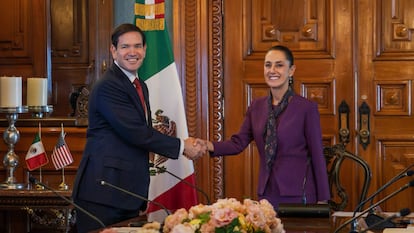

Mexico has decided not to shake up its trade status quo and maintain an economic strategy aligned with U.S. interests, while also scoring points with domestic industry. Negotiations the government held to build a plant for BYD, China’s leading electric car manufacturer, had raised speculation of a potential strategic rapprochement between the two countries — despite the warnings from U.S. President Donald Trump. But tariffs on a significant slice of imports from Asia have undermined those ambitions.
Last week, Mexican President Claudia Sheinbaum’s economic team outlined the contents of a draft decree that would impose nearly 1,500 new tariff categories of up to 50% on imports, with special emphasis on cars, auto parts, motorcycles, footwear, glass, steel, and cardboard from China — Mexico’s second-largest supplier of goods and raw materials. As of July 2025, China had sold about $11.58 billion in goods to Mexico, a figure surpassed only by the United States, which exported nearly double that amount at $21.45 billion, according to Mexico’s central bank (Banxico).
The proposal is a cornerstone of next year’s revenue budget and reflects the financial priorities of Sheinbaum, who, while seeking to defend regulatory and territorial autonomy, is also inclined to maintain Mexico’s healthy relationship with the U.S. — a relationship forged through at least three decades of free trade negotiations. At the same time, the government is trying to respond to steadily declining domestic manufacturing figures.
Óscar Ocampo, director of Economic Development at the Mexican Institute for Competitiveness (IMCO), noted that although the measure is presented as a revenue tool, it should also be seen in the context of Mexico’s upcoming talks with the United States and Canada to renew the USMCA trade agreement.
“It’s written in Trumpian style,” he says. “If you swapped the country name, it could be a White House document. And that’s fine, but today Mexico is complaining that the U.S. is closing market access, and it is doing exactly the same to trade partners with which it has no free trade agreement. Now Mexico is still respecting the World Trade Organization, and that’s no trivial distinction, even if the approach resembles the White House’s.”
The tariff plan could still be changed by Mexico’s Congress, which must debate and approve it before it becomes law. While Morena, the ruling party with a legislative majority, has shown it is not entirely monolithic, the budget is expected to pass without major changes.
In the meantime, China has urged restraint, emphasizing that the two countries share a fruitful relationship. Sheinbaum signaled openness to “sensible conversation” and stressed that China would not be the only country affected, noting that South Korea had also reached out to Mexico’s Foreign Ministry. The measure is broad, covering products across 19 sectors from China, South Korea, India, Indonesia, Russia, and Thailand. It would raise the average tariff rate from the current 16.1% to 33.8%, generating an additional 40 billion pesos ($2.2 billion) in 2026.
“It’s true that Mexico has free trade agreements with most of its major partners — the one mayor exception being China. But the $13 billion in imports from South Korea last year is not trivial. Nor are the $10 billion from India. The cost is rising for many countries,” Ocampo added.
Rising protectionism
The impact of the policy will depend on the final decree. However, China — positioned as one of the world’s most open economies and its leading exporter — is unlikely to suffer significant losses. Mexico’s sales to China carry more relative weight, though imports still far outstrip exports. Last year, Mexico’s top export to China was copper and concentrates worth $2.31 billion, mainly from Sonora. Its biggest import from China in 2024 was cell phones, totaling $9.44 billion. Direct Chinese investment in Mexico remains limited; in 2024, it amounted to just $710 million.
At the same time, Mexico’s manufacturing strength — a pillar of its economy — is showing weakness. Industrial activity fell 1.2% month-over-month in July 2025, according to the national statistics agency (Inegi), while manufacturing contracted 1.8% year-on-year.
These figures, along with underutilized installed capacity, are feeding into the government’s official narrative. “China doesn’t have much room for retaliation. Mexico exports virtually nothing to China. We have a trade deficit of 17 to 1,” explains Jorge Guajardo, Mexico’s ambassador to China from 2005 to 2013.
“I don’t think this is due to pressure from the United States,” adds Guajardo, who is a partner at DGA Group. “It’s just about defending Mexico’s industry and jobs, which had no way to compete with subsidized, low-cost Chinese imports. It just happens to align with U.S. interests. And that’s a good thing, because if it helps in the USMCA negotiations, it shows Mexico and the U.S. have aligned interests on issues related to China — and that makes for a solid trade alliance."
The expert — who even recommended a 100% tariff to effectively block car imports from China — also notes that the free trade agreement with Vietnam still needs revisiting, since many Chinese imports enter through that country. “That chapter remains open for a future date.”
Sign up for our weekly newsletter to get more English-language news coverage from EL PAÍS USA Edition









































