
Molly Roden Winter, the writer who shared her polyamorous experience: ‘If your options are divorce or open marriage, get divorced and save yourself some time’
In her bestseller ‘More: A Memoir of Open Marriage,’ the American author bares her soul
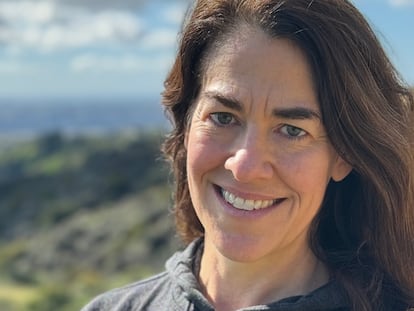

In 2008, after eight years together, Molly Roden Winter proposed to her husband that they open their marriage. When she did this, she didn’t really have the slightest idea what she was asking for, or what awaited her.
“Open marriage.” Never have two words together contradicted each other more. The idea of marrying only one person (forever, in theory) seems to clash with a concept that suggests freedom and a variety of options. But the journey that Winter embarked on when she decided to open her relationship not only led her to reconcile these two terms, but also to dismantle — one by one — some of the ideas associated with open relationships, ultimately finding a more confident and self-aware version of herself. She recounts this experience in More: A Memoir of Open Marriage (2024), a hilarious book, written in an unfiltered first person that’s both embarrassing and heartwarming.
In its pages, Winter, 53, documents emotional highs and lows, tearful visits to the therapist, awkward sexual encounters and parallel relationships that would change everything: “My book is the story of the first 10 years of my open marriage, because it took me 10 years to feel comfortable loving another person,” the Illinois-born author explains, in a video call with EL PAÍS.
When she decided to open up their relationship, her marriage to Stewart — to whom she is still married today, in addition to having three other “partners” — wasn’t teetering on the brink of divorce… but it wasn’t exactly at its best, either. Two young children, a husband working late and a life with few surprises led her to notice a man who also noticed her. And that ignited everything.
With Stewart — who had previously shown himself as being receptive to an open relationship — everything was easy. There were no lies… only some innocent omissions, discussions and negotiations that resulted in the marriage becoming more open. For Molly, however, nothing was simple. The supposed freedom it was going to bring her morphed into insecurities about herself, about what she was doing and why. Meanwhile, she worried that, for her husband, having emotional and sexual relationships with other people seemed like a piece of cake. It’s all in the book, but she sums it up in one sentence: “The hardest thing is allowing your partner to love someone else.”
In her memoir, the author revisits all these emotions, which she managed to mitigate thanks to her therapist: “He used a metaphor that helped me a lot: the idea that there was a hole in my bucket and that I needed to learn to mend it myself. Otherwise, you never feel like it’s enough. You try to fill yourself from the outside, instead of realizing that everything you need is within you.”
For Winter, opening her marriage was the beginning of an inner journey of self-discovery that “is still ongoing.” The author affirms that “relationships are my favorite way of learning about myself.”
She explains further: “When you’re monogamous, you can think that everything is fine; you have a foundation and you don’t need anything else. But when you have many relationships simultaneously, there’s a kind of gap between them: you come out of one and you’re not quite ready for the next. If you’re a grounded person, then you don’t feel that gap.” In a lighthearted and always humorous tone, the author asserts that, today, she feels like she’s enough, “so everything else is enough, too. It’s only taken me 52 years to figure that out!”
Besides offering a peek into her most private life, which she generously shares with readers, More: A Memoir of Open Marriage also serves as a guide — a highly-personalized and vivid one — for those who want to try an open relationship. Or, at least, for those who are curious about the idea. In it, you’ll find the red lines and rigid rules that Winter and her husband initially set for themselves, believing these conditions would ensure that their new glass toy wouldn’t break. “Our golden rule was not to fall in love with other people,” the author explains. They also couldn’t see people who lived in their neighborhood, among other naive notions that crumbled with time and practice.

Unfortunately (and fortunately), nothing is so simple. “There’s no map, no clear way to do this,” she warns. Those who do it to explore sex, while attempting to avoid emotional involvement, can end up like the writer: “I started out like that… and now, I’m not interested in having relationships with people I don’t love,” she sighs.
Those who try to save their marriage this way are also on the wrong track: “If your options are divorce or an open marriage, it’s better to just get divorced and save yourself some time. It’s like having children to save a marriage. Don’t complicate things; you know that’s not going to work,” she concludes.
She also has some tips for getting an open marriage off to a good start, such as going “at the pace of the less enthusiastic person. If the more enthusiastic person takes the initiative, everything will fall apart.” She explains this in greater detail: “If two people are invested in each other and one of them thinks that opening the relationship is exciting, but also feels nervous about it, let that person set the pace.” She also recommends taking time to process feelings and catch up, because the pace can be different for each person. One partner may still be hurt by something that happened, for instance, two months ago.
For Winter, polyamory has been an eye-opener: “People want to feel strong and free… and maybe we equate romantic love with a loss of freedom, or with weakness. When you’re not monogamous, when you have multiple relationships, you have complete freedom, but you also need a lot of strength.” Returning to her own experience: “I once believed that if I had many relationships, if I had many partners, then I would never be alone again. But every time I ended a relationship, I felt abandoned. And if my husband continued having relationships and I had just broken up with someone, I felt even more alone. I learned that what’s important is having a good relationship with yourself.”
Forever grateful to her therapist, she says that she was able to break free from this cycle because he helped her identify the pattern and ask herself the right questions, which were hidden behind her desire to open her marriage: “What are you doing here? Why do you want this? And what are you running away from?” Now, with things much clearer, the publication of her memoir has taken her around the world, where, to her surprise, she’s met many women like herself.
“In January 2025, I participated in a literary festival in Sri Lanka. After my talk, many women approached me to chat. Although their culture seems quite conservative, they would say things like, ‘My friend has an open marriage,’ or ‘I want to ask my husband, but I don’t know how.’ It was very unifying,” she says.
Sign up for our weekly newsletter to get more English-language news coverage from EL PAÍS USA Edition









































