
Kate Winslet makes her directorial debut: ‘There aren’t more female directors because we’re busy raising children’
The actress steps behind the camera to direct Helen Mirren and Toni Collette in the Christmas drama ‘Goodbye, June,’ which was written by her eldest son


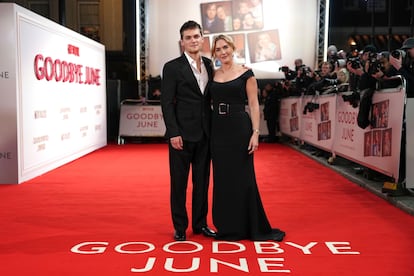
In a simple, friendly conversation, it’s easy to understand why Kate Winslet, 50, is such a revered figure in the entertainment industry. While many actors smile for the camera and leave without looking back, the British actress stays on, chatting until she almost misses her flight home with a group of journalists whom she knows — some for years, others from only brief encounters — even by name. She comes over, hugs them, asks about their families, laughs at anecdotes, and takes selfies. The event takes place during a screening of Goodbye, June, her first film as a director, with a script by her eldest son, Joe Anders, 21 (his full name is Joe Alfie Winslet Mendes).
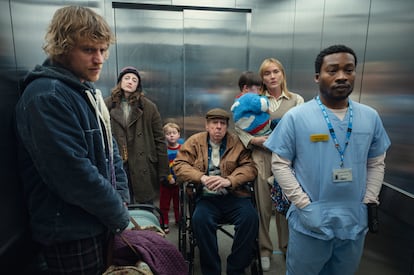
A couple of days later, during an interview with EL PAÍS, Winslet once again shows that same warmth. She talks about her return to London, about what the flight was like, even about the weather. She is happy. Her first film behind the camera premieres on December 24 on Netflix. While it is not a typical Christmas story, the holiday season serves as its backdrop. In addition to directing, Winslet plays one of June’s four children. June, the protagonist (Helen Mirren), is a terminally ill woman who celebrates her last Christmas in hospital alongside her devoted husband (Timothy Spall) and her children (Winslet, Toni Collette, Andrea Riseborough and Johnny Flynn) and grandchildren, who are divided by years of unresolved grievances. Shot on a low budget over a month and a half in an old hospital on the outskirts of London, Winslet says she is proud not only of her own debut, but also of her eldest son’s.
Question. You look genuinely happy.
Answer. I’m so happy; I have felt so consistently uplifted by the process. I was recently listening to a podcast that talked about how stress is different from pressure: stress is really bad and can affect your health, whereas pressure, rising up to the task, can lift you up and make you feel fulfilled. At every point in the process of Goodbye, June, I felt stimulated, creative, challenged, fulfilled, and proud to be able to lead and take care of all those people. Although I didn’t have a big budget, I finished on time, and we had a completely sustainable production: we didn’t use any single-use plastics, all the actors used electric cars, and we worked in a certified sustainability studio. I’m so proud of everything; it was diverse and inclusive. It was everything I could have ever dreamed of doing as a director — creating such a space for everybody, not just the actors. It was fantastic.
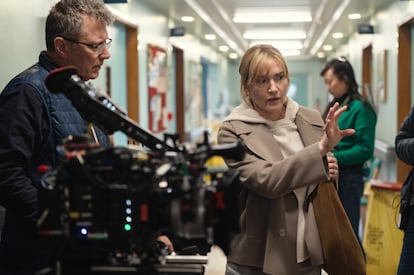
Q. When did you first feel the need to direct?
A. I don’t think I ever felt the need to direct, but I did feel ready. Over the last 10 years, a lot of people have said to me, “When are you going to direct? You really should.” While filming Steve Jobs, [director] Danny Boyle told me I should be a director. I said, “Really?” He replied, “Yes, you think like a director.” I hadn’t been aware of that, I guess. But when you’ve been doing this for as long as I have, you develop an awareness not just of what’s going on for the actors, but for the entire crew, and technically, how to put a story together. I’ve learned all of that. And I wouldn’t have been able to do it any sooner in my life because I was raising a family, and I think people forget that a lot of the reason why there aren’t more female directors is because we’re busy raising children, and the job of the director is so much longer. The actors come for a few weeks, a few months, whatever it is; this was only a seven-week shoot. Helen Mirren was here for three weeks and a day. And then they move on to another job. But I’ve been completely dedicated to this for over a year; if you include the development process, while Joe was finishing the script, it’s been much, much longer. There was no way I would have been able to do that until now, when I have a little more space.
Q. A project like this requires a lot of time; moreover, this is a difficult story to tell: because of the small spaces and where to place the camera, but also because of the tone, because of the blend of humor and drama.
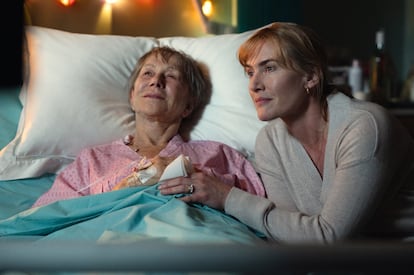
A. It’s very difficult. The thing with the drama side of it, with the emotion of it, is that, as an actress, I don’t like false sentiment.
Q. Spectators don’t like it either.
A. No, I just have such an allergic reaction to it. It was very difficult to strike the balance while making this film.
Q. And what is it like to knock on doors and ask for favors, ask for money, ask people to work with you? Because that, too, is new for you
A. Actually, I did quite a bit on Lee Miller [a movie about the famous war photographer that Winslet starred in and produced]. So I’m no stranger as a producer; I’m no stranger to going out and finding a great crew and bringing people on board based on their skills, but also on who they are as people, because that also matters. When you’re shooting in a very short period of time, you have to work hard, sometimes for less money, and the actors do too. It’s a lot to ask, and you have to have the goodwill. That’s why I’ve always believed that what you, as a person, put out into the universe comes back to you. And we had wonderful spirits on this set.
Q. You’ve been in the industry for over 30 years. Is it still difficult to be a woman in this business?
A. Yes. I find it amazing that after all these years I still have to advocate for myself so much. People assume that because I was in Titanic, I can do whatever I want, get whatever I want, but it’s not like that. You can’t. People don’t just give you money to make a film unless they believe what you’re telling them. But I will say one thing I learned late in life: as an actress, every time we step on the red carpet, we get asked different questions than actors get asked. When an actress steps on the red carpet, they say, “Hi, how are you? What are you wearing?” If it’s an actor, they say, “Hi, how are you? What was it like working with Steven Spielberg?” This double standard is out of control. And as a director, there are ways in which people have conversations with me — not on our crew — that are completely different from the conversations they have with my male colleagues. There is a lot more judgment placed on actresses stepping into these roles. That’s in no way a criticism of male actors, it is simply very different.
We have to fight to be heard, we have to fight to have people believe in the stories we want to tell. It’s hard to make films as a woman. But in stepping into Goodbye, June and being a director, I had to put aside any nerves I might have had, because the most important thing for me was that, by taking this step, I could contribute to changing the culture. After years of advocating for other women and always trying to elevate them to leadership roles in film, I thought, “Hang on, I’m not really doing it unless I’m actually doing it.” Exactly. So I thought: it’s now or never. And even if I never get to direct again, I’m so proud that I took the step now, at this time in my life. At an age when women are starting to think, “What’s left for me now?” I’m still at the beginning. I have so much to do.
Q. In a recent interview for Avatar, James Cameron talked about how you in 1997 were the obvious choice for Titanic because at that time you were known as “corset Kate,” the one who always played period roles.
A. My God, yes... How crazy...
Q. What would you say to corset Kate?
A. What was interesting for me was that when I became successful in my 20s, the media put me under enormous scrutiny, focusing on how I looked, right? Things that really weren’t okay. I actually learned a lot then about how to be resilient, how to ignore the voices of other people and stick to what I believe in, stick to my own trajectory, and not be affected by any of it. And it was hard. I mean I’m not going to pretend it wasn’t very hard and, sometimes, very damaging, but I kept going because I love this industry, I love my job, I love acting. It turns out I love telling stories, and I always hung onto that and kept trying to be a good person. We live in such a difficult world now, where people are mean, society is mean. We’re down on ourselves all of the time. I don’t want to live like that. I want to be able to make people feel seen and heard through the characters I play and the stories I tell. And I really felt that with Goodbye, June. I felt there was an opportunity to do it because it’s such a universal story.









































