
From the White House to diplomatic gifts: Lego wins over adult fans, brick by brick
The Danish foreign minister’s gift to his Egyptian counterpart — a Lego recreation of the Great Pyramid — and the portrait of Trump symbolize the success of the company, which, with increasingly complex toys, is now targeting adults


The king of Spain, the chancellor of Germany, and the Dutch prime minister were all present. The Grand Egyptian Museum — the world’s most comprehensive exhibition on the civilization that arose on the banks of the Nile — was being inaugurated in Cairo. After two decades of construction, setbacks, delays, and revolutions, the long-awaited project had finally become a reality. And so Denmark’s foreign minister, Lars Løkke Rasmussen, decided that such a solemn occasion deserved a gift worthy of it.
Not even protocol could contain the enthusiasm of his local counterpart, Badr Abdel Aty, when he received it: in an official photograph, his smile is the same as that of millions of children — and increasingly, adults — when faced with a new Lego set. Specifically, the Great Pyramid of Giza, a recreation of the ancient wonder that stands near the new museum. The original construction is estimated to have taken at least 20 years. Who knows how long it will take the Egyptian politician to build its Lego replica: he must fit together 1,476 pieces, one of the largest sets in the catalog.
Meanwhile, the Danish company has added another brick to its already impressive reputation. It has been a fixture in many homes, but now it’s being invited to the most exclusive venues. Even the White House, in its Christmas decorations, is displaying a Lego portrait of U.S. President Donald Trump.
Just eight years ago, the Danish company saw its profits plummet and laid off part of its workforce. Today, it has become one of the most solid and recognized brands on the planet. And not just in the children’s market: the neologism kidults reflects the unprecedented rise in adult consumerism. The company sells kits for building everything from a French-fries truck and a chicken farm to the Trevi Fountain or Van Gogh’s Starry Night, not to mention the Millennium Falcon or the machines faced by Aloy in the video game Horizon.
Brands such as Disney, Stranger Things and the Spice Girls have authorized it to break down and reassemble their icons. And the little yellow figures now enjoy similar success in clothing, films and board games, such as Brick Like This! or Monkey Palace. A study cited by Bloomberg in 2019 concluded that investing in Lego between 1987 and 2015 had proven more profitable than investing in gold, art or wine.
The company, founded in 1932 by carpenter Ole Kirk Kristiansen, still upholds its long-standing motto: “Inspire and develop the builders of tomorrow.” Yet this is also where its main challenges lie: prices that are sometimes out of reach even for builders of today, and a plastic-based production model that threatens that very future.
“Their business has always been based on diversification. The founder started with all kinds of toys, initially made of wood. But building with little bricks eventually took center stage, and that’s where he decided to focus his energy,” reflects Sarah Herman, author of books such as Building a Story: The Lego Group and A Million Little Bricks. To write them, she researched, conducted interviews, and was granted access to the company’s headquarters in Billund, a Danish town of around 7,000 inhabitants where the company was founded and still keeps its heart. She left with a surprise: “Many people think the bricks and figurines were there from the very beginning, but that’s not true.”
This was clarified for her by Jens Nygaard Knudsen, the very inventor of the yellow miniatures. The man, it seems, ran a shop before joining the company in 1968, when he was tasked with creating “Lego people.” The first one, unveiled in 1974, was larger and more detailed than today’s version. As a result, the buildings designed to house them also required more space and more pieces. This led to the creation of the so-called “extra,” a smaller and simpler version. Some 50 prototypes gradually brought it closer to the icon it is today.
“We have hundreds of designers [more than 430 in Billund], human inspiration, numerous product tests and studies, and very precise manufacturing,” says Pilar Vilella, brand director for France and Iberia, regarding the creative process.
Rok Žgalin Kobe, a designer in the Lego Architecture line, which recreates buildings such as the Eiffel Tower or Himeji Castle, explained on the company’s official website the development of one particularly high-profile project: the Colosseum, launched in 2020 with 9,036 pieces, the largest set in the company’s history. “Among the most stressful moments in a LEGO designer’s life is when the product of months, sometimes years, of hard work… is shoved into an industrial oven,” he recounted. After all, the replica aspired to defy the passage of time just like the original Roman monument.

But the Lego version of the Amphitheatrum Flavium represents much more than the company’s ambition. The recommended age is 18 and up — the group that spent the most on toys in the U.S. in 2024, as Herman notes. “It has always been an expensive pastime. But the larger, more expensive sets are a more recent phenomenon. And it has a lot to do with adult fans, who have turned collecting them into a status symbol,” she explains.
Pilar Vilella acknowledges that some releases come with “higher prices,” which she links to the number of pieces, the research involved, and “the exclusivity.” At the same time, she points out that a quarter of the catalog costs less than €19.99 ($23.50). In any case, she celebrates the passion of adults, who are likely to pass it on to their children.
Lego needs to make room for around 800 new releases each year, which is why some creations gradually go out of production. “Lego sets don’t show a significant correlation to the financial crises and can be seen as an attractive investment with a diversification potential,” concluded the analysis of 2,300 sets cited by Bloomberg, carried out by Victoria Dobrynskaya, assistant professor at the Higher School of Economics in Russia.
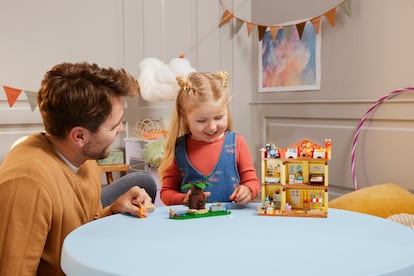
“The Lego brick has enduring appeal: it transcends language, culture, age, and interests,” boasts Pilar Vilella. She maintains that it remains at the center of the company’s strategy: any new initiative must “follow the brand’s DNA.” Lego already has a presence in film, board and digital games, series, books, and more than 20 licensed properties, selected based on trend studies, fan feedback, longevity calculations, and the complexity of translating them into physical builds. The offering is set to expand: the Lego Play app aims to introduce programming in some sets, and the adult community can already assemble the Mona Lisa, a tropical aquarium, or an orchid.
According to Herman, this approach has yielded good results after decades of uncertainty and uneven performance: “Some fans might be drawn in through Star Wars or Harry Potter and buy only the sets from those licenses. This creates a collector’s aspect, as well as a certain anticipation for new releases. They’ve also invested heavily in the brand, building trust and a reputation for quality. Video games and films have helped to reinforce this, introducing more humor and characters, and gaining new audiences.”
However, there is one area where Lego has struggled. In 2021, the company announced trials to produce a brick made from recyclable plastic instead of traditional, polluting ABS. Ultimately, though, it chose to focus on reducing the carbon footprint of its usual material. “We tested hundreds and hundreds of materials. It’s just not been possible to find a material like that,” admitted CEO Niels Christiansen to the Financial Times in 2023.
Tim Brooks, head of sustainability, described the failed attempts to find alternatives as a “disappointment”: in some cases, processes to achieve the same strength and performance with other materials ended up being even more polluting. As a result, the initial goal of eliminating all petroleum-based plastic from its creations by 2030 has been postponed to 2032, alongside a 37% reduction in emissions compared with 2019.
“It’s complicated because the new bricks have to meet standards for safety, quality, and durability,” Vilella explains. She notes that more than 600 materials have been tested, from artificial marble to sugarcane, fishing net waste, and recycled oils. Meanwhile, this year marks the deadline for another Lego commitment: eliminating all single-use plastic from its packaging.

“The very nature of these global brands is antithetical to reducing carbon emissions and combating climate change,” Herman emphasizes. She suggests that the company focus more on a path it is beginning to explore: the free — or even incentivized — return of old sets so they can be reused by others. The writer adds: “In its defense, the enduring nature of Lego means that one person’s collection can be passed on to another generation and have several more lives.” It turns out the little bricks can build just about anything. Even tributes to memories.
Sign up for our weekly newsletter to get more English-language news coverage from EL PAÍS USA Edition









































