
Lisa Herzog, philosopher: ‘We have to fight to not be available outside of work hours’
The German social scientist proposes that employees themselves organize their work environment because they are the ones who know it best
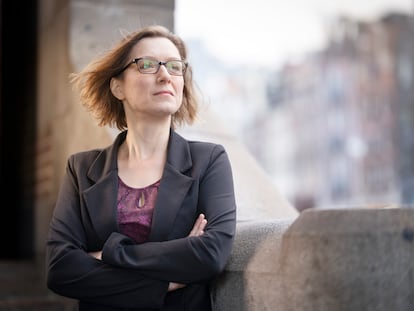

The organization of work influences people’s ability to live together and shapes citizens’ perception of society. In a world constantly changing due to new technologies, German philosopher and social scientist Lisa Herzog asks what it means to act ethically while working as just one part of public or private organizations. Standing at the intersection of political philosophy and economic thought, Herzog has studied various free-market thinkers (from Georg Wilhelm Friedrich Hegel to Adam Smith) and analyzed the ethics of the financial sector. She has also done fieldwork, which is rare for a philosopher. She is interested in the relationship between ideas and real life.
In her work, Herzog proposes that employees themselves should organize their work environment because they know it best. She advocates for making paid work more democratic at a time when education, training, or motivation no longer guarantee a decent job or salary. And she addresses the fear many have of being controlled or pushed around by algorithms designed to maximize efficiency.
Herzog studied at the universities of Munich and Oxford, and in 2019 she began teaching at the Center for Philosophy, Politics, and Economics at the University of Groningen, in the Netherlands. Speaking to EL PAÍS via videoconference, she advocates not only for institutional reforms. Above all, she believes in the transformative power of workers when they move forward together.
Question. You advocate for teamwork, has that skill been lost?
Answer. Work is the primary factor of social cohesion in modern society. But we continue to suffer from the rhetoric of recent decades, which is based on individualism and focused on success, on having a career and advancing alone. Modern management and administration theories don’t emphasize teamwork. On the contrary, people are encouraged to compete for promotion, bonuses, and so on. And that’s a divisive strategy. The idea that we can progress together, collectively, seems to be admitting defeat. At the same time, there are attempts to organize something together, although it doesn’t quite translate into a stable partnership.
Q. In many jobs, you have to meet with others, but there never seems to be enough time.
A. Work is what brings people together, but daily tasks no longer allow for lunch or a quick chat after a meeting. There’s no time for other things, and the time you have is incredibly politically valuable. There’s a teamwork dimension, and we have to fight for shorter hours — or for not having to be available outside of work hours. Putting all of this on the table can help.
Q. Does that tension a result of the broken promise that you can earn a decent salary by working hard?
A. The connection between economics and politics is inevitable. People working together creates the potential for community. In the past, employees never left the company. Today, there is fragmentation, and the challenge is to organize ourselves together, something that usually happens in times of crisis, when it’s too late. I’m not saying that unions alone are the answer. The democratization of work stems from our unity; I don’t think we’ll be replaced by robots. We need to analyze working conditions and ask ourselves how they can improve.
Q. Doesn’t it seem sad that we’re talking about work in these terms?
A. It is sad to see the erosion of the achievements of the labor movement of the past. It would be good if work weren’t as absorbing as it is today. There would be time for life. In sectors like caregiving, the human factor is vital. In others, reducing the physical burden with technology will be good. Giving workers a voice is a moral imperative.
Q. How can workplace collaboration have influence in an era of fast-paced technology?
A. Many workers will be able to use these technologies to make their lives easier, while for others it will be an imposition. Most companies won’t be open to employee voices, but there’s a kind of grandiose technological illusion that everything can be done by algorithms. Humans will always be needed. An example of this is the Hollywood screenwriters, even though they are a privileged group. With their union’s strike [in 2023], they tried to resist artificial intelligence. What’s coming our way isn’t an automatic force of nature.
Q. Has the work environment changed that much due to digital challenges?
A. We need to critically ask ourselves what problem the new technology we’re receiving is going to solve. And this can only be done politically. We shouldn’t use innovations just because they exist, and what I see is a lack of dialogue between different sectors of society. But regulating new technologies is a political issue, and the EU has its role in that. Although it’s true that lobbyists sometimes appear on regulatory committees, and that corrupts democracy.
Q. Why do we trust machines?
A. They can perform their function reliably, but they don’t have a moral component. We all use airplanes or computers. It’s different from trusting another person. Perhaps I’m overly optimistic in thinking that machines can be used appropriately. What we can ask ourselves is what new technologies add to our lives. Or are they just trying to make us consume more? All in all, humans have been adapting to machines throughout history.
Q. You have a lot of faith in people.
A. Yes and no. We are easily corrupted when we have power, and we must always ask ourselves who has that power and how it can be controlled. I see our dark side. By working together, there are ways to hold each other accountable that bring out the best in us.
Q. And the fear of the future driven by unstoppable technological advances?
A. We need to talk about what we fear: losing our jobs, our salaries, our identity as workers... let’s think strategically. Reducing the workday thanks to new technologies — while maintaining salaries — would free up people’s energy and bring about changes that can’t be planned.
Q. Let me change the subject. Is it true that far-right parties in Europe or the U.S. are popular?
A. They present themselves as “parties of the people,” and they often pretend they’re not part of “the elite” and that they’re going to restore good working conditions to “ordinary people.” But if you look at who’s in leadership positions, they’re usually very rich. And what they actually do for working people is very little. I hope people will eventually see through these lies and stop believing these narratives. But that requires a credible alternative from the left.
Sign up for our weekly newsletter to get more English-language news coverage from EL PAÍS USA Edition









































