
Katseye, the first global K-pop group born from a reality show and meticulously crafted to succeed
Nothing the six members of this group do is by chance. Their dances go viral, their campaigns keep growing, and each member has a personality linked to a charm that can be bought by their fans, the Eyekons
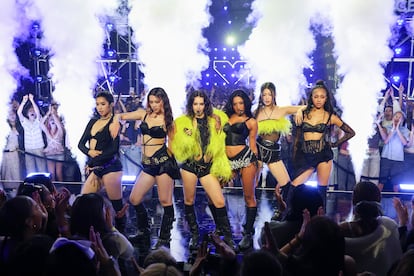

“This moment makes it all worth it.” This isn’t the typical opening line of an award acceptance speech — but then, neither is the story of the person saying it. Lara Raj, 19, was chosen from 120,000 applicants to become one of six members of Katseye, an unprecedented experiment in the music industry. The group was designed to export the methodologies of Korean pop, or K-pop, to the rest of the world.
And it seems to be working: a few weeks ago, they won their first award, the Video Music Awards for Push Performance of the Year. The rest of Katseye’s acceptance speech also provides insight into the phenomenon: “Thanks to our Chairman Bang for being our visionary leader.” The group finished by saying thank you in two more languages: Filipino and Tamil.
The fact that the group speaks different languages is no accident. Nothing in Katseye is. Neither the countless commercial campaigns — like the one they led this summer for GAP — nor the TikTok dances that accompany, and sometimes overshadow, viral tracks like Gabriela. Everything has been meticulously studied for years by dozens of executives, led by a single figure: Bang Si-hyuk, the “visionary leader” mentioned in the speech. Bang is the founder and chairman of the South Korean label Hybe, responsible for the success of bands like BTS. He began as an amateur musician and is now considered by Forbes one of South Korea’s richest men, with an estimated fortune of $2.4 billion.
In 2021, with K-pop on the verge of conquering the international market thanks to groups like Blackpink, Bang decided it was time to export the unique universe surrounding this phenomenon to other countries. In an interview with The New Yorker, he compared creating K-pop groups to an act of “engineering” and admitted that he spent months studying audience dynamics and reactions using a method very similar to that of an AI.
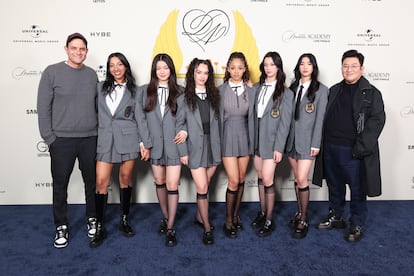
To create Katseye, Bang relied on two key pillars: first, an international partner — after months of negotiations, he signed a deal with Geffen, one of Universal’s labels; and second, almost equally important, a reality show. In Korea, reality shows are crucial for cultivating a loyal audience that follows and participates in forming the groups as they face various talent challenges (shooting a music video, recreating choreography, etc.).
After a massive casting that included more than 120,000 applicants from around the world (reaching every continent was vital to achieve the ideal of a “global group”), 20 contestants were selected to take part in Dream Academy, a reality show first broadcast on YouTube. Once it ended, it was turned into the Netflix documentary Pop Star Academy: Katseye. The main controversy was that the contestants were not initially told they were part of a reality show.
They spent a full year in Los Angeles training in K-pop disciplines, thinking it was just a standard group audition. “The K-pop methodology is about [perfecting your] singing and dancing performance, everything to make for a great performance; and also synchronization for the choreography,” Yoonchae, one of the six final members, told InStyle months later.
Once they had mastered the rules, they learned they were actually part of a reality show, where they would compete against each other to win the public’s favor. From then on, they faced challenges judged in categories as subjective as “attitude” or “star quality.” Contestants who failed to gain public support were eliminated.
Finally, in November 2023, the definitive members were chosen: Sophia, a 22-year-old Filipino, became the group leader; Daniela, a 21-year-old American of Latino origin, was named the main dancer; Lara, a 19-year-old American of Indian descent, became the lead vocalist; Manon, a 23-year-old Swiss with a Ghanaian father, was chosen as the “visual center,” the most charismatic with the strongest stage presence, often positioned at the center of choreographies; Megan, a 19-year-old Hawaiian American, was designated the all-rounder, the most versatile; and Yoonchae, a 19-year-old South Korean, became the maknae, or youngest member of the group.
Throughout the entire process, audience participation via Weverse was crucial. This app — part social network, part e-commerce platform, and part fan forum — was created in 2019 by Hybe to strengthen the bond between K-pop fans and their idols, away from the toxicity of much of the internet.
“Artists who use the platform feel safer than when they’re thrown into that wild, wild social-media world,” one of the platform’s managers told The New Yorker. Through Weverse, fans voted for their favorites and now receive daily notifications, from “private” messages from Katseye wishing them well to announcements about upcoming concerts. This is also how the label revealed the official name for the fan community: Eyekons.

Since then, captivating those Eyekons with their own symbolism and universe has become the group’s top priority. To achieve this, Katseye has turned to Humberto Leon, the creative director formerly in charge of the brand Kenzo.
“Whether it’s if the girls can paint their nails this color or what’s the music video for their launch, I’m involved in every single aspect of it,” Leon told NME.
Unlike the creative directors of other stars, he oversees every detail of Katseye. We’ve tried to embed the way the girls dress with a little bit of their background, for sure, without it being heavy-handed or tokenizing them,” he explained months ago to the Los Angeles Times.
Leon unifies the group under the Y2K style, or early 2000s fashion, evoking icons like Shakira or Milla Jovovich through low-rise pants and crop tops. Still, every look includes distinctive details designed to delight the fans.
In K-pop jargon, these details are called charms — traits representing each member’s unique character, depicted with different icons. For Katseye, for example: a key for Lara’s empathy, a shield for Daniela’s courage, and an anchor for Sophia’s stability. These details are key to identifying with the public, but above all for merchandising. Because much of the furor they cause is due to their commercial collaborations.
In every campaign, each member of Katseye chooses a product that matches her personality, continuing to cultivate their bond with the Eyekons. In just a year, Katseye have partnered with brands such as Monster High (dolls), Glossier (makeup), Pandora (jewelry), and Fendi (luxury). However, their most significant collaboration was with the U.S. brand GAP, which propelled them to global recognition.
The ad caused a frenzy for offering an interracial take on classic American jeans. Many saw it as a response to the controversy over American Eagle’s jeans ad featuring actress Sydney Sweeney. It also drew attention for the polished K-pop–style choreography accompanying the song Milkshake by Kelis.
It may seem surprising that Katseye rose to fame performing a song that isn’t theirs, but this is precisely their focus. Their two EPs, SIS (Soft is Strong) last year and Beautiful Chaos three months ago, feature long lists of composers and producers, with none of the Katseye members credited. The group’s specialty — and what they were trained for during the competition — is performing others’ songs on stage, delivering charisma and meticulously crafted choreography. These dance routines, endlessly repeated on social media, have helped them perform on stages worldwide, and in November, they are set to embark on their first full tour across the United States.
Following the success of this first experiment, Hybe and Geffen have just announced a new four-member group. Three of the members will be former contestants who didn’t make it to the final lineup of Katseye, and the fourth will be chosen through a new reality show, this time focusing exclusively on Japanese participants. The idea is for the groups to interact and collaborate — a full K-pop multiverse, coming soon on TikTok.
Sign up for our weekly newsletter to get more English-language news coverage from EL PAÍS USA Edition









































