
The hummingbirds that hold 80 years of pollution in their feathers
Researchers from the Autonomous University of Campeche, in Mexico, are analyzing samples from these tiny birds in order to reconstruct the chemical history of the area
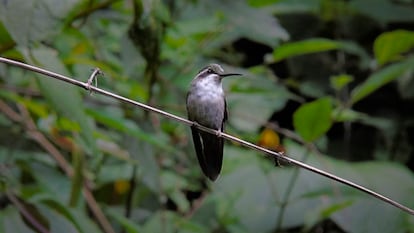
Hummingbirds molt at least three times throughout their lives. And each shedding of feathers enables these birds to perform their characteristic hovering flight — that ability to float without moving from their spot.
But a feather can also be a record of what happens (chemically) in a hummingbird’s life. Nutrients, hormones and — if present — pollutants are trapped within them. In these samples, Dr. Ruth Partida, a researcher at the Autonomous University of Campeche (Mexico), saw an opportunity to reconstruct the chemical history of a region. Thus, she and other researchers set out to profile southeastern Mexico, made up of states such as Chiapas, Campeche, Yucatán and Quintana Roo.
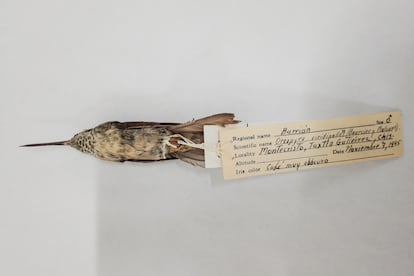
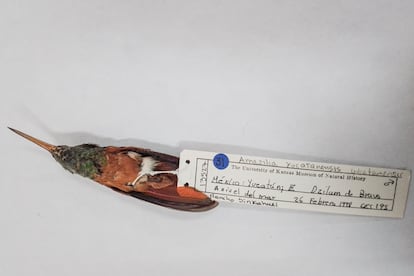
However, sampling living hummingbirds only provides part of the chronology. Therefore, to obtain a more complete timeline, scientists consulted Mexican scientific collections, which serve as inventories of the nation’s biodiversity.
Keeping hummingbird specimens in various biological collections began in 1932, when researchers collected and preserved specimens of these birds. This process continued until 2012, representing 80 years of data in total.
Although almost a century has passed since the sampling of several hummingbird specimens, the preservation conditions allowed their feathers to retain the “chemical fingerprint” of heavy metal pollution. This allows scientists to see how contamination has fluctuated in the environment over the course of several decades.
To carry out this study, the researchers consulted several collections located in different regions of southeastern Mexico. Some specimens were housed in cabinets at the Autonomous University of Campeche (UACAM), while others are in the ornithological collections of the National Autonomous University of Mexico (UNAM), the College of the Southern Border (ECOSUR) or the Chiapas Ministry of Environment and Natural History. All of these formed a sufficiently robust regional archive to work with.
“Mexico lacked a baseline for heavy metal contamination,” Dr. Ruth Partida explains. “That’s where the idea arose to leverage the scientific collections, in order to highlight their value.”
An archive of feathers
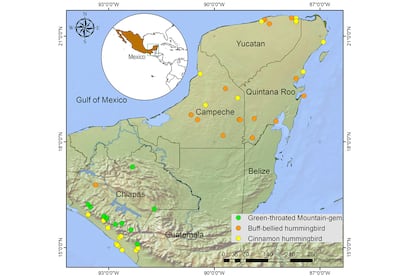
Together with researchers from ECOSUR and the University of Sciences and Arts of Chiapas, Partida reviewed heavy metal contamination in species such as the cinnamon hummingbird (Amazilia rutila), the buff-bellied hummingbird (Amazilia yucatanensis) and the green-throated mountain-gem (Lampornis viridipallens). Specifically, they mapped the concentrations of mercury, arsenic and lead in the feathers.
“Heavy metals don’t degrade,” Ruth explains. “They can remain present in feathers for centuries.” Keratin, the protein that hummingbird feathers are made of, preserves this chemical record virtually intact, largely thanks to its dense network of disulfide cross-links (bonds between atoms). This means that those with access to scientific collections are able to compare organisms even if they existed decades apart from each other, and reconstruct environmental changes.
When a hummingbird develops, its feathers are supplied with blood vessels that transport nutrients, but also toxic substances. If there’s contamination, the bird’s body incorporates these foreign agents into the feathers. This is a means of elimination, the researcher explains, because eventually, when it reaches its full length, the feather stops receiving blood and exposure decreases.
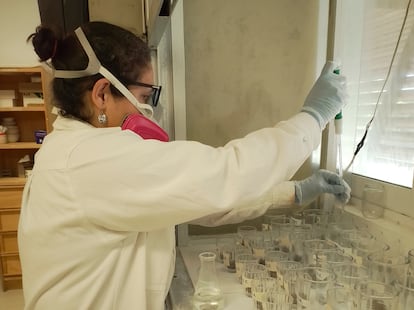
The research was made possible by the use of voltammetry, a measurement technique that requires only a few milligrams of a sample in order to detect heavy metals. Conventional methods, Partida notes, required much larger quantities of tissue — a limitation that practically excluded small species from this type of study.
The journey of the pollutants
Scientists found that the findings from the specimens in the collections were consistent with events in the region’s environmental history. For example, the decrease in lead in the feathers coincides with the phasing out of this heavy metal in gasoline, one of the most important environmental policies of the previous century.
In contrast, some concentration peaks line up with the 1982 eruption of the Chichonal volcano, which released trace elements (such as mercury, sulfur gases and ash) into the atmosphere. The impact of this has also been documented in other environmental records.
Once released, these compounds can travel hundreds or thousands of miles before being redeposited by rain. This means that even ecosystems that are considered well-preserved (or even designated as Protected Natural Areas) can receive pollutants emitted far away from them.
“Heavy metals remain in the environment and can volatilize (vaporize) or be transported by air currents to other areas,” the researcher explains. Pollution doesn’t recognize the boundaries of protected areas.
Part of the explanation for this phenomenon is that atmospheric dynamics influence the movement of these metals. In the mountains, orographic rainfall and persistent humidity favor the deposition of pollutants on leaves, flowers and the soil. Likewise, by feeding on nectar or insects present in these ecosystems, hummingbirds can ingest these metals.
The health issue for hummingbirds
While the study didn’t directly evaluate the physiological effects of contamination on hummingbirds, evidence in other bird species suggests that chronic exposure to heavy metals can alter the immune and reproductive systems, while causing neurological and respiratory damage. And, Partida points out, this pollution can even modify wing symmetry, impacting flight ability.
In addition to the concern for the health of these birds, there are other worries. Hummingbirds perform essential ecological functions, such as pollination. According to biologist and researcher María del Coro Arizmendi (who was not involved in the study), 7,000 plant species depend on them for reproduction. And, since these birds are found exclusively in the Americas, their role is crucial for the continent’s ecosystems.
Likewise, their presence contributes to the reproduction of native plants and the maintenance of plant genetic diversity. Arizmendi explains that, indirectly, these relationships support ecological networks upon which other organisms and processes depend on, be it for food availability, water regulation, or the capacity to respond to environmental changes.
In this context, biological collections can help us reconstruct the history of pollution and detect threats that aren’t always visible in the present. “By doing this work, we demonstrate that chemical pollution must also be considered a threat to hummingbird conservation,” Partida concludes.
Sign up for our weekly newsletter to get more English-language news coverage from EL PAÍS USA Edition









































