
The secrets of the Washingtonia palm, named after the first US president
They are among the most widely cultivated plants in the world, and can thrive in complete neglect, able to withstand both harsh summers and low temperatures
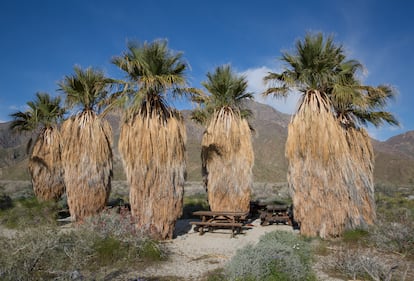

Palms possess the elegance of simplicity: a powerful, or perhaps it is better to say graceful, trunk crowned by a crown of attractive leaves that sway in the breeze. Each palm species has its own charm, a personality that makes it recognizable among the others. To the untrained eye, many of these plants may appear identical, but with just a little attention, the differences will emerge, noticeable, for example, in their trunks — more accurately called stems — each with its own unique shape and color.
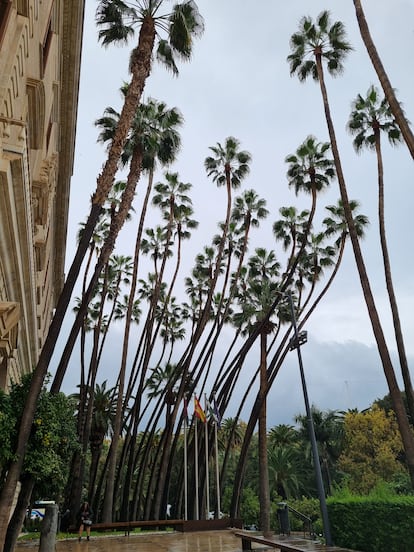
Washingtonia palms are among the most widely cultivated palms in the world. There are two species in this genus, although we will see later that their current classification is somewhat more complex. In this article we discuss Washingtonia filifera — with a wide stem and a height that rarely exceeds 20 meters (65.6 ft) — and Washingtonia robusta — with a slender, thin, and very tall stem, reaching up to 30 meters (98 ft). Some specialized publications also talk about a hybrid resulting from these two species, called Washingtonia x filibusta. All these palms are native to California and to Baja California and Sonora in Mexico. In those regions, Washingtonia palms often thrive alongside cacti of all kinds.
It is generally thought, however, that there is only one species, Washingtonia filifera, which, in turn, has two main varieties: Washingtonia filifera var. robusta (the taller one), and Washingtonia filifera var. filifera. A third variety that adds to this confusion grows in the Mexican region of Sonora: Washingtonia filifera var. sonorae.
Its name doesn’t come from the state or city of Washington, but from the first president of the United States, George Washington (1732-1799), to whom this botanical genus is dedicated. Because they grow in a semi-arid climate in their native land, with enormous temperature fluctuations throughout the year — from periods with nighttime frosts to temperatures exceeding 45°C (113ºF) at other times — they are highly resistant to both cold and heat.
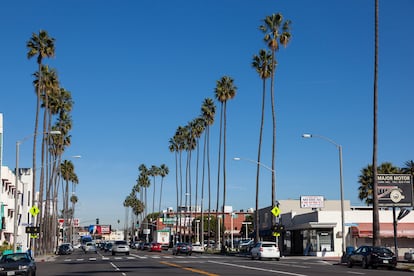
In fact, they are so hardy that, once firmly established, Washingtonia palms can thrive despite complete neglect, and can withstand both dry, harsh summers and low temperatures, especially Washingtonia filifera, which can endure frosts below -10 °C (14ºF) once well acclimatized. Washingtonia robusta is somewhat more sensitive to cold, and temperatures below -5 °C (23ºF) can damage its tissues, depending also on growing conditions.
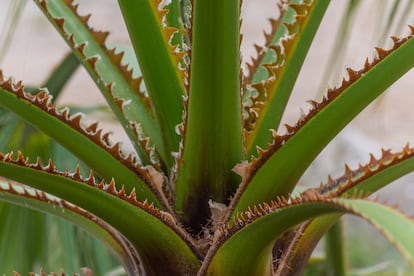
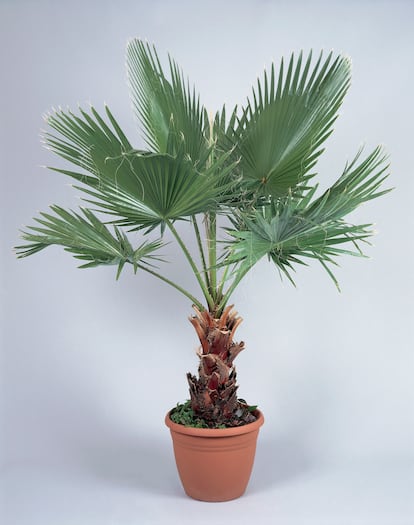
Washingtonia palm leaves are palmate — shaped like the palm of a hand — and their impressive size isn’t truly appreciated until a gardener cuts one, places it on the ground, and one sees its magnitude up close. The petiole that attaches the leaf to the stem is often over a meter long. It’s precisely this petiole that requires caution, as it bears fierce thorns that can cut any unsuspecting hand that tries to grasp it. The bases of these petioles clasp and encircle the stem, a characteristic that becomes visible when the leaves are pruned, revealing this brownish-red base.
Adding to this unique feature is the fact that the lower part of the trunk of these palm trees has a very characteristic widening shape, which surely provides them with greater stability against strong winds.
Another distinctive feature is precisely what gives them their botanical “surname”: filifera, which means “thread-bearing.” These threads are observed on all their leaves, which fray into fine, light ochre-colored filaments along the edges of their leaflets, which are each of the leaf’s divisions.
Both species accumulate their dry, brownish leaves against the stem, creating a charming Hawaiian-style skirt. It’s common to prune these dead leaves — which are the oldest and lowest-placed ones — leaving only the fresh, green ones at the top; however, retaining at least some of these withered leaves gives the Washingtonia a beautiful character, because brown leaves aren’t always unsightly.
Its flowering is a beautiful display, even if it doesn’t attract much attention. This indifference is also due to the height at which this spectacle occurs, sometimes dozens of meters up, far from the usual human gaze. Its long clusters of small, creamy flowers appear between late spring and mid-summer, later giving way to hundreds of seeds. These are surrounded by a light, sweet pulp, with a flavor similar to that of dates from the date palm (Phoenix dactylifera).
The tiny seeds germinate beautifully, as evidenced by the abundance of miniature Washingtonia palms that often grow near mature palms. These seedlings frequently sprout in cracks in sidewalk paving and at the base of low walls, as the seeds fall into these crevices, providing them with ideal conditions for undisturbed growth. Thanks to their ease of germination — occurring within one to two months — it’s a lovely activity to do with children, either as a family or in the classroom, in a simple pot. Then, a little piece of the American semi-desert regions will be just a blink away.
Sign up for our weekly newsletter to get more English-language news coverage from EL PAÍS USA Edition









































