
Is dressing ‘badly’ a privilege of the rich? ‘If someone in power does it, it’s either audacity or irony’
From prominent and controversial businessmen like Sam Bankman-Fried to political advisors like Dominic Cummings, several public figures have become famous for their disheveled appearance. But would they be able to do so if they weren’t rich, powerful, white men?

Two years ago, fashion critic and journalist Eugene Rabkin, founder and editor of StyleZeitgeist magazine, wrote a piece explaining why those from disadvantaged backgrounds strive to dress elegantly. “Aspiration stems from the need to constantly prove that you’ve earned your place in society.” He believes that, therefore, the privileged are those who don’t need to use their wardrobe as an ally to prove something, precisely because they have nothing to prove. “So, why dress elegantly?” he asks. His thesis, in short, is that dressing badly is a privilege.
Luxury expert Beatriz Carranza agrees, pointing out that consciously breaking the dominant code and dressing badly “on purpose” requires cultural capital: knowing what you’re breaking and why. “In that sense, it can become a sophisticated way of communicating status, because you’re showing that you don’t need to follow the rules to be validated. However, for this behavior to be successful, context is essential. There are cultures and social circles where dressing poorly or not following polished protocol can be taken as an offense because it shows no respect for the hosts of the gathering,” she warns. “Clothes that don’t follow conventions, or that are directly perceived as ugly, taking into account the subjective implications of this term, can work against you if you don’t have a context to support your choice. On the other hand, if it’s worn by someone with power or recognition, it’s interpreted as audacity or irony,” she adds.
Rabkin, who has now reshared the 2023 piece on social media, believing its content carries more weight than ever, spoke with W. David Marx, author of Status and Culture (Viking, 2022). The writer noted that being a white, wealthy, heterosexual man comes with being born with a status advantage, which reduces the need to flaunt it with your possessions. “This also allows for modest dressing, as people don’t assume you’re actually poor. Over time, this detachment from signaling through possessions becomes a sign of elevated status,” he said.
Journalist Robert Armstrong reflected in 2016 on Boris Johnson’s anti-style attitude, arguing that casual dress can, at crucial moments, convey a message of power and entitlement. “Devil-may-care style is usually an expression of privilege,” Armstrong noted in the Financial Times.


Three years ago, he spoke to the same outlet about the disastrous looks of Sam Bankman-Fried, founder of FTX, the cryptocurrency exchange. “Running a multi-million-dollar business in a T-shirt, wrinkled shorts, and worn-out sneakers seemed like a perfectly normal techie strut. ‘I can dress like a gamer who hasn’t launched anything because we’re all about meritocracy here at FTX; we’re too busy disrupting things to worry about clothes, and besides, I’m richer than you.’”
Dressing badly in the political world is much less straightforward for women, as the Netflix series The Diplomat demonstrates in a scene in which the Vice President of the United States, played by Allison Janney, gives diplomat Kate Wyler, played by Keri Russell, a lesson in how her esthetic sends messages and cannot be neglected. “You probably think your hair says you’re too busy serving your country to get a blowout. But it reads as bedhead, which sends the signal, I think in this case, that’s better unsent. East and west, try a bra with a little padding. I know there’s not much to hide, but when your jacket opens, I’m getting headlights,” she explains to a stunned Russell, who then confesses that she’s wearing a safety pin in her fly because she had a problem with the zipper.
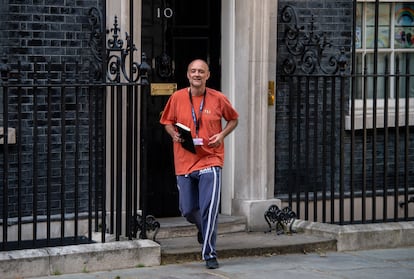
But deliberate sloppiness is one thing, and deliberately dressing badly is another, says Luke Sweeney of London tailor Thom Sweeney. “There’s nothing wrong with dressing down. Stylish men can wear a T-shirt and sneakers as well as they can a dinner jacket. But [the] sort of dressing down [you’re talking about] has no redeeming features. Firstly, it’s purposeful — a grown man has to work hard to look that bad — and secondly, it shows a level of contempt for those around you, particularly if you’re in the public eye,” he commented in an article in which GQ analyzes Dominic Cummings, the former advisor to Boris Johnson who appeared with a look that Begoña Gómez Urzaiz described in EL PAÍS as “the middle ground between the suit he never wears and the ex-raver looks he has continued to wear.”
The journalist claimed that dressing badly at work is something that only those with a lot of power can afford, and Kate Finnigan said in the British edition of Vogue that Cummings dressed that way on purpose. “Cummings despises career politicians so he chooses not to dress like one. He’s invented his own sartorial code, no less self-conscious than Jacob Rees-Mogg’s unflattering bespoke suits. The manky athleisure look is a two-fingered salute to the history and tradition of parliament,” she wrote.
Sociologist Tressie McMillan Cottom wrote a piece called The Poor Can’t Afford Not to Wear Nice Clothes in which she echoes Rabkin’s original reflection. “Why do poor people make stupid, illogical decisions to buy status symbols? For the same reason all but only the most wealthy buy status symbols, I suppose. We want to belong,” she writes. She argues that looking “presentable,” as a sufficient condition for decent, paid work or successful social interactions, is a privilege. “It’s the aging white hippie who can cut off the ponytail of his youthful rebellion and walk into senior management, while aging Black Panthers can never completely outrun the effects of stigmatization against which they were courting a revolution. Presentable is relative, and, like life, it ain’t fair. In contrast, ‘acceptable’ is about gaining access to a limited set of rewards granted upon group membership,” she says.
Fashion sociologist Pedro Mansilla explains to EL PAÍS that the truly rich and privileged can afford almost anything. “The upper class, especially the old upper class, has long flirted with these excesses. In a way, they also do it to shock the bourgeoisie, who are incapable of breaking a rule, as they are the most zealous guardians of the imitated customs of the aristocracy, which they never dare to break,” he says.

So, can the deliberate and conspicuously bad attitude toward dressing be seen as a status symbol? “Initially, yes,” Mansilla replies. “It’s another matter if it ends up becoming a trend. Imagine if suddenly, all the posh kids, going to their posh friend’s place for a beer, start dressing up as Pirates of the Caribbean,” he fantasizes.
Silvia Bellezza, Francesca Gino, and Anat Keinan published a study at Harvard called The Red Sneakers Effect: Inferring Status and Competence from Signals of Nonconformity, in which they investigate how people react to nonconformist behaviors such as entering a luxury boutique in athletic wear instead of an elegant outfit, or wearing red sneakers in a professional setting. “These gestures can act as a particular form of conspicuous consumption and generate positive inferences of status and competence in the eyes of others,” they say. Beatriz Carranza, speaking about this thesis, points out that breaking dress norms in certain environments conveys confidence, as long as the environment perceives that you have the authority to do so. “It’s not just a matter of esthetics; it’s a silent tool of differentiation,” she says.
Rabkin, who points out that fashion can be perceived (sometimes with good reason) as superficial and materialistic, has the perfect response when he hears those who mock those who have no money but still strive to dress well: “For those who don’t have much dignity in their lives, there is dignity in dressing well.” Because as Armstrong said, considering that fashion is always a mask, “there is no disguise more traditional or more theatrical, for those in power, than that of indifference.”
Sign up for our weekly newsletter to get more English-language news coverage from EL PAÍS USA Edition









































