
‘Joaquinraptor casali,’ a previously unknown top predator that lived in Argentine Patagonia: ‘They were truly powerful’
A team of paleontologists has discovered a complete set of fossil remains of one of the megaraptors that lived shortly before the extinction of dinosaurs
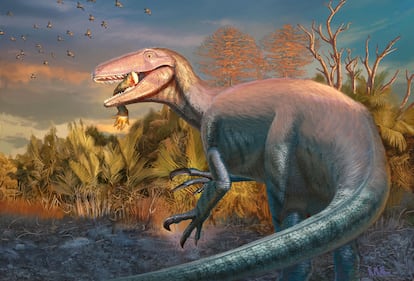

Seventy million years ago, in the final chapters of the Cretaceous, Patagonia was a warm and humid landscape, very different from the territory we know today. Various types of dinosaurs coexisted there, including a group of enigmatic predators: the megaraptors. From this lineage, which still puzzles scientists due to the scarcity of complete fossils, a team of paleontologists has discovered in Argentina’s southern Chubut province the partial skeleton of a specimen they have named Joaquinraptor casali. The animal, 19 years old, seven meters long, and weighing over a ton, lived shortly before the extinction of the dinosaurs.
The research was led by Argentine paleontologist Lucio Ibiricu and provides one of the clearest images yet seen of this group: a well-preserved, partially articulated fossil that includes much of the skull, the forelimbs and hindlimbs, the ribs, and the vertebrae. For Ibiricu, this is the significance of the discovery, published on Tuesday in Nature Communications: “It’s a well-represented group in Australia and Argentina, but, unlike other land-dwelling theropods, the material from the species is quite incomplete.”
Joaquinraptor is named in memory of Ibiricu’s son and was found with bones primarily from the skull, which have been compared for the first time with those of another member of its group. According to the paleontologist, this is scientifically significant because such comparisons allow hypotheses to be formed about the nature of the animal. “Previously, only a single jawbone of a megaraptorid had been discovered,” explains the researcher from the Patagonian Institute of Geology and Paleontology in Argentina.
Megaraptors are considered the top predators of their time, and this is due in part to their claws. According to Ibiricu, the claws were used to tear the flesh of their prey, hold it, and manipulate it. “They measured 30 centimeters or more,” the expert explains. These weapons, he says, were decisive for the success of megaraptors, which managed to thrive from the Early Cretaceous until its end: “They were truly powerful.”
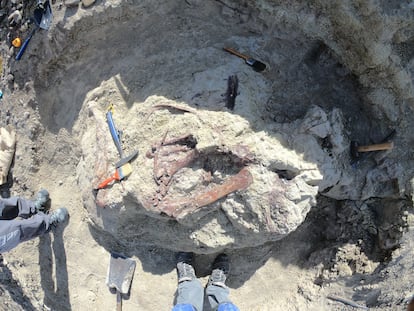
For paleontologist Angélica Torices, the fact that the partial skeleton preserves elements of the arm indicates an unusually high level of preservation. This, she says, not only allows for a more precise description of Joaquinraptor’s anatomy but also provides insights into how it moved and the role it played in its ecosystem. “What is most remarkable is that it belongs to such a fragmentary group as the megaraptorans, yet this specimen preserves highly diagnostic anatomical parts,” she says.
Argentine Patagonia is home to some of the most recent and complete finds of this lineage of predators. But they were not exclusive to the region: these were versatile animals capable of thriving in very different ecosystems. Their remains have also been found in Chile, Australia, and Japan. According to the discoverers of this dinosaur, in South America they reached much larger sizes than in other regions.
While in Australia they barely reached five meters in length, some South American specimens grew to over nine meters.
According to Verónica Díez, a paleontologist specializing in sauropods, the discovery of a new dinosaur species always represents a valuable opportunity to explore the Earth’s distant past. “All the information we can obtain from the past is useful. Especially if they are new species, because they give us insights into the diversity of the ecosystem, how they lived, and what they ate. Thanks to this, we can have a more general idea of what the past was like on our planet,” she says.
This is also the significance of Joaquinraptor. Experts highlight that it offers clues about its species’ diet. Among the jaw bones, the researchers found a humerus that did not belong to the dinosaur but to a crocodile relative. “It is possible that it choked while eating,” admits Ibiricu, though he does not rule out other explanations, such as a fight with other dinosaurs. Future analyses, including taxonomic studies and CT scans, will help determine whether the bone shows damage consistent with this theory of its death.
Sign up for our weekly newsletter to get more English-language news coverage from EL PAÍS USA Edition









































