Christian Louboutin: ‘Young people don’t want to be like their parents. And if their parents wear sneakers, they’re going to look for something else’
He became globally famous for painting the soles of his shoes red, although he’d been sketching since he was a child. Today, Louboutin is celebrating: his brand turns 35, rejuvenating itself thanks to Gen Z and changes in the way heels are perceived
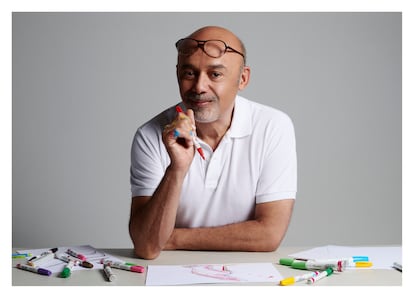

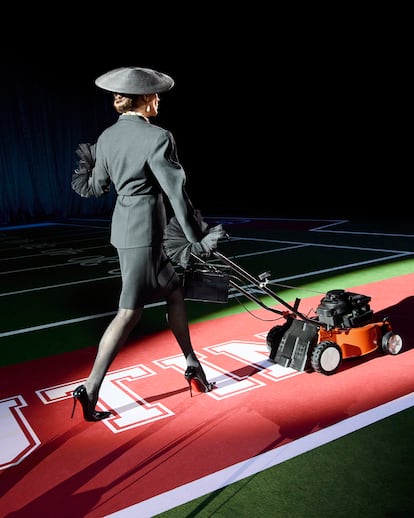
French chic permeates the office of Christian Louboutin in the French capital. From its location next to the Louvre to the seemingly casual way the shoe designer has mixed new and vintage pieces. Sculptures, film posters, shoes, art books, fashion, gardening... He greets us with a warm smile the morning after celebrating his Loubi Show, a cabaret-style fantasy in a stadium on the outskirts of the city. “It was a collaboration, like last year, with David LaChapelle and Blanca Li. We envisioned a show that would place the shoes in an unexpected setting, so we came up with the idea of a small-town American football game.” The result was an event as unexpected as it was electrifying. As was his conversation. Although he announced in September that Jaden Smith would be the creative director of his menswear line, the move doesn’t foreshadow any retirement by the 62-year-old Parisian. On the contrary, the decision stems from Louboutin’s preference to focus on his favorite: women’s footwear.

Q. Your first job was at the legendary Folies Bergère. How did you end up there?
A. A friend from school and I realized that many shows in Paris had an intermission where the audience went outside to smoke. Afterward, it was very easy to get in without a ticket; you’d sneak in and find a seat. So I saw the second act of many shows many times, although my favorite was musical theater. At the Folies Bergère, I ended up knowing all the dancers. One day I showed up with a notebook with all their names, and they took me on as an intern. I didn’t do anything, but I was there and I helped them. It was very interesting to see the performances, the rehearsals, etc. You learn a lot from that, from the structure of a show.
Q. And how did you know that shoes could be your profession?
A. Because someone gave me a book that said Roger Vivier. I didn’t even know who he was, but I realized that my hobby could be a job. I had started drawing shoes as a preteen, around 11 or 12 years old. I loved it and did it all the time. In class, they nicknamed me Guy Degrenne, after a television commercial for a cutlery company that featured a boy in school who wasn’t paying attention to the teacher, but when they asked him what he was doing, he showed them very elaborate sketches of cutlery. I became the Guy Degrenne of shoes.
Q.Then you began to collaborate as a designer for brands.
A. At 18, I went to work for Charles Jourdan in the south of France, and then I collaborated as a freelancer with Chanel, Saint Laurent… I worked on-the-jobs at some of them, but they always ended up letting me go. I’d start as an assistant, but I wanted to do everything, and they’d say, “Who does this guy think he is?” I didn’t understand, so I started developing the idea of becoming a landscape designer. It’s also beautiful, but I was young and impatient; I couldn’t wait for a garden to evolve. If you want speed, fashion has it. I missed shoes, so I went back and started my own brand.
![“Queríamos que el espectáculo contuviera la energía del deporte y a David [LaChapelle] se le ocurrió recrear un partido de fútbol americano; pero no la Super Bowl, sino de un pueblo pequeño”, dice Louboutin.](https://imagenes.elpais.com/resizer/v2/WIYWLMU7KRAGDAQPPUI7S7TSSQ.jpg?auth=6f95e0882c9fcaff0f09f00560672e88016fd08e61ec4261cb1716ffc5c8db89&width=414)
Q. Do you still want to control everything today?
A. Yes, it’s important to be very involved. For example, we make the women’s shoes in Italy, and I built an apartment above the main factory. When I go, I stay there, and in a week, I have time to modify a prototype up to three times.
Q. It’s not your own factory, but it works exclusively for the brand. Do you find it difficult to find suppliers in this scenario dominated by conglomerates?
A. Not much, it’s just that it’s more expensive than ever. Everything has become dramatically more expensive.
Q. In 2021, you sold 24% of your company to Exor, the Agnelli family’s fund. I imagine you received many offers, why did you choose them?
A. I didn’t want it to be a fashion company because I wasn’t looking for a father figure; I preferred something more like a brother. Someone I could talk to, not someone who would tell me to shut up.
Q. And thus continue to be in control.
A. No, it’s not that. They have very intelligent people, and they don’t think they know everything. It’s been good for me to have a colleague who asks me questions. This is interesting, especially because when you’re in your own company, no one is going to ask you all the necessary questions. It’s like in interviews with journalists, who, since they aren’t close friends, can ask you different questions that force you to reflect, to delve deeper. At Exor, they’ve made me question things I’d never stopped to think about before. It’s pleasant and very stimulating.
Q. Like what, for example?
A. For example, we did an exhibition in Paris and considered repeating it elsewhere. They told me we could do it wherever I wanted, but suggested we do it in a location that would make sense for the company, to combine the exhibition with the commercial aspect. I hadn’t even thought about it.
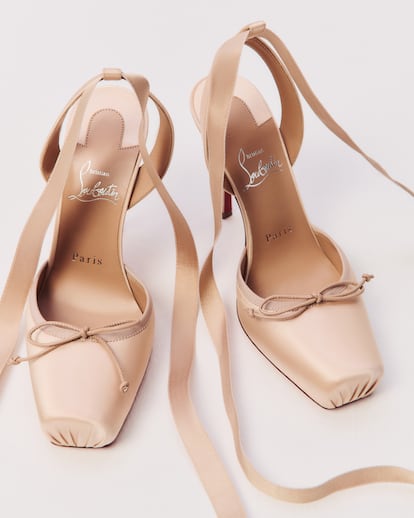
Q. Your shoes became iconic in a short time. The red sole certainly helped, but it can’t be the only reason. Have you thought about that?
A. I have great respect for women, and that comes across; many people tell me so. But there’s also something else I realized recently. We had an exhibition, and there was a guestbook. A collaborator on that project brought it to me, pointing out that all the dedications were addressed directly to me. Usually, people write things like “what a beautiful exhibition” or something similar, but they were writing me letters. People feel a closeness and connection with me.
Q. Women’s relationship with high heels has changed. Now they’re an option, but before, in certain circles, they were almost mandatory. How have you followed this evolution?
A. Now everything is acceptable. We’re never the same; I have three sisters, but sometimes they seem like 300. Every woman has different facets, different moments throughout the day. You don’t even wake up every morning feeling the same. Fashion today offers the possibility of embracing all those personalities.
Q. Generation Z is also discovering your creations.
A. At their age, they’re reaching that point where they want to experiment with the concept of womanhood, to play with femininity… Besides, young people don’t want to be like their parents. If their parents wear sneakers, they’re going to look for something else.
Q. After so many years, what gives you the most satisfaction?
A. Drawing. I also like to travel, but I love sitting down to draw in this office, which is new and I’m crazy about it.
Q. That boy who was always painting hasn’t changed that much.
A. I also enjoy my freedom. The other day, LaChapelle was asked about the show and he said, “Christian doesn’t need to do it, he just wants to.” And that’s true, I do it for pleasure, that’s why I’m still here.