
Ortega and Murillo’s latest strike: Nicaraguan regime dissolves Professional Baseball League
The presidential couple completes their coup against the historic Sandinista leader Bayardo Arce, godfather of baseball in the country, who was arrested in July
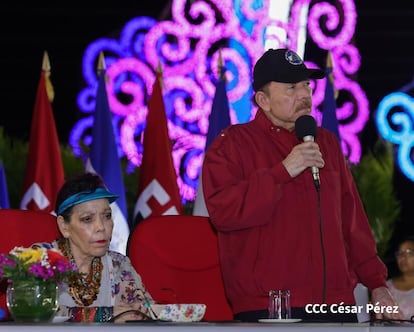

In Nicaragua, there is one indisputable truth: baseball is the “king of sports.” And another, until recently, was that Bayardo Arce — Sandinista commander and former presidential advisor on economic affairs — was one of its main promoters. For years, he managed Indios del Bóer, the most popular and well-resourced team, and was one of the strongmen of the Professional Baseball League. But last July, he “fell from grace”: the regime of Daniel Ortega and Rosario Murillo arrested him amid the internal purge with which the co-president is paving the way for a dynastic succession.
Since his arrest, the latest blow to Arce’s economic and political establishment has been the Ministry of the Interior’s cancellation of the Nicaraguan Professional Baseball League (LBPN). In its place, another legal entity was created, called the Nicaraguan Professional Baseball Association. The regime handed its leadership to Cristhian Jiménez, a militant loyal to the co-presidential couple who emerged from the ranks of the Sandinista Youth.
Before the creation of the new sports entity, on August 14, 2025, police officers raided the offices of the Nicaraguan Professional Baseball League, led by Pancansán Arce, son of the historic Sandinista commander, now “disgraced” for confronting Murillo. Commander Arce is no minor figure in Sandinismo: he was one of the nine leaders of the revolution in the 1980s and a figure historically close to Ortega, so much so that he was one of his key businessmen and one of the architects of the fractured relationship of “dialogue and consensus” between the government and big capital.
After Murillo consolidated her power, Arce’s image has been eclipsed. In 2007, he was appointed presidential advisor and confirmed in the position on August 16, 2024. He became one of the regime’s most trusted men. However, as part of the Sandinista old guard, the co-president maintained differences with him, which left him reduced to a purely ceremonial position, without any responsibilities and instead dedicated to his multiple private enterprises.
Arce was among the officials to voice criticism of Murillo’s growing power and was purged to remove him from the equation in the event of a possible dynastic succession, according to Sandinista sources consulted by EL PAÍS.
The business of baseball
In October 2024, Arce bowed to pressure and handed over control of the popular Indios del Bóer team and was replaced with a close associate of the co-presidential couple. Nicaragua — a predominantly baseball-loving country and the birthplace of several U.S. Major League players, such as the legendary Dennis Martínez, who was banned by the regime — has two major leagues. One is the semi-professional Germán Pomares Championship, which seeks to include teams from all departments and regions of the country and operates thanks to a government subsidy, and the other is the professional LBPN, which Arce championed.
The Professional League operated for nearly two decades and over time established itself as an attractive business, so much so that it began to sign international players. However, in recent years, Ortega and Murillo’s sons have gained prominence in professional baseball. The most recent example occurred last August, when Maurice Ortega Murillo welcomed Dusty Baker, legendary Major League Baseball coach and former manager of the San Francisco Giants, to Managua as the new coach of Nicaragua’s national team, which will participate in the 2026 World Baseball Classic.
Sources close to baseball and the Sandinista party agree that the co-presidential family’s interest is to control professional sports in the country, as is already the case with soccer, in a totalitarian effort to dominate all possible aspects of society.
However, sports journalist Miguel Mendoza believes that the league’s name change isn’t a novelty in itself, but rather a formality. “It’s not that the regime is taking over baseball now; they’ve been in control for a long time,” he maintains. He recalls that it was Arce himself who, in 2009, revived the Professional League after a year without sponsors, and he did so with direct support from the state, which disbursed up to $250,000 in television rights to finance the teams. From then on, the dictatorship had one foot on the diamond.
The real turning point, Mendoza explains to EL PAÍS, occurred in 2017, with the inauguration of the new Dennis Martínez National Stadium, whose name was changed to Soberanía in retaliation for the former Major League player’s criticism of the regime. Until then, Indios del Bóer and the league controlled the previous stadium in the capital: they collected ticket fees, cafeteria fees, and billboard fees without paying the state. But in the new stadium, the business passed into the hands of Ortega’s children and Fidel Moreno, co-president Murillo’s right-hand man. Arce protested publicly, but received only a symbolic compensation of $30,000. This was the beginning of Bóer’s financial decline as the team lost sponsors and prominence.
Over time, Arce gradually ceded ground: first, he lost Indios del Bóer, then control of the Professional League, although his son, Pancansán, remained president for a brief period. “The teams have always been in the hands of figures linked to the regime,” Mendoza recalls. The difference, he concludes, is that this time the political purge directly affected Arce. What was previously an unequal relationship between the Sandinista commander and the presidential family was now resolved with his political imprisonment. Baseball, an emblem of national identity, thus falls under the absolute control of the co-presidential couple, as yet another space where the regime wields its power in Nicaragua.
Sign up for our weekly newsletter to get more English-language news coverage from EL PAÍS USA Edition









































